Quality Today, Confidence Tomorrow: What B2B Buyers Really Value
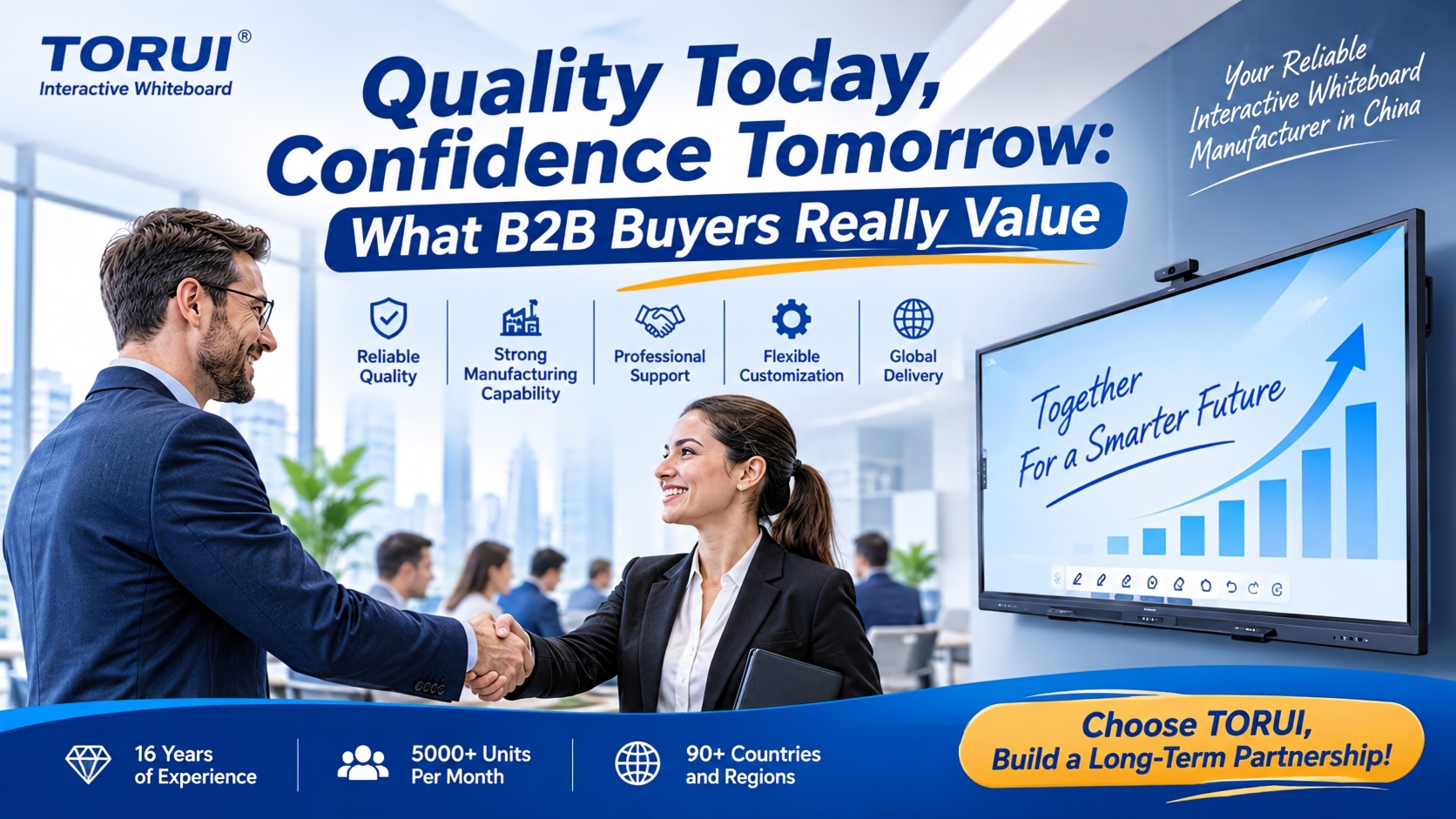
In B2B purchasing, the lowest quotation is rarely the real measure of value. For distributors, wholesalers, system integrators, schools, and corporate buyers, the more important question is simple: Will this product deliver reliable performance today and continue creating value tomorrow?
This is especially true when purchasing professional technology products such as interactive whiteboards. A product may look competitive on paper, but long-term quality, manufacturing capability, technical support, delivery reliability, and after-sales service can ultimately determine whether a purchasing decision becomes a successful business partnership or an expensive problem.
For B2B buyers, quality today creates confidence tomorrow.
1. Quality Is More Than Product Appearance
When evaluating an interactive whiteboard manufacturer, buyers should look beyond screen size, resolution, processor configuration, and price.
A high-quality interactive whiteboard should provide stable touch performance, accurate writing, clear images, reliable connectivity, durable glass, and consistent system operation. These details directly affect the daily experience of teachers, students, employees, and meeting participants.
For distributors, product quality is even more important because every unit represents their own reputation in the local market. If a product frequently develops problems after installation, the distributor may need to spend additional money on transportation, technical support, replacement parts, and customer service.
Therefore, B2B buyers should evaluate the total value of the product, rather than simply comparing the initial purchase price.
2. Manufacturing Capability Matters
A reliable supplier needs more than a good sales team. Behind every successful B2B order is a capable manufacturing and quality-control system.
Buyers should consider questions such as:
-
Does the supplier have its own production capability?
-
How much manufacturing experience does it have?
-
What is its monthly production capacity?
-
Can it support large-volume orders?
-
Does it have stable component suppliers?
-
Can it provide OEM, ODM, or SKD services?
-
Does it have a systematic quality-control process?
These questions help buyers distinguish between a genuine manufacturing partner and a company that simply purchases products from different factories.
For long-term cooperation, manufacturing capability provides an important foundation for stable quality, consistent specifications, predictable lead times, and scalable orders.
3. Consistency Is Critical for B2B Purchasing
For a consumer buying one device, a small difference between two units may not be significant. For a distributor ordering hundreds of interactive whiteboards, consistency becomes essential.
Imagine receiving a large shipment where different batches have different interfaces, touch performance, colors, accessories, or software configurations. Such inconsistencies can create unnecessary problems during installation and customer training.
Professional B2B suppliers should therefore maintain consistent production standards across different batches.
This includes hardware configuration, display performance, touch technology, operating system, interfaces, accessories, packaging, and software.
Consistency reduces risk and makes a supplier easier to work with.
4. Certifications Build Market Confidence
International B2B buyers also need to consider regulatory and market-access requirements.
Depending on the destination market, products may need certifications such as CE, FCC, RoHS, CCC, or other local compliance documents.
Certifications are not simply documents for a quotation package. They demonstrate that a manufacturer understands international market requirements and has established processes for product compliance.
For distributors entering a new market, the availability of appropriate certification documents can make product registration, customer presentations, tenders, and project procurement much easier.
A reliable supplier should be able to clearly explain which certifications are available and which markets they support.
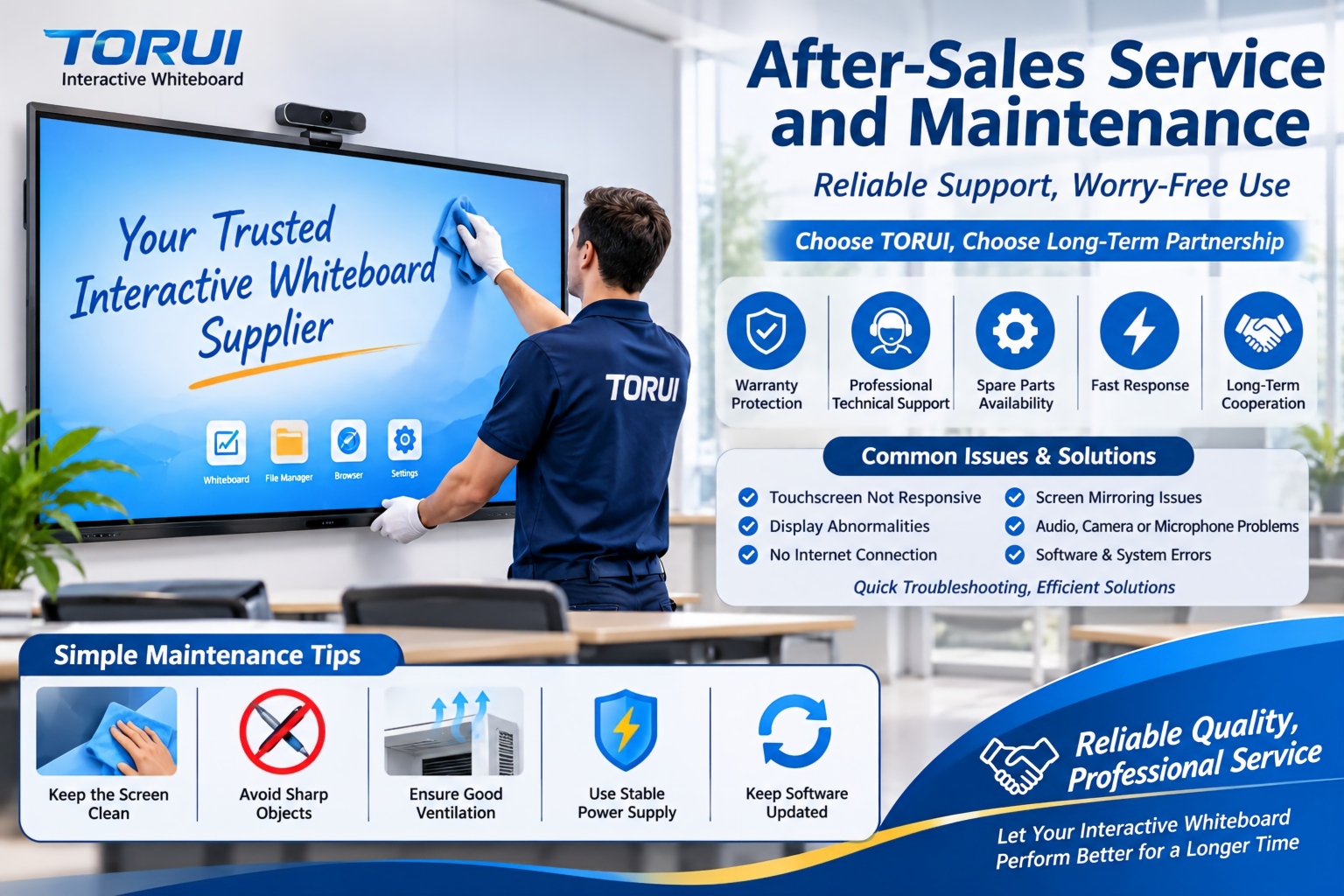
5. After-Sales Service Is Part of Product Quality
One of the most overlooked factors in B2B purchasing is after-sales support.
Even high-quality products can occasionally encounter technical issues. What matters is how quickly and professionally the supplier responds when a problem occurs.
A strong after-sales system should include:
-
Technical troubleshooting
-
Spare-parts support
-
Installation guidance
-
Software and firmware assistance
-
Remote technical support
-
Clear warranty policies
-
Professional communication
-
Efficient problem-solving procedures
For distributors and system integrators, responsive support can significantly reduce the pressure placed on their own technical teams.
In other words, after-sales service is not an additional benefit—it is part of the product value itself.
6. Delivery Reliability Protects Business Plans
For B2B buyers, a delayed shipment can affect much more than a delivery date.
Schools may have fixed installation schedules. Corporate projects may have strict completion deadlines. Distributors may have customers waiting for inventory. Government projects may have contractual milestones.
This is why delivery capability should be evaluated before placing a large order.
Buyers should understand the supplier's production capacity, standard lead time, peak-season capacity, packaging process, inspection procedures, and export experience.
A manufacturer that can provide realistic delivery schedules and communicate proactively when circumstances change is much more valuable than a supplier that simply promises the fastest delivery.
7. Customization Creates Competitive Advantage
Different markets have different requirements.
Some distributors may need their own brand logo and packaging. System integrators may require specific operating systems or hardware configurations. Education projects may require customized software, languages, interfaces, or accessories.
This is where OEM and ODM capabilities become important.
A capable manufacturer can help B2B customers create products that better match their target market instead of forcing every customer to sell exactly the same standard configuration.
Customization can help distributors build their own brand identity, improve market differentiation, and develop longer-term customer relationships.
8. The Cheapest Supplier Is Not Always the Most Competitive
Price remains important in every B2B purchasing decision. However, price should be evaluated together with quality, reliability, service, and long-term operating costs.
A cheaper interactive whiteboard may appear attractive initially, but if it has a higher failure rate, slower technical support, inconsistent quality, or difficult spare-parts availability, the actual cost can become much higher.
A better purchasing approach is to evaluate total cost of ownership.
This includes:
Purchase price + transportation + installation + maintenance + warranty costs + technical support + replacement costs + potential business losses.
A slightly higher initial price may be worthwhile if it provides significantly better reliability and long-term support.
9. What Should B2B Buyers Ask Before Cooperation?
Before selecting an interactive whiteboard manufacturer, professional buyers should consider asking:
-
Where are your products manufactured?
-
How many years of manufacturing experience do you have?
-
What is your monthly production capacity?
-
Which screen sizes and configurations do you offer?
-
What quality-control procedures do you use?
-
Which international certifications are available?
-
Can you provide OEM, ODM, or SKD services?
-
What is your standard production lead time?
-
What after-sales support do you provide?
-
Can you provide product samples, factory videos, inspection support, and reference cases?
The answers to these questions can reveal much more about a supplier than a simple price list.
10. Quality Today, Confidence Tomorrow
The strongest B2B partnerships are rarely built around one purchase order.
They are built through repeated orders, consistent product quality, reliable communication, predictable delivery, professional technical support, and mutual trust.
For distributors and wholesalers, a dependable manufacturer can become an important part of their supply chain. For system integrators, a reliable product partner can reduce project risks. For schools and enterprises, stable equipment can improve teaching and communication efficiency for years.
Therefore, when comparing suppliers, B2B buyers should not only ask:
“How much does it cost?”
They should also ask:
“What kind of confidence will this supplier give us after the order is delivered?”
That is the real difference between purchasing a product and building a long-term supply partnership.
Why Choose TORUI Interactive Whiteboard?
For B2B buyers looking for a reliable interactive whiteboard manufacturing partner in China, TORUI Technology focuses on quality, manufacturing capability, customization, and long-term cooperation.
With 16 years of manufacturing experience, TORUI specializes in interactive whiteboards for education, corporate meetings, training centers, conference centers, medical institutions, government organizations, and other professional applications.
TORUI offers a broad product range from 55-inch to 110-inch interactive whiteboards, supporting different market requirements and project applications. The company provides OEM, ODM, and SKD services, helping distributors, wholesalers, and system integrators develop products under their own brands or according to specific project requirements.
Its manufacturing capability supports 5,000+ interactive whiteboards per month, providing a solid foundation for both sample orders and larger-scale B2B procurement.
Quality management covers key areas such as display performance, touch accuracy, component inspection, aging tests, high-temperature testing, transportation simulation, and finished-product inspection. This systematic approach helps improve product consistency and reliability.
TORUI also supports modern configurations including Android and Windows systems, high-performance processors, AI camera solutions, microphone options, wireless screen mirroring, annotation functions, and up to 100-point touch, depending on the selected model.
With products exported to 90+ countries and regions, TORUI understands the practical requirements of international distributors and project buyers.
For B2B buyers, the goal is not simply to find a supplier offering a competitive quotation. The goal is to find a manufacturing partner that can provide stable quality, reliable delivery, professional support, flexible customization, and confidence for future growth.
Quality today. Confidence tomorrow. That is the value a reliable interactive whiteboard manufacturer should deliver.
Common Interactive Whiteboard After-Sales Problems and Maintenance: A B2B Buyer’s Guide
Related Article