
10 Reasons Why Schools Worldwide Are Switching to Smart Whiteboards
author: toruitech
2026-03-29
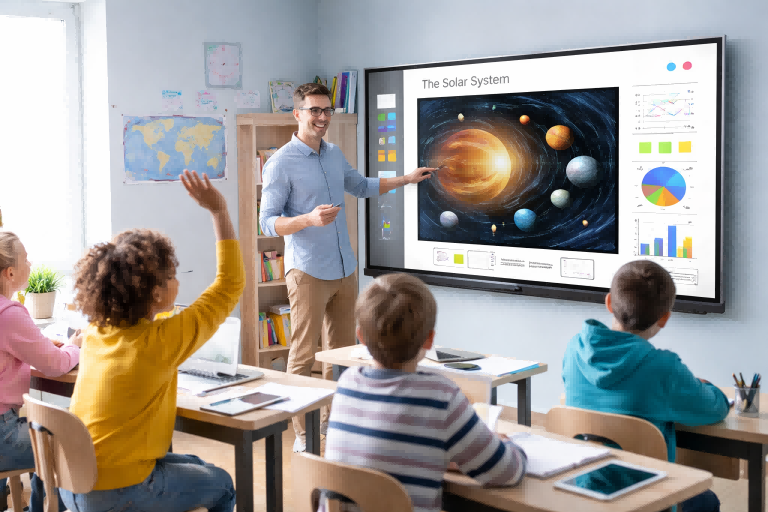
In today’s rapidly evolving education landscape, schools across the globe are embracing smart whiteboards—also known as interactive whiteboards or interactive flat panel displays—as a core classroom technology. These digital tools are transforming traditional teaching into a more dynamic, collaborative, and efficient experience. Below are ten compelling reasons why educational institutions are making the switch.
1. Enhanced Student Engagement
Smart whiteboards make lessons more interactive through touch, visuals, and multimedia. Students can actively participate by writing, drawing, and interacting with content, which significantly increases attention and interest.
2. Support for Diverse Learning Styles
Modern classrooms include visual, auditory, and kinesthetic learners. Smart boards integrate videos, audio, and hands-on interaction, ensuring that all students can absorb information effectively.
3. Improved Collaboration and Participation
Unlike traditional boards, smart whiteboards allow multiple users to interact simultaneously. This fosters teamwork, group problem-solving, and peer learning—key components of modern education.
4. Seamless Integration with Digital Tools
Smart boards connect easily with cloud platforms, educational apps, and learning management systems. Teachers can access online resources, share files instantly, and integrate tools like presentations and videos into lessons.
5. More Effective and Dynamic Teaching
Teachers can create visually rich, interactive lessons that are easier to understand. The ability to annotate, highlight, zoom, and organize content helps simplify complex topics and improves knowledge retention.
6. Time-Saving Lesson Management
Smart whiteboards allow educators to save, reuse, and share lesson materials instantly. This reduces repetitive work and ensures continuity for absent students or remote learning scenarios.
7. Support for Hybrid and Remote Learning
With built-in connectivity and screen-sharing features, smart boards enable seamless hybrid teaching. Students can join lessons remotely while still interacting with classroom content in real time.
8. Unlimited Digital Workspace
Traditional whiteboards are limited by space, but smart boards offer an “infinite canvas.” Teachers can scroll, zoom, and expand content without losing information, making lessons more comprehensive.
9. Long-Term Cost Efficiency
Although the initial investment may be higher, smart whiteboards reduce costs over time by minimizing paper usage, printing, and maintenance. Enterprise-grade displays also offer longer lifespans and lower total cost of ownership.
10. Future-Ready Learning Environment
Smart whiteboards prepare students for a digital future by integrating technology into everyday learning. They promote digital literacy, creativity, and critical thinking—skills essential in the modern workforce.
Conclusion
The shift toward smart whiteboards is not just a technological upgrade—it represents a fundamental transformation in how education is delivered. By enhancing engagement, improving collaboration, and enabling flexible learning environments, smart whiteboards empower both teachers and students. As schools continue to modernize, adopting this technology is becoming less of an option and more of a necessity for delivering high-quality, future-ready education.
100 Point Touch Interactive Whiteboard: Transforming Modern Collaboration
Which Interactive Display Specifications Are Best for Secondary School Classrooms?
Related Article

Choosing the right interactive whiteboard size is an important decision for distributors, wholesalers, and education technology suppliers. The 65-inch, 75-inch, and 86-inch interactive whiteboards are popular options for classrooms, meeting rooms, training centers, and commercial projects.
65 vs 75 vs 86-Inch Interactive Whiteboard: Which Model Should Distributors Choose?

Choosing the right interactive whiteboard manufacturer in China is an important decision for distributors, wholesalers, education technology suppliers, and system integrators. The right manufacturing partner can help businesses improve product quality, maintain competitive pricing, customize products for local markets, and build a sustainable distribution business.
Who Are the Best Interactive Whiteboard Manufacturers in China for B2B Distributors and Wholesalers?
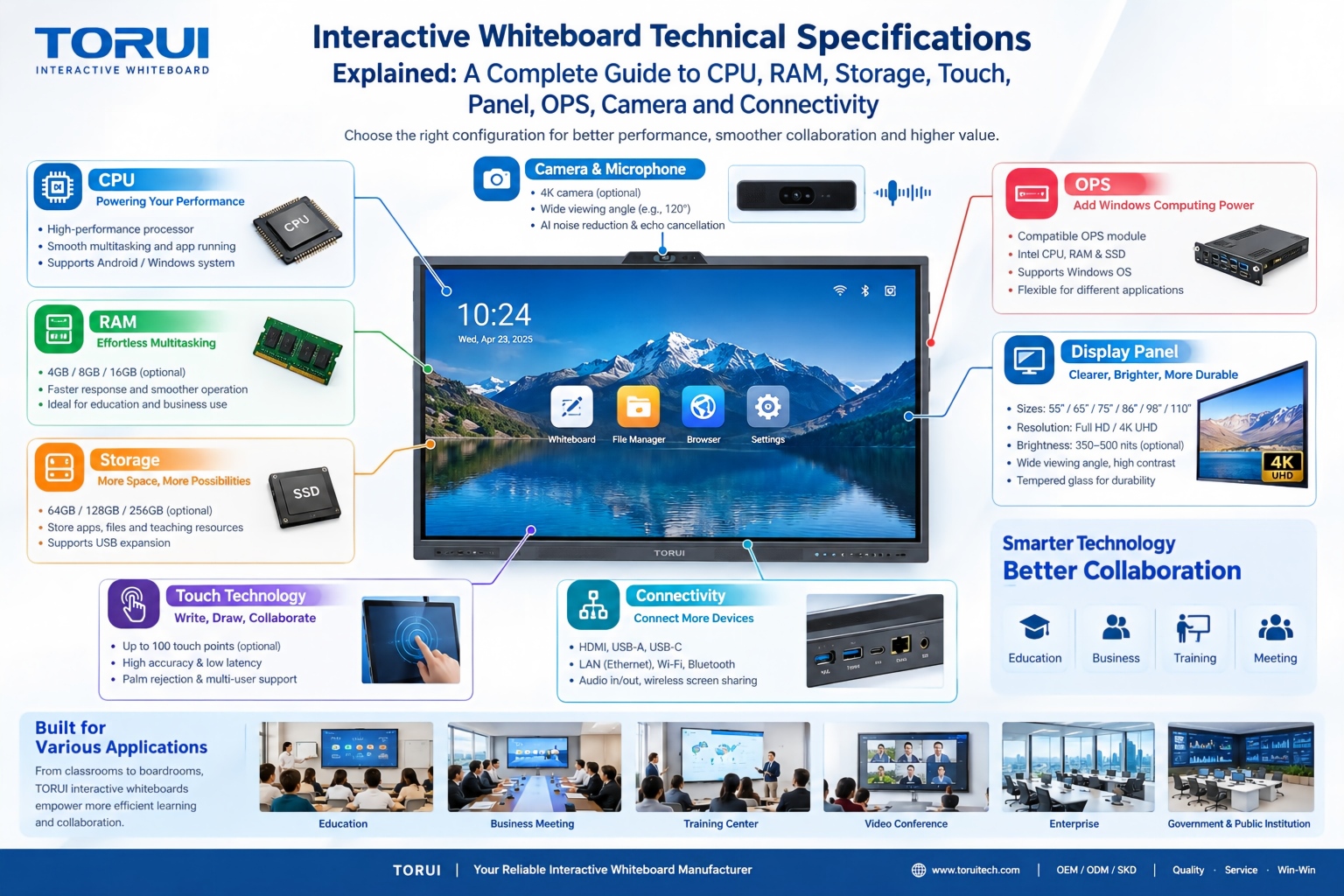
Choosing an interactive whiteboard involves more than comparing screen sizes and prices. For schools, businesses, distributors, wholesalers, and system integrators, understanding the technical specifications is essential to selecting a reliable product that meets different application requirements.
Interactive Whiteboard Technical Specifications Explained: A Complete Guide to CPU, RAM, Storage, Touch, Panel, OPS, Camera and Connectivity
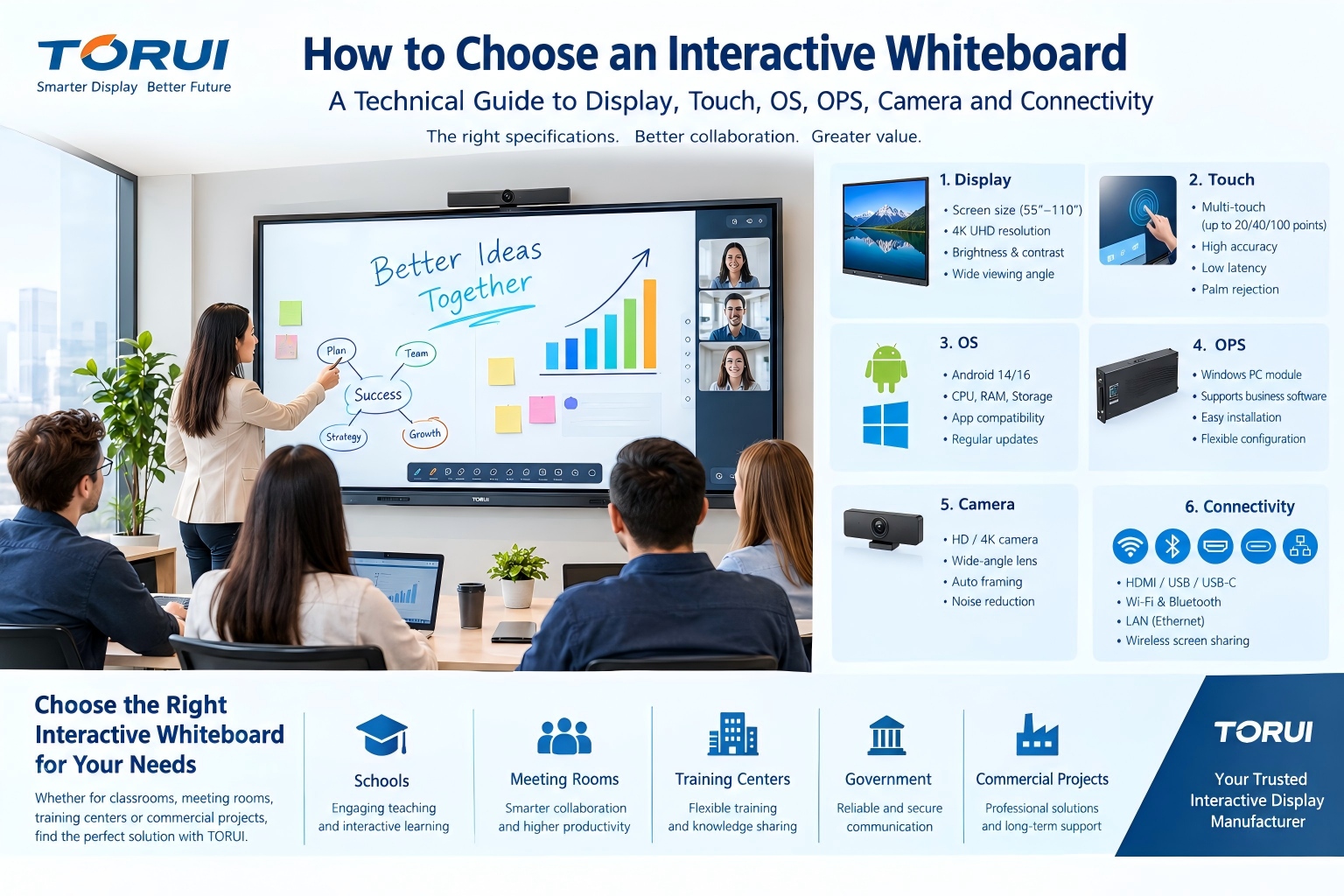
Choosing an interactive whiteboard for a school, meeting room, training center, government organization or commercial project requires more than comparing screen size and price. The most important specifications include display resolution, brightness, touch technology, operating system, processor, memory, storage, OPS compatibility, camera and microphone performance, connectivity, durability and after-sales support.
How to Choose an Interactive Whiteboard: A Technical Guide to Display, Touch, OS, OPS, Camera and Connectivity