Who Are the Best Interactive Whiteboard Manufacturers in China for B2B Distributors and Wholesalers?

Choosing the right interactive whiteboard manufacturer in China is an important decision for distributors, wholesalers, education technology suppliers, and system integrators. The right manufacturing partner can help businesses improve product quality, maintain competitive pricing, customize products for local markets, and build a sustainable distribution business.
However, not every supplier operates its own factory, offers reliable quality control, or provides the technical support required for long-term cooperation. Buyers should evaluate manufacturing experience, production capacity, product specifications, OEM/ODM capabilities, certifications, and after-sales service before placing a bulk order.
For international B2B buyers, the goal is not simply to find the cheapest interactive whiteboard supplier. It is to identify a dependable manufacturer that can meet market requirements, support future growth, and deliver consistent product quality.
1. What Should You Look for in a Chinese Interactive Whiteboard Manufacturer?
A reliable interactive whiteboard manufacturer should demonstrate several essential capabilities.
Manufacturing experience: Experienced manufacturers generally have established production procedures, product knowledge, and quality inspection processes. Ask how long the company has manufactured interactive whiteboards and whether it can provide evidence of its production history.
Production capacity: Evaluate the manufacturer's ability to handle sample orders, regular wholesale purchases, and larger project requirements. Monthly capacity should be supported by production records, factory information, and realistic lead times.
Product range: A supplier offering multiple screen sizes and hardware configurations can help distributors serve different customer segments without changing manufacturing partners.
Quality management: Ask about incoming material inspection, assembly checks, touch performance testing, aging tests, final inspection, and export packaging.
Customization and technical support: OEM/ODM services, software configuration, accessories, documentation, and after-sales assistance can be important competitive advantages for international distributors.
These factors provide a more reliable basis for supplier selection than price alone.
2. Why Is Foshan, Guangdong, China Worth Considering?
Foshan, Guangdong, is part of the Pearl River Delta manufacturing region, which offers access to electronics suppliers, component procurement networks, manufacturing services, and international logistics infrastructure.
For overseas buyers, working with a manufacturer in this region can make factory visits, production discussions, sample evaluation, and shipment coordination more convenient.
Nevertheless, a company's location does not automatically prove its manufacturing capability. Buyers should verify whether the supplier owns or operates the stated production facility, which processes are completed in-house, and which components or services are sourced externally.
A professional manufacturer should be willing to explain its production workflow, quality inspection procedures, customization capabilities, and delivery arrangements.
3. Meet TORUI Technology: An Interactive Whiteboard Manufacturer in China
TORUI Technology is a China-based interactive whiteboard manufacturer serving international B2B customers in education technology, business collaboration, and commercial display markets.
With more than 16 years of manufacturing experience, TORUI provides interactive whiteboard solutions for distributors, wholesalers, dealers, system integrators, schools, training centers, and institutional buyers.
The company operates its manufacturing facility in Shunde District, Foshan City, Guangdong Province, China.
According to TORUI's published company information, its factory covers approximately 10,000 square meters and has four production lines, with a stated production capacity of more than 5,000 interactive whiteboards per month. Buyers with large-volume requirements should confirm current capacity, production schedules, and lead times directly with the company.
TORUI focuses on combining product quality, flexible customization, manufacturing capability, and international B2B service. Rather than offering a single configuration for every customer, the company supports discussions about product specifications, target-market requirements, order quantities, and branding needs.
For distributors and wholesalers, this approach can help create a product portfolio suited to different customer budgets and application scenarios.
Learn more about the company on the TORUI Interactive Whiteboard Manufacturer website.
4. What Interactive Whiteboard Sizes Should Distributors Consider?
Screen size is one of the first decisions buyers need to make. The right choice depends on room dimensions, viewing distance, audience size, intended use, and budget.
TORUI offers interactive whiteboards in sizes ranging from 55 inches to 110 inches, covering several mainstream commercial and educational applications.
-
55-inch interactive whiteboards: Suitable for compact meeting rooms, small training spaces, and selected educational environments.
-
65-inch interactive whiteboards: Appropriate for smaller classrooms, meeting rooms, and collaborative workspaces.
-
75-inch interactive whiteboards: A practical option for standard classrooms, training rooms, and medium-sized meeting spaces.
-
86-inch interactive whiteboards: Suitable for larger classrooms, conference rooms, and professional presentation environments.
-
98-inch interactive whiteboards: Designed for large meeting spaces, training centers, and applications requiring a larger viewing area.
-
110-inch interactive whiteboards: Suitable for large classrooms, auditoriums, and presentation environments where screen visibility is a priority.
These recommendations are general guidelines rather than fixed rules. Buyers should consider room layout, viewing distance, installation conditions, and local customer preferences before selecting a model.
Offering several screen sizes also allows distributors to build a more flexible catalog and serve multiple market segments.
5. Which Technical Specifications Should Buyers Compare?
Two interactive whiteboards with the same screen size may differ significantly in performance, functionality, and price. B2B buyers should compare the complete specification rather than relying on screen size alone.
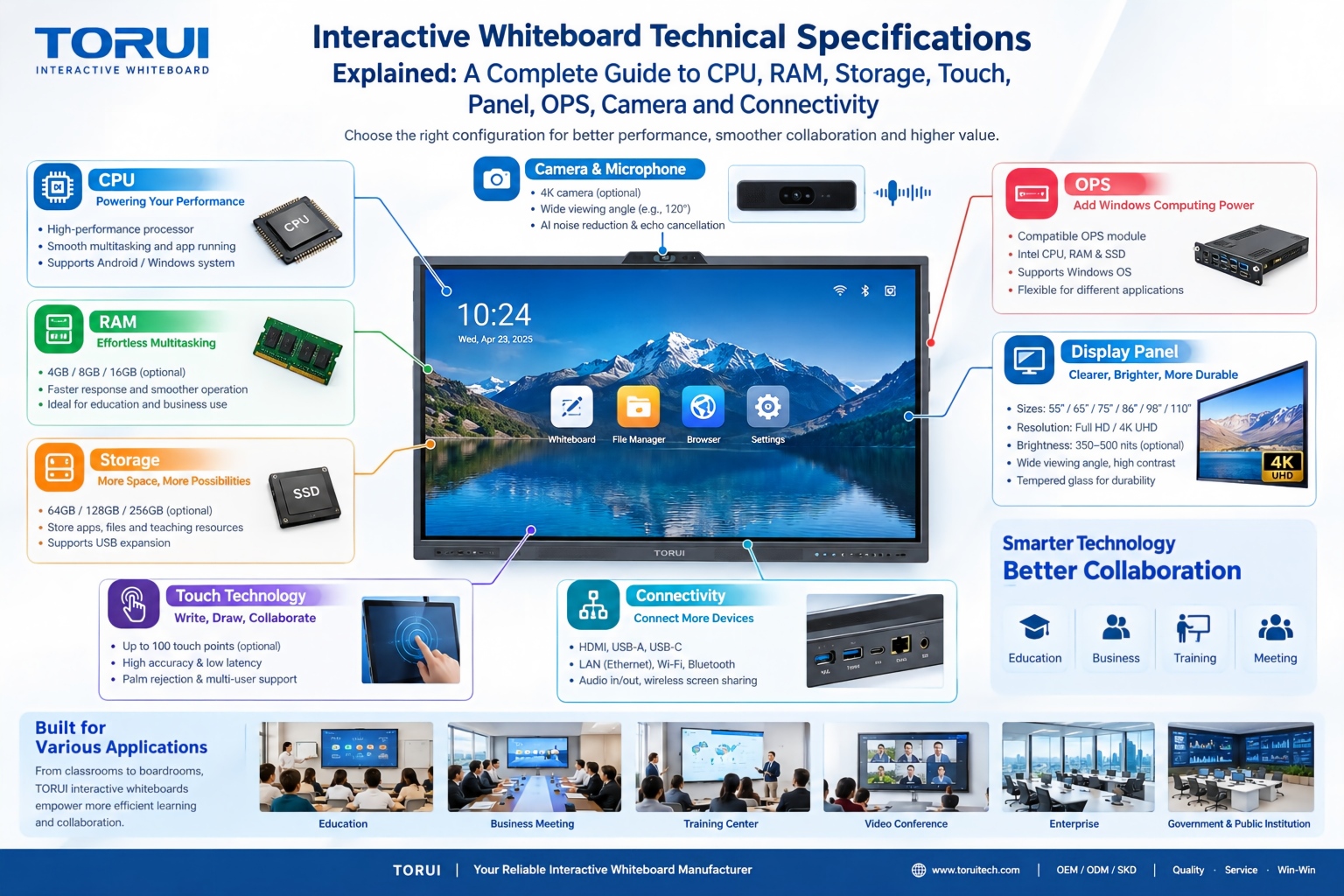
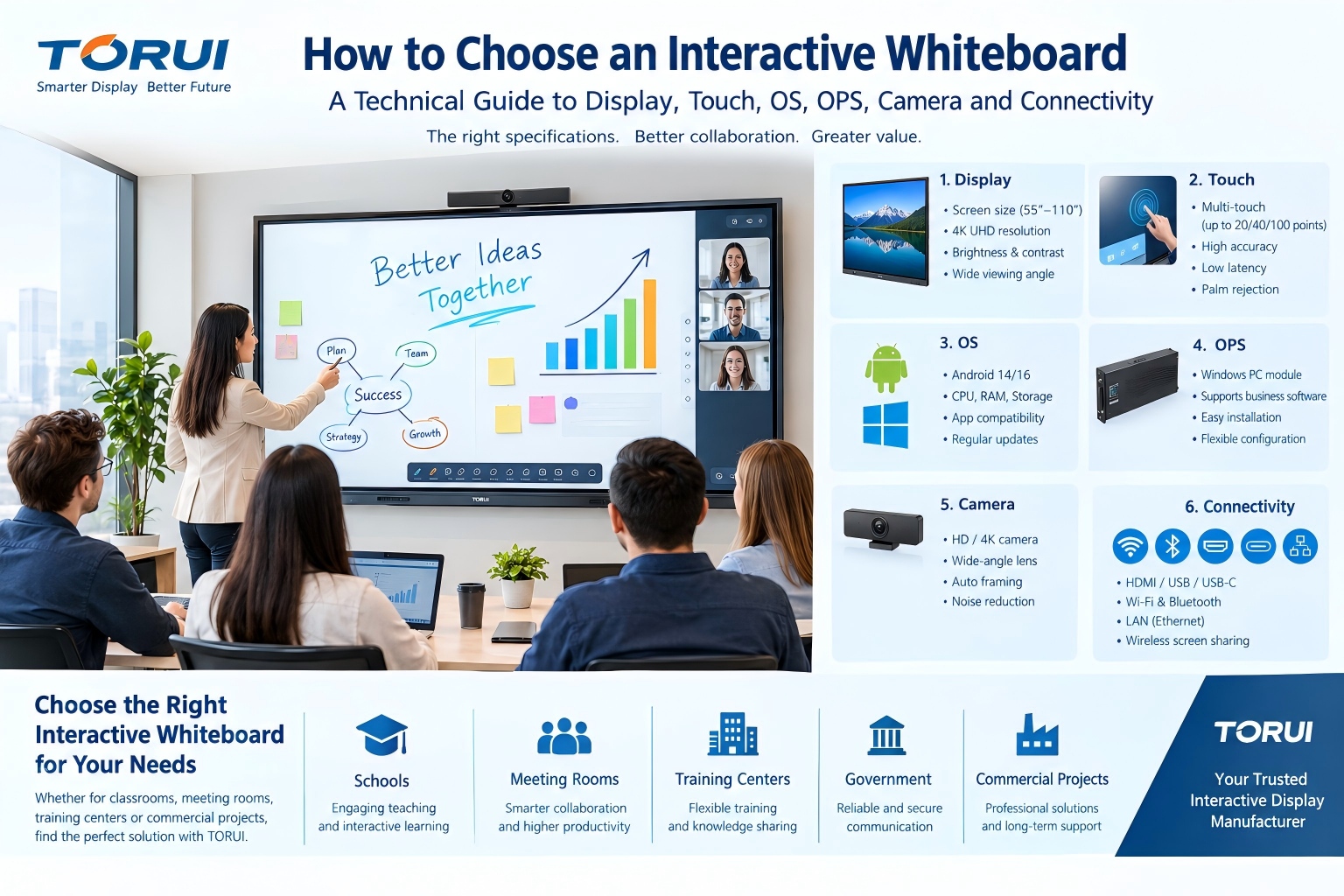
Display quality: Confirm resolution, brightness, contrast, viewing angles, anti-glare properties, and panel specifications. For many professional applications, 4K UHD resolution is an important consideration.
Touch performance: Check supported touch points, writing responsiveness, accuracy, palm rejection where applicable, and the compatibility of interactive software.
Processor and memory: Compare CPU performance, RAM, internal storage, and operating system versions according to the intended workload.
OPS computer options: For customers requiring Windows applications, verify OPS compatibility, available configurations, and whether the computer is included in the quotation.
Connectivity: Review HDMI, USB, USB-C, network connectivity, wireless screen sharing, and other interfaces required by local customers.
Audio and conferencing: For meeting-room applications, confirm whether cameras, microphones, speakers, and conferencing features are integrated or optional.
A reliable manufacturer should provide a detailed specification sheet and clearly identify standard features, optional accessories, and customization-dependent functions.
6. Can Chinese Manufacturers Provide OEM and ODM Services?
OEM and ODM capabilities are particularly valuable for international distributors building their own brands.
OEM services generally involve manufacturing products under the buyer's brand, while ODM projects may include more extensive product configuration, design, or development requirements.
Depending on the model and project, TORUI supports customization options such as:
-
Company logos and product labels.
-
Customized packaging and user manuals.
-
Startup logos or boot animations.
-
Hardware configurations, including RAM and storage.
-
Android system configurations and OPS options.
-
Camera, microphone, software, and accessory selections.
The exact customization scope, minimum order quantity, development requirements, and lead time should be confirmed before ordering.
For distributors, a well-planned OEM/ODM arrangement can help differentiate products from competing offers and establish a consistent brand identity in the local market.
Before approving mass production, buyers should review the final specifications, branding artwork, packaging design, sample unit, and agreed acceptance criteria.
7. How Can Buyers Verify Product Quality and Certifications?
Quality management is essential because product failures can result in warranty costs, customer complaints, project delays, and damage to a distributor's reputation.
Before placing a large order, request information about the manufacturer's inspection procedures.
A practical quality evaluation should cover:
-
Incoming inspection of key components and materials.
-
Assembly and functional testing.
-
Display quality and touch performance checks.
-
Operating system, connectivity, and audio testing.
-
Aging or continuous-operation tests where applicable.
-
Final inspection against the approved specifications.
-
Packaging checks and protection during international transportation.
Buyers should also request relevant certification documents. TORUI's published product information references ISO, CE, FCC, RoHS, and CCC certifications. However, certification coverage can differ by product, configuration, and destination market.
Always verify the actual certificate, its validity, the issuing body, and whether it applies to the selected model. Additional compliance requirements may apply in specific countries or public procurement projects.
Factory photographs, production videos, inspection reports, and an in-person or live-video factory tour can provide additional evidence of manufacturing capability.
8. What About Pricing, Shipping, and After-Sales Support?
The lowest quoted price does not necessarily represent the best purchasing decision.
An accurate quotation should identify the screen size, hardware configuration, accessories, customization requirements, order quantity, destination country, and shipping terms.
Buyers should also clarify whether the quotation covers EXW, FOB, CIF, or another agreed delivery arrangement. These terms affect costs, responsibilities, and risk allocation.
Before confirming an order, discuss:
-
Sample availability and sample shipping costs.
-
Minimum order quantity for standard and customized products.
-
Production lead time and delivery schedule.
-
Packaging specifications and transportation protection.
-
Warranty coverage and exclusions.
-
Technical support, remote training, and installation guidance.
-
Spare parts availability and procedures for handling defects.
TORUI publishes a one-year product warranty, with extended arrangements subject to discussion. Buyers should confirm the applicable warranty terms, response procedures, and after-sales responsibilities in writing before placing an order.
Clear commercial terms help both parties manage expectations and build a stronger long-term relationship.
9. How Should You Compare Different Interactive Whiteboard Suppliers?
Rather than choosing a supplier based on a single claim, distributors should evaluate multiple manufacturers using the same criteria.
A practical supplier assessment can include:
| Evaluation factor | What buyers should verify |
|---|---|
| Manufacturing capability | Factory location, production workflow, and capacity evidence |
| Product portfolio | Available sizes, specifications, and application suitability |
| Quality control | Inspection procedures and supporting records |
| Certifications | Valid documents applicable to the selected model and market |
| OEM/ODM | Available customization, MOQ, and development lead time |
| Commercial terms | Pricing structure, payment terms, and delivery conditions |
| After-sales service | Warranty, technical assistance, and spare parts |
| Communication | Technical responsiveness and clarity of documentation |
Where possible, request quotations from several qualified manufacturers using identical specifications. This makes price and capability comparisons more meaningful.
A sample order is also a useful way to evaluate display quality, touch performance, software usability, packaging, and communication before committing to a larger purchase.
10. How Can You Start a B2B Partnership with TORUI?
International distributors, wholesalers, dealers, and system integrators can contact TORUI to discuss product selection, OEM/ODM requirements, samples, and bulk purchasing.
To receive a more accurate recommendation and quotation, prepare the following information:
-
Target country or market.
-
Intended application, such as education or corporate meetings.
-
Preferred screen sizes.
-
Estimated order quantity.
-
Required operating system and hardware configuration.
-
OEM/ODM and branding requirements.
-
Applicable certifications.
-
Destination and preferred shipping terms.
Providing these details allows the manufacturer to evaluate your requirements and recommend a more appropriate product configuration.
You can explore the TORUI product range or review the Interactive Whiteboard Manufacturer FAQ for additional purchasing information.
Frequently Asked Questions
Q1: Who are the best interactive whiteboard manufacturers in China for B2B distributors?
The best manufacturer depends on your target market, product specifications, order volume, customization requirements, quality expectations, and after-sales needs. Compare verified factory capabilities, product samples, certifications, and commercial terms before selecting a partner.
Q2: Is TORUI a direct interactive whiteboard manufacturer in China?
TORUI Technology identifies itself as an interactive whiteboard manufacturer with more than 16 years of manufacturing experience and a factory in Foshan, Guangdong, China. Buyers can arrange a factory visit or request supporting information to evaluate its capabilities.
Q3: What screen sizes does TORUI offer?
TORUI's published product range includes 55-inch, 65-inch, 75-inch, 86-inch, 98-inch, and 110-inch interactive whiteboards.
Q4: Does TORUI support OEM and ODM orders?
Yes. TORUI supports OEM/ODM discussions covering branding, packaging, hardware configurations, and other available customization options. The MOQ and project requirements depend on the selected model and customization scope.
Q5: How can I obtain a wholesale quotation?
Contact TORUI with your target market, required screen sizes, estimated quantity, hardware specifications, customization requirements, and destination country. The company can then discuss a suitable configuration and quotation.
Conclusion: Choose a Manufacturing Partner for Long-Term Growth
Finding a reliable interactive whiteboard manufacturer in China requires more than comparing prices or browsing product catalogs. International B2B buyers should assess production capability, technical specifications, quality control, certification documents, customization services, shipping arrangements, and after-sales support.
TORUI Technology offers an option for distributors, wholesalers, and system integrators seeking interactive whiteboards in multiple sizes, OEM/ODM services, and factory-direct cooperation.
The next step is to verify the manufacturer's capabilities against your specific market requirements, evaluate a suitable sample, and agree on clear quality and commercial terms before placing a bulk order.
Looking for an interactive whiteboard manufacturing partner in China? Contact TORUI to discuss your product requirements, customization plans, and wholesale purchasing needs.
65 vs 75 vs 86-Inch Interactive Whiteboard: Which Model Should Distributors Choose?
Interactive Whiteboard Technical Specifications Explained: A Complete Guide to CPU, RAM, Storage, Touch, Panel, OPS, Camera and Connectivity
Related Article