
2026 Trends in Interactive Whiteboards: What Businesses Need to Know
author: toruitech
2026-03-01

Interactive whiteboards are no longer simple presentation screens. In 2026, they have become intelligent collaboration hubs that connect teams, streamline workflows, and support digital transformation strategies. As organizations continue adapting to hybrid work, digital training, and data-driven decision-making, understanding the latest interactive whiteboard trends is essential for making informed investment decisions.
Below are the most important developments shaping the interactive whiteboard market in 2026.
1. Hybrid Collaboration Becomes the Standard
Hybrid work is now a long-term business model rather than a temporary adjustment. Companies require meeting room technology that connects in-office employees with remote participants seamlessly.
Modern interactive whiteboards now integrate directly with leading video conferencing platforms and cloud collaboration tools. Features such as real-time annotation sharing, wireless screen casting, and multi-device synchronization ensure that remote participants can see, edit, and contribute simultaneously.
Businesses are prioritizing boards that:
-
Support dual-screen conferencing layouts
-
Include high-quality built-in cameras and microphone arrays
-
Enable instant wireless casting from laptops and mobile devices
The goal is simple: eliminate communication gaps between physical and virtual meeting spaces.
2. Artificial Intelligence Enhances Productivity
Artificial Intelligence is redefining how teams interact with technology. In 2026, AI-powered interactive whiteboards assist users before, during, and after meetings.
Key AI-driven capabilities include:
-
Automatic meeting transcription and summaries
-
Handwriting-to-text conversion with high accuracy
-
Smart content organization and keyword tagging
-
Voice command functionality for hands-free operation
These features reduce manual note-taking, improve documentation accuracy, and help teams focus on strategy instead of administrative tasks.
For companies managing frequent strategy sessions, training workshops, or technical planning meetings, AI integration significantly improves operational efficiency.
3. Advanced Display Technology and Visual Clarity
Visual performance continues to improve. 4K resolution has become the standard in professional environments, while some premium models now incorporate OLED or mini-LED technologies for enhanced brightness and contrast.
Important display upgrades in 2026 include:
-
Anti-glare and anti-reflection coatings
-
Adaptive brightness for different lighting conditions
-
Reduced blue light emissions to minimize eye strain
-
Ultra-narrow bezels for a modern, seamless appearance
For businesses presenting detailed engineering diagrams, financial data, or creative designs, higher resolution and improved clarity directly impact communication effectiveness.
4. Deeper Software Ecosystem Integration
Interactive whiteboards are now integrated ecosystems rather than isolated hardware devices. Companies expect seamless compatibility with productivity suites, cloud storage systems, and project management platforms.
Modern systems allow users to:
-
Access cloud documents instantly
-
Edit shared files in real time
-
Launch video meetings directly from the board interface
-
Sync meeting notes automatically to team collaboration platforms
Open API support is increasingly important for enterprises that want to customize workflows or connect the whiteboard system with internal IT infrastructure.
5. Modular and Scalable Solutions
Businesses vary widely in size and operational structure. As a result, interactive whiteboard solutions are becoming more modular and scalable.
Organizations can now choose:
-
Different screen sizes (55” to 98” and beyond)
-
Optional add-ons such as PTZ cameras or enhanced audio systems
-
Upgradeable computing modules
-
Flexible operating systems (Android, Windows, or dual systems)
This flexibility allows companies to deploy whiteboards in small huddle rooms, large conference halls, training centers, or executive boardrooms without overinvesting in unnecessary features.
6. Stronger Security and IT Control
As interactive whiteboards connect to enterprise networks, cybersecurity becomes a priority. In 2026, businesses are demanding enterprise-level protection.
Security enhancements now include:
-
Secure boot and encrypted data transmission
-
Multi-user account management with permission controls
-
Remote device management by IT departments
-
Network isolation options
These measures ensure that confidential meeting data, strategic plans, and intellectual property remain protected.
For large enterprises, centralized device management has become particularly important, allowing IT teams to monitor, update, and secure multiple boards across different office locations.
7. Lower Total Cost of Ownership
Companies are evaluating interactive whiteboards based not only on purchase price but also long-term operational value. Energy-efficient displays, durable tempered glass panels, and long lifecycle components reduce maintenance costs.
In addition, many manufacturers now offer:
-
Extended warranty programs
-
Remote technical support
-
Firmware updates to extend system lifespan
Subscription-based software models provide predictable budgeting while ensuring access to ongoing feature upgrades.
8. Sustainability and Environmental Responsibility
Corporate sustainability goals are influencing purchasing decisions. Energy-efficient components, recyclable materials, and reduced packaging waste are becoming key evaluation criteria.
Interactive whiteboards help organizations reduce paper usage and minimize travel by enabling virtual collaboration, supporting broader environmental objectives.
Many companies now prefer products certified under international energy efficiency and environmental standards.
Conclusion
In 2026, interactive whiteboards are strategic business tools designed to improve collaboration, streamline communication, and support digital transformation initiatives. From AI-enhanced productivity and hybrid meeting optimization to advanced security and sustainable design, the latest innovations are reshaping how teams work together.
For decision-makers, the key is to evaluate solutions based on long-term value, scalability, integration capability, and security — not just screen size or price. Businesses that invest in future-ready interactive whiteboard systems will be better positioned to enhance efficiency, empower teams, and maintain a competitive advantage in an increasingly digital marketplace.
Best 75-Inch Interactive Whiteboard for Classrooms
How to Choose the Best Interactive Whiteboard for Your Business Needs in 2026
Related Article

Choosing the right interactive whiteboard size is an important decision for distributors, wholesalers, and education technology suppliers. The 65-inch, 75-inch, and 86-inch interactive whiteboards are popular options for classrooms, meeting rooms, training centers, and commercial projects.
65 vs 75 vs 86-Inch Interactive Whiteboard: Which Model Should Distributors Choose?

Choosing the right interactive whiteboard manufacturer in China is an important decision for distributors, wholesalers, education technology suppliers, and system integrators. The right manufacturing partner can help businesses improve product quality, maintain competitive pricing, customize products for local markets, and build a sustainable distribution business.
Who Are the Best Interactive Whiteboard Manufacturers in China for B2B Distributors and Wholesalers?
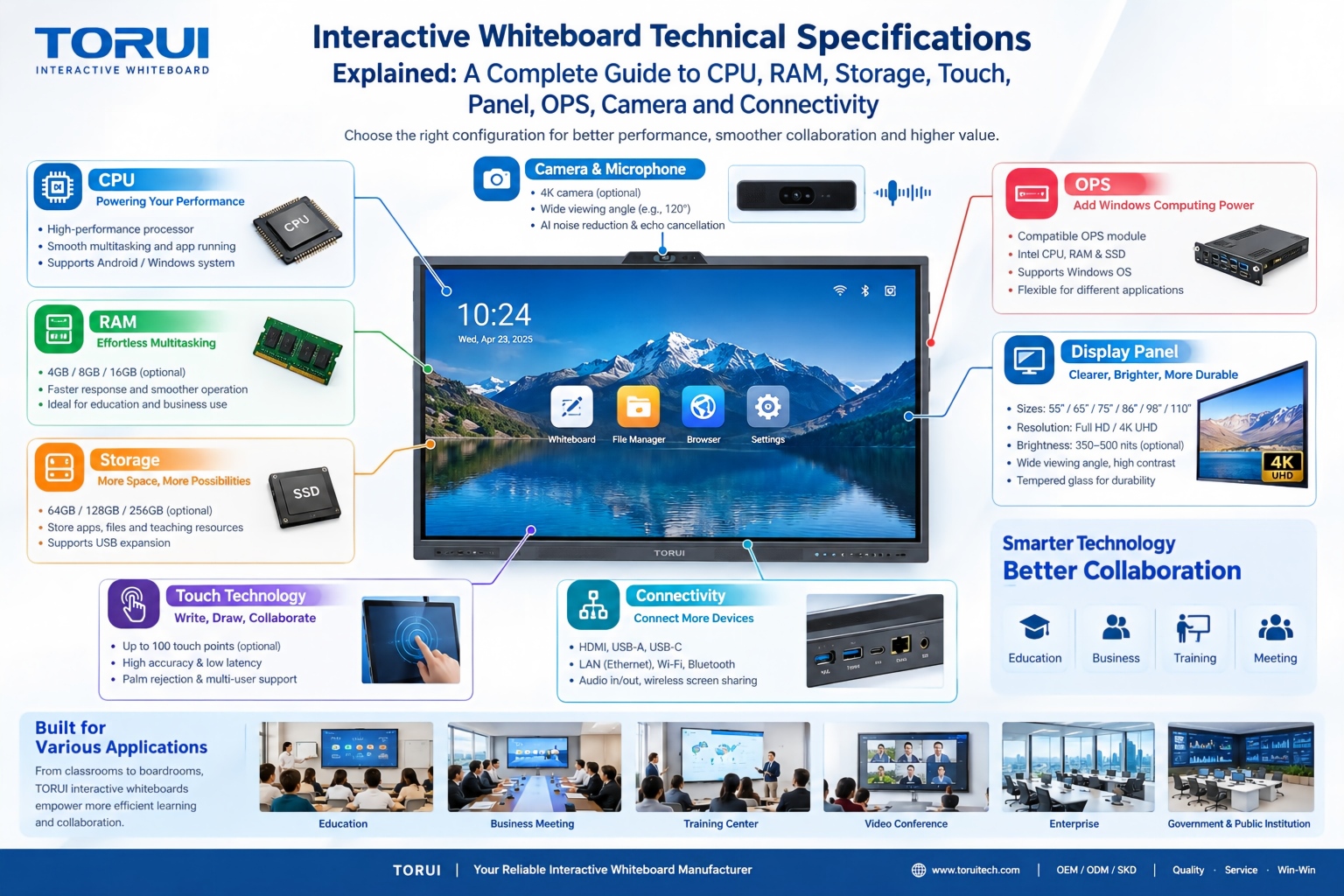
Choosing an interactive whiteboard involves more than comparing screen sizes and prices. For schools, businesses, distributors, wholesalers, and system integrators, understanding the technical specifications is essential to selecting a reliable product that meets different application requirements.
Interactive Whiteboard Technical Specifications Explained: A Complete Guide to CPU, RAM, Storage, Touch, Panel, OPS, Camera and Connectivity
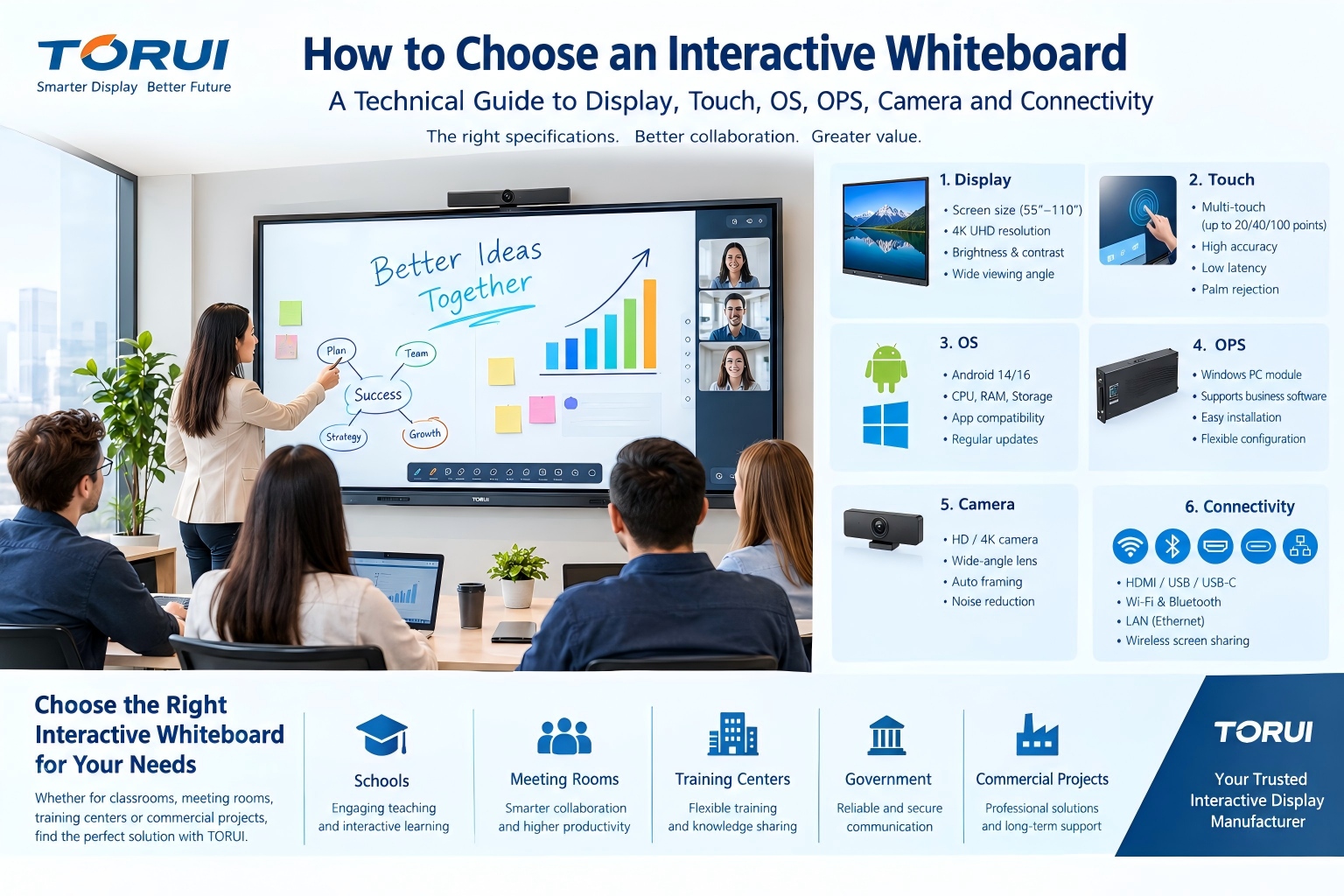
Choosing an interactive whiteboard for a school, meeting room, training center, government organization or commercial project requires more than comparing screen size and price. The most important specifications include display resolution, brightness, touch technology, operating system, processor, memory, storage, OPS compatibility, camera and microphone performance, connectivity, durability and after-sales support.
How to Choose an Interactive Whiteboard: A Technical Guide to Display, Touch, OS, OPS, Camera and Connectivity