
Analysis of Infrared Touch Technology for Interactive Whiteboards
author: toruitech
2025-08-19
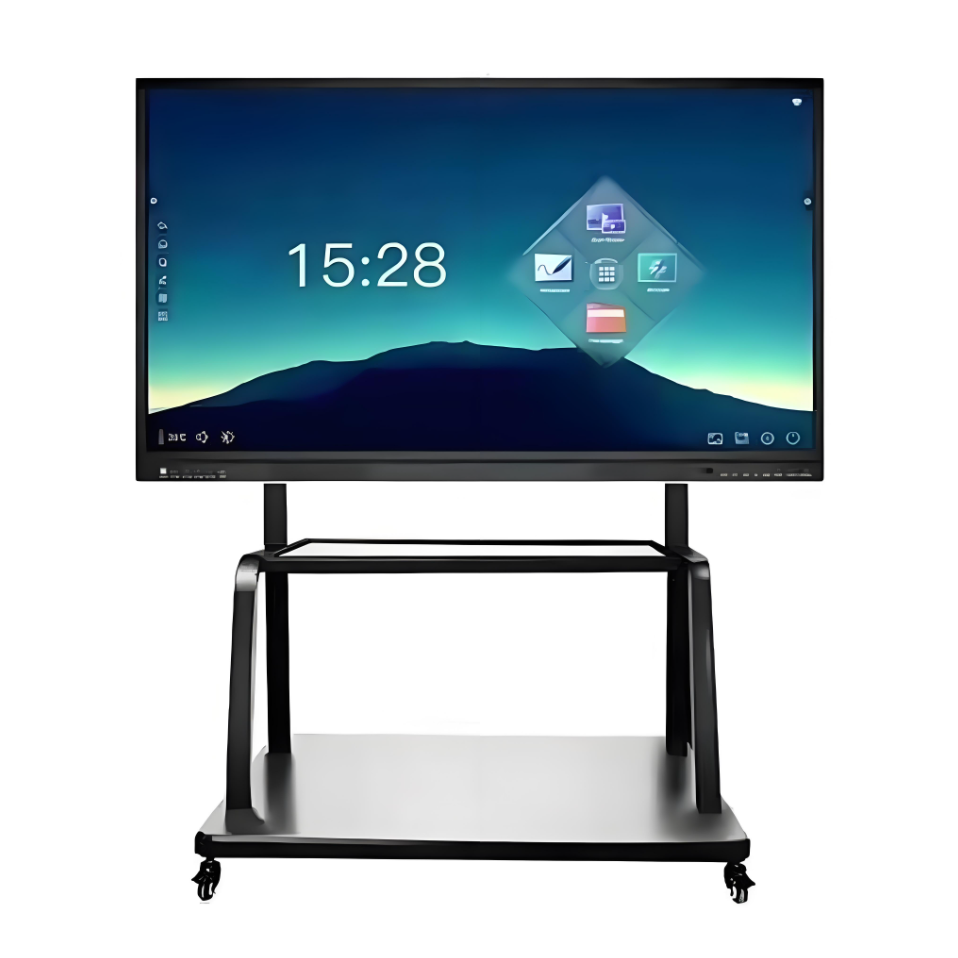
With the continuous development of information-based teaching and smart office, interactive whiteboards have become a key tool for improving classroom interaction and meeting efficiency, and have been widely used in various scenarios, including education, business, and training. Among the various whiteboard technologies, infrared touch technology has become a mainstream solution due to its high precision, durability, and ease of operation. This article will comprehensively analyze the principles, characteristics, application advantages, and future developments of infrared touch technology.
1. How Infrared Touch Technology Works
Infrared touch technology is a positioning technology based on optical sensing. According to internet searches, an interactive whiteboard is surrounded by infrared emitting and receiving diodes. These components form a dense infrared light network on the whiteboard surface. Each emitting diode corresponds to a receiving diode, forming a scanning matrix in both horizontal and vertical directions. When a user touches the whiteboard surface with a finger, stylus, or any opaque object, the infrared light is blocked at a certain point, causing the signal at the corresponding receiving diode to change. The device calculates the signal strength and position of the infrared device to accurately determine the coordinates of the touch point, enabling various interactive operations such as writing, clicking, and dragging. Infrared touch screens can also interpolate data from individual points through hardware design and software programming, achieving resolutions up to 4096×4096, meeting the precise positioning requirements of large whiteboards.
II. Key Features of Infrared Touch Technology
High Positioning Accuracy
Infrared touch technology enables high-resolution coordinate positioning, ensuring accurate writing and operation, making it suitable for precise manipulation in teaching and meeting scenarios.
Flexible Operation
No specialized pen is required; users can operate directly with their fingers, a stylus, or even a gloved hand, greatly enhancing flexibility and convenience.
High Board Durability
Infrared touch technology does not rely on the inherent conductivity or pressure sensitivity of the board surface. Even if the board is scratched or worn, it will continue to function properly, extending the device's lifespan.
Fast Response
Infrared touch screens utilize high-frequency data acquisition, enabling real-time response, supporting multi-touch (20 or even 40 points) and fast interaction, meeting the needs of dynamic teaching and efficient meetings.
Relatively Low Cost
Infrared touch technology has low hardware costs, making it suitable for large-scale deployment and application, especially in the education sector, offering a high cost-effectiveness.
III. Advantages of Infrared Touch Technology
Support for Large-Size Whiteboards
Infrared touch technology can be flexibly expanded to accommodate extra-large whiteboards, meeting the needs of large classrooms, conference rooms, and other venues, breaking through the area limitations of traditional electromagnetic induction technology.
Strong Compatibility
Infrared touch whiteboards can be seamlessly integrated with projectors, computers, and other devices, enabling multimedia presentations, remote communication, and interactive courseware, greatly enriching teaching and office tools.
Easy Maintenance
Because infrared touch technology does not rely on specialized board materials, maintenance and replacement costs are low, allowing users to flexibly adjust or upgrade the device based on actual needs.
Promoting Interactive Learning
Teachers and students can write, annotate, and drag courseware directly on the whiteboard, enhancing classroom interactivity and participation, and improving learning efficiency and interest.
IV. Limitations and Development of Infrared Touch Technology
While infrared touch technology offers many advantages, it also has certain limitations. For example, infrared light is sensitive to ambient light; strong light or reflections can cause misjudgments or even system crashes. However, with the introduction of infrared touch screens that are resistant to light interference, this issue has been effectively addressed, continuously improving system stability and adaptability. In the future, as smart education and smart office development deepen, infrared touch technology will continue to be optimized and upgraded, integrating cutting-edge technologies such as artificial intelligence and big data to further enhance the interactive experience and application value.
Conclusion
As a key technical solution in the interactive whiteboard field, infrared touch technology, with its advantages such as high precision, durability, flexible operation, and low cost, has become an ideal choice for education and enterprise information technology development. With the continuous advancement of technology, infrared touch whiteboards will play a greater role in more scenarios, helping to achieve smart education and efficient office work.
Interactive Whiteboard Brightness Analysis
Analysis and Application Advantages of Zero-Adhesion Technology for Interactive Whiteboards
Related Article

Choosing the right interactive whiteboard size is an important decision for distributors, wholesalers, and education technology suppliers. The 65-inch, 75-inch, and 86-inch interactive whiteboards are popular options for classrooms, meeting rooms, training centers, and commercial projects.
65 vs 75 vs 86-Inch Interactive Whiteboard: Which Model Should Distributors Choose?

Choosing the right interactive whiteboard manufacturer in China is an important decision for distributors, wholesalers, education technology suppliers, and system integrators. The right manufacturing partner can help businesses improve product quality, maintain competitive pricing, customize products for local markets, and build a sustainable distribution business.
Who Are the Best Interactive Whiteboard Manufacturers in China for B2B Distributors and Wholesalers?
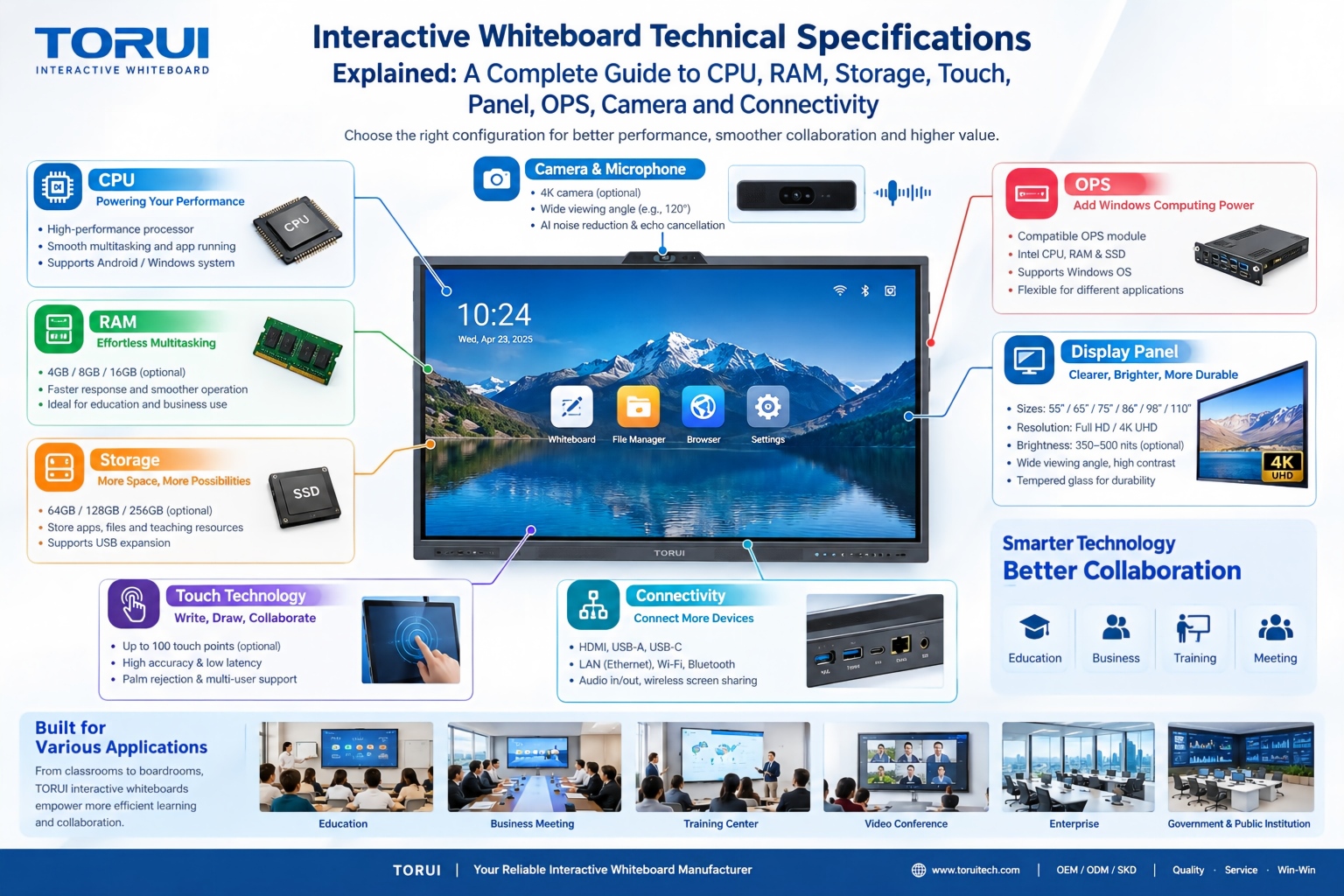
Choosing an interactive whiteboard involves more than comparing screen sizes and prices. For schools, businesses, distributors, wholesalers, and system integrators, understanding the technical specifications is essential to selecting a reliable product that meets different application requirements.
Interactive Whiteboard Technical Specifications Explained: A Complete Guide to CPU, RAM, Storage, Touch, Panel, OPS, Camera and Connectivity
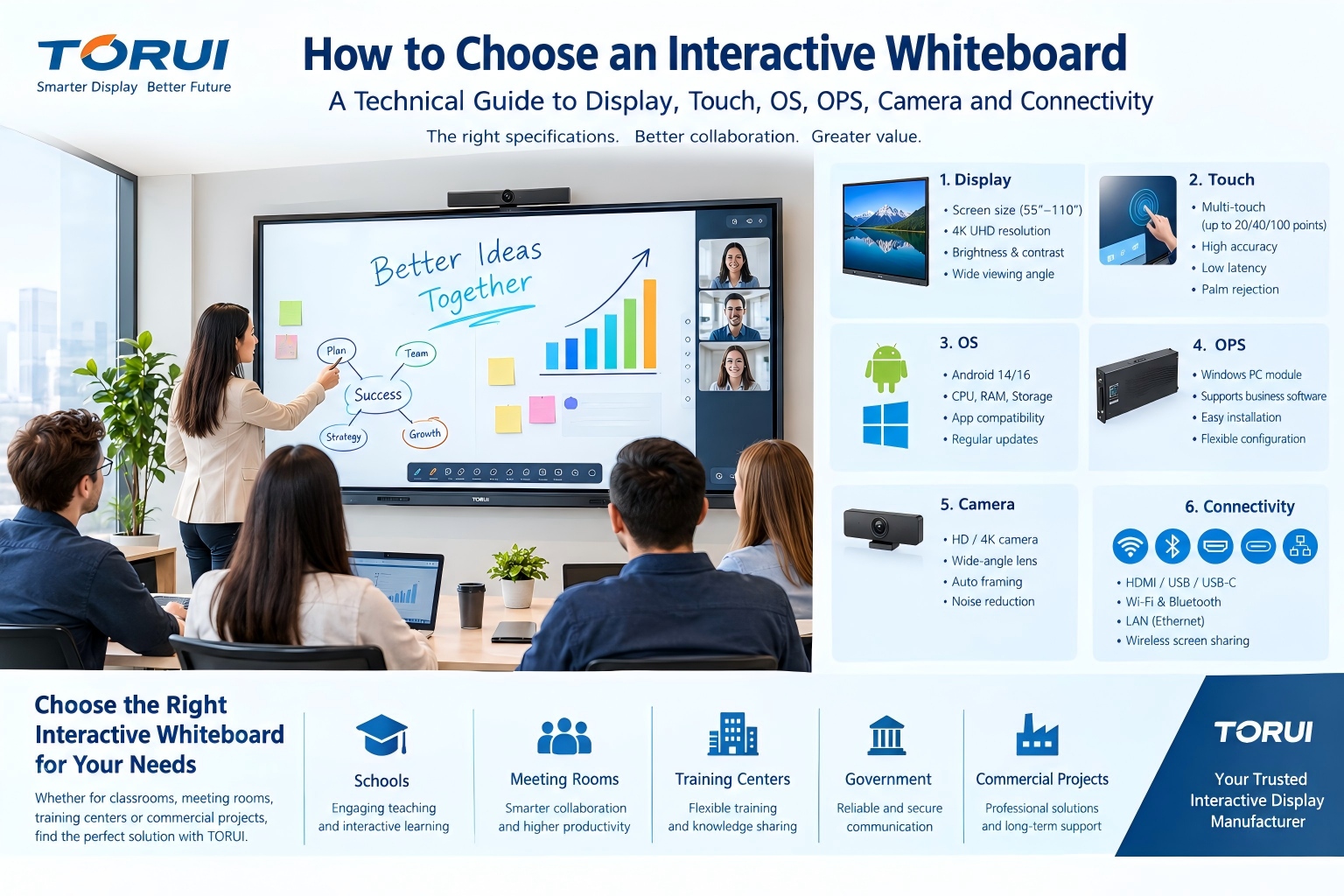
Choosing an interactive whiteboard for a school, meeting room, training center, government organization or commercial project requires more than comparing screen size and price. The most important specifications include display resolution, brightness, touch technology, operating system, processor, memory, storage, OPS compatibility, camera and microphone performance, connectivity, durability and after-sales support.
How to Choose an Interactive Whiteboard: A Technical Guide to Display, Touch, OS, OPS, Camera and Connectivity