
Analysis of Interactive Whiteboard Response Time and Its Application Value
author: toruitech
2025-08-22

With the continuous advancement of information technology, interactive whiteboards (IWBs) are increasingly used in education and conferencing. Integrating multimodal interaction technologies such as touch, voice, and vision, they have become a crucial component of smart classrooms and digital conference rooms. As a key performance metric, the response time of an interactive whiteboard directly impacts the user experience and teaching and office efficiency. This article systematically analyzes the response time and its value of interactive whiteboards from the perspectives of technical principles, influencing factors, practical applications, and future development.
1. What is Interactive Whiteboard Response Time?
The response time of an interactive whiteboard refers to the time it takes for the system to receive a command and display the corresponding result on the screen when a user operates on the whiteboard surface using touch, an electronic pen, or other methods. Ideally, this process should be "instantaneous," meaning that every touch, writing, or drag is quickly and accurately recognized and displayed by the whiteboard. The shorter the response time, the smoother the user's operational feedback and the better the interactive experience.
II. Major Factors Affecting Interactive Whiteboard Response Time
Hardware Configuration
Interactive whiteboard hardware includes touch sensors, processors, and displays. High-performance touch sensors can more quickly capture user actions and reduce signal transmission delays. The processor's computing speed determines data processing efficiency. The display's refresh rate also affects the speed of final presentation. Some high-end products utilize advanced technologies such as electromagnetic induction, infrared, and nano-touch, achieving response speeds of up to milliseconds.
Software System and Algorithm Optimization
The optimization of the whiteboard's operating system and driver directly impacts response speed. Efficient software can quickly recognize and process multi-touch and complex gestures, reducing system lag and latency. Furthermore, the smoothness of supporting application software is also a key factor influencing the overall experience.
Network Environment
In remote teaching or conferencing scenarios, interactive whiteboards often need to synchronize data with the cloud, and network latency can also affect response speed. If the local network is poor, operational feedback may experience noticeable delays.
III. The Impact of Response Time on Teaching and Conferencing
Improving Teaching Interactivity
The application of interactive whiteboards in education has greatly enriched teaching methods. Teachers can write, annotate, and present multimedia content in real time, and students can also participate in the interaction. The short response time ensures smooth communication between teachers and students, avoiding awkward moments and distractions caused by delays. According to relevant training experiences, the interactive whiteboard's efficient response greatly stimulates a lively classroom atmosphere, improving student engagement and learning efficiency.
Optimizing Meeting Collaboration Efficiency
In meetings, participants often need to mark up, modify, and share information instantly. A whiteboard's fast response time allows team members to collaborate efficiently, quickly capture ideas, and improve decision-making efficiency. A low-latency interactive experience is particularly crucial for cross-regional communication, especially in remote video conferencing.
IV. Technological Development and Future Trends
In recent years, with the integration of technologies such as artificial intelligence and cloud computing, the response time of interactive whiteboards has been continuously improved. Some products have achieved millisecond-level response times and support multi-touch and complex gesture recognition. At the same time, policies are promoting the popularization of smart classrooms and digital campuses, providing strong impetus for the upgrading of interactive whiteboard technology.
In the future, the response time of interactive whiteboards is expected to be further shortened. Combined with AI to achieve intelligent recognition and prediction, it will enhance the naturalness and fluidity of human-computer interaction. Furthermore, hardware upgrades and software iterations will continue to drive product performance improvements, bringing more efficient and intelligent experiences to education and office environments.
Conclusion
An interactive whiteboard's response time is not just a technical parameter; it's a core factor influencing user experience and application value. With technological advancements and increasing application demands, interactive whiteboards will continue to optimize their response speed, creating a more efficient, interactive, and intelligent environment for modern teaching and office work. Choosing an interactive whiteboard with fast response time and excellent performance will be a key factor in improving educational quality and work efficiency.
Analysis of Interactive Whiteboard Touch Methods
Interactive Whiteboard Viewing Angle Analysis
Related Article

Choosing the right interactive whiteboard size is an important decision for distributors, wholesalers, and education technology suppliers. The 65-inch, 75-inch, and 86-inch interactive whiteboards are popular options for classrooms, meeting rooms, training centers, and commercial projects.
65 vs 75 vs 86-Inch Interactive Whiteboard: Which Model Should Distributors Choose?

Choosing the right interactive whiteboard manufacturer in China is an important decision for distributors, wholesalers, education technology suppliers, and system integrators. The right manufacturing partner can help businesses improve product quality, maintain competitive pricing, customize products for local markets, and build a sustainable distribution business.
Who Are the Best Interactive Whiteboard Manufacturers in China for B2B Distributors and Wholesalers?
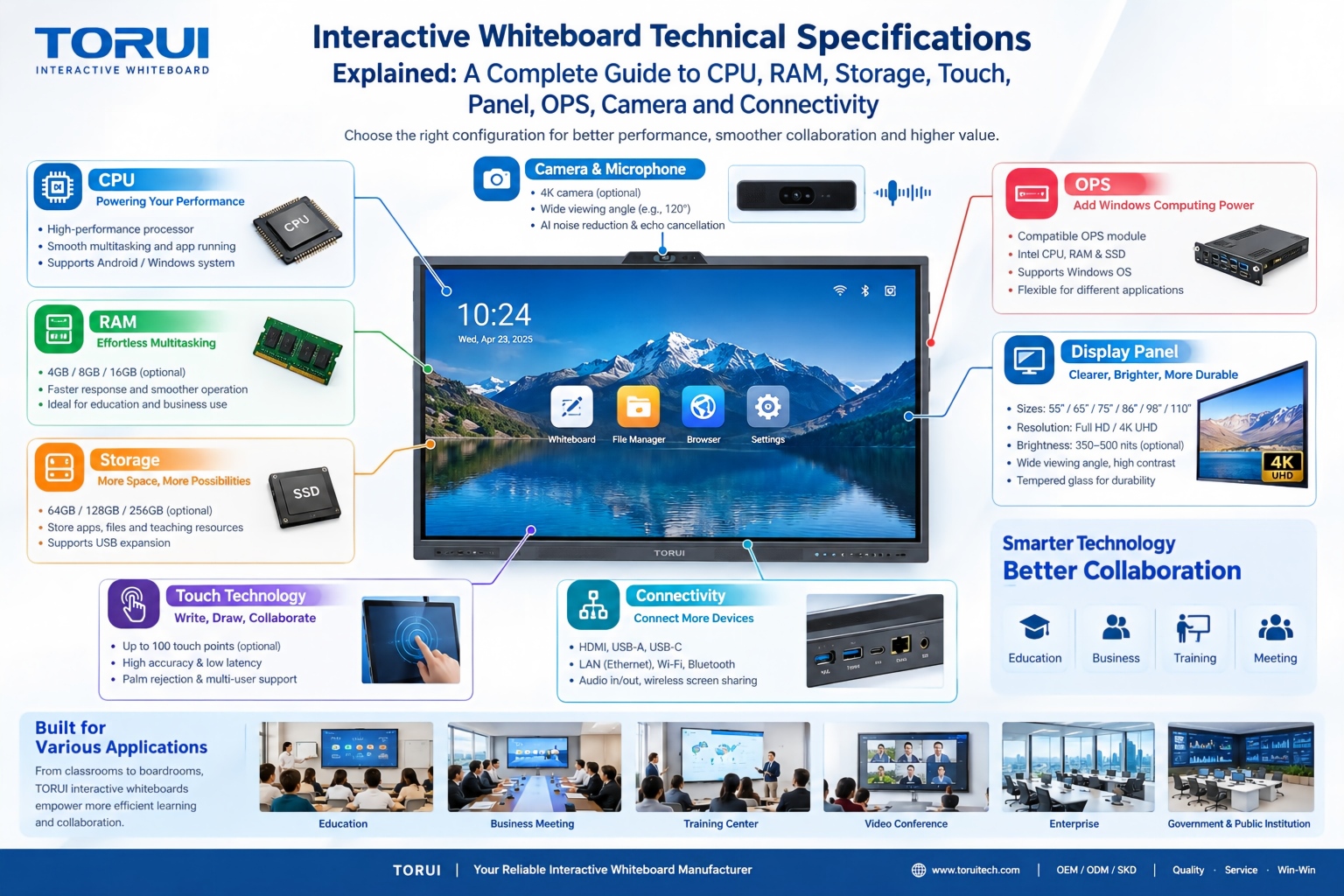
Choosing an interactive whiteboard involves more than comparing screen sizes and prices. For schools, businesses, distributors, wholesalers, and system integrators, understanding the technical specifications is essential to selecting a reliable product that meets different application requirements.
Interactive Whiteboard Technical Specifications Explained: A Complete Guide to CPU, RAM, Storage, Touch, Panel, OPS, Camera and Connectivity
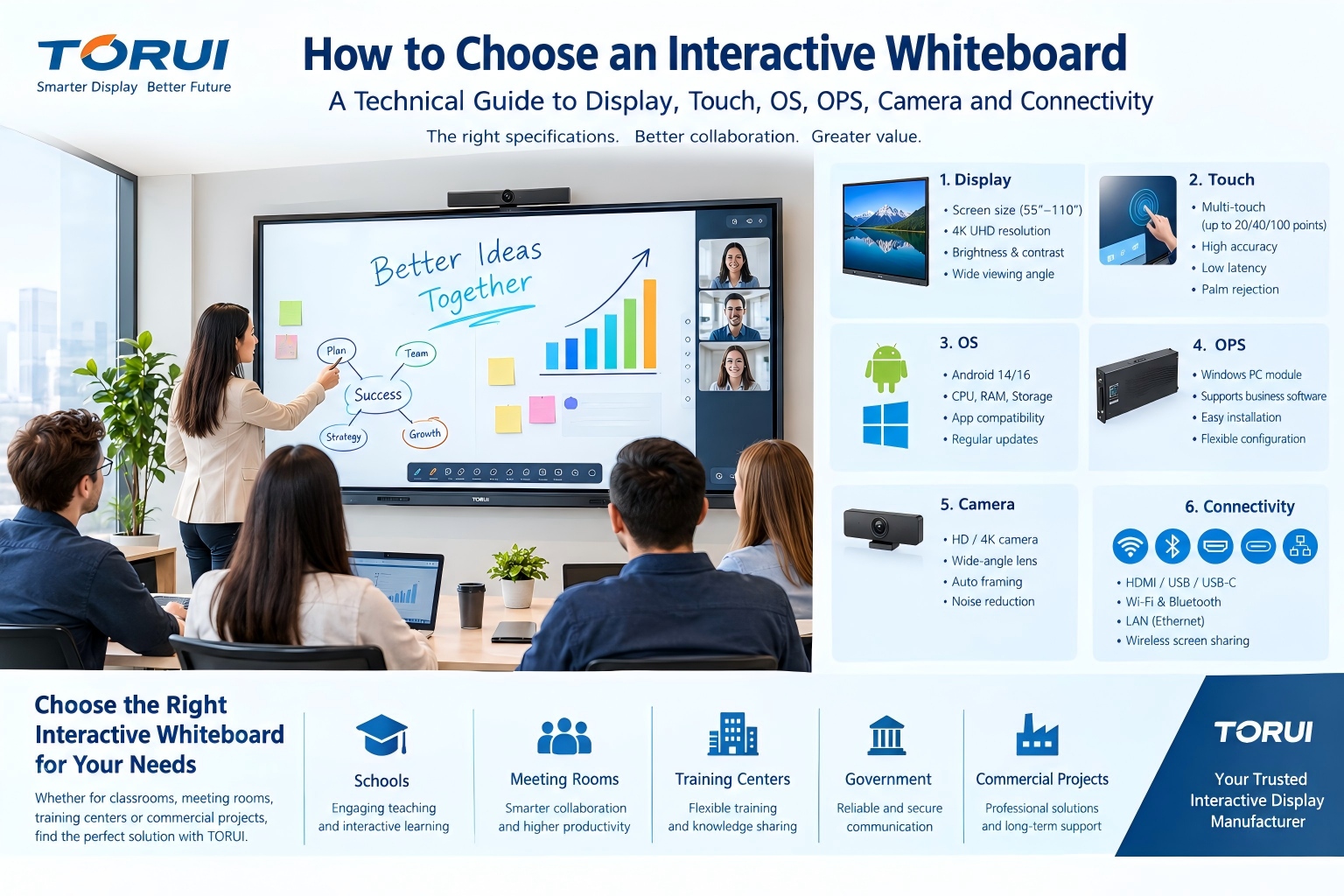
Choosing an interactive whiteboard for a school, meeting room, training center, government organization or commercial project requires more than comparing screen size and price. The most important specifications include display resolution, brightness, touch technology, operating system, processor, memory, storage, OPS compatibility, camera and microphone performance, connectivity, durability and after-sales support.
How to Choose an Interactive Whiteboard: A Technical Guide to Display, Touch, OS, OPS, Camera and Connectivity