
Analysis of Interactive Whiteboard Touch Methods
author: toruitech
2025-08-23

With the continuous development of information technology and intelligent technologies, interactive whiteboards have become an essential tool in modern education, conferencing, training, and other fields. Their core advantage lies in enabling efficient interaction between people and devices. Touch, as the foundation of this interaction, directly impacts user experience and practical application results. Currently, mainstream interactive whiteboards support a variety of touch methods, primarily including finger touch, dedicated pens, and any opaque object with a diameter greater than 5mm. This article systematically analyzes the principles, characteristics, and practical application value of these touch methods.
1. Finger Touch Method
Finger touch is one of the most common and intuitive interaction methods. Users simply tap, swipe, or drag their fingers directly on the whiteboard surface, and the system responds quickly. The technical foundation of this method primarily relies on infrared or capacitive touch technology. Infrared touch technology uses infrared transmitters and receivers arranged along the whiteboard's borders to form a staggered infrared beam pattern. When a finger touches the surface, it partially blocks the infrared beam, allowing the system to determine the touch point's location. Capacitive touch relies on the body's electrical conductivity. When a finger touches the whiteboard, the surface capacitance changes, and the system detects this change and locates the touch point. The advantage of finger touch is that it requires no additional tools, is easy to use, and is suitable for users of all ages. This is especially true in classroom settings, where teachers and students can write, annotate, and interact on the whiteboard at any time, greatly enhancing classroom activity and participation. Furthermore, the development of multi-touch technology allows multiple users to work on the whiteboard simultaneously, enhancing collaboration.
However, finger touch also has certain limitations. For example, the thickness and precision of fingers are difficult to meet the high requirements for detailed writing or drawing, and prolonged writing can easily lead to fatigue.
2. Pen Touch
Specialized pens or styluses are another important touch method for interactive whiteboards. Some whiteboards use electromagnetic induction or pressure-sensitive technology, requiring a dedicated pen. Electromagnetic induction technology uses signals from the whiteboard's internal sensing grid to interact with the electromagnetic pen, achieving high-precision positioning and pressure sensing, making it suitable for scenarios requiring detailed writing, drawing, and annotation. Pressure-sensitive technology detects changes in pen tip pressure to adjust line thickness, enhancing the writing experience.
The advantages of pen touch are smooth and precise writing, making it easier for teachers to write on the blackboard, derive formulas, and draw graphs. Some whiteboards also support multiple pen tools, such as erasers and highlighters, enriching teaching and presentation methods. In meetings, dedicated pens also facilitate quick annotation and content modification, improving collaboration efficiency.
It is important to note that dedicated pens may be lost or damaged, and some technologies require specialized pens, increasing maintenance costs.
3. Touch with any opaque object (diameter > 5mm)
With the advancement of infrared and nano-touch technology, some interactive whiteboards now support touch operations with any opaque object (diameter > 5mm). Whether it's a finger, a regular ballpoint pen, a pointer, or other objects, as long as they block infrared light or are detected by the nano-sensor, the system can identify the touch point. This greatly expands the whiteboard's application scenarios and operational flexibility, eliminating the need for specialized tools and enabling flexible response to unexpected situations.
For example, during teaching, teachers can easily annotate teaching aids or the edges of books without worrying about tool limitations. This makes operation more user-friendly and safer for children and those with special needs. Furthermore, this technology is particularly suitable for large-scale whiteboards, enabling multiple people to touch simultaneously. However, the object diameter limit (generally greater than 5mm) is intended to improve recognition accuracy and prevent accidental touches and environmental interference. For fine writing, using a dedicated pen or finger is still recommended.
IV. Comprehensive Applications and Future Development
Currently, mainstream interactive whiteboards on the market mostly utilize a "pen-and-finger" touch system, supporting touch with fingers, dedicated pens, and opaque objects. This provides strong compatibility and meets the needs of diverse scenarios. With technological advancements, touch recognition accuracy, sensitivity, and multi-point collaboration capabilities are continuously improving, and future interactive whiteboards will become even more intelligent and user-friendly.
In practical applications, users can flexibly choose the touch method based on their needs. For example, in teaching scenarios, fingers are convenient, dedicated pens provide fine writing, and object touch is flexible. In conference settings, multi-person collaboration and quick annotation are becoming mainstream. With the integration of technologies such as artificial intelligence and the Internet of Things, the touch experience of interactive whiteboards will be further optimized, providing solid support for smart education and smart office work.
Conclusion
The diverse touch methods of interactive whiteboards bring great convenience and room for innovation to users. Whether it is a finger, a special pen, or any opaque object, as long as you make a reasonable choice based on actual needs, you can fully tap the value of the interactive whiteboard and promote the sustainable development of information-based teaching and efficient office work.
Interactive Whiteboards with Built-in Cameras, Microphones, and Speakers
Analysis of Interactive Whiteboard Response Time and Its Application Value
Related Article

Choosing the right interactive whiteboard size is an important decision for distributors, wholesalers, and education technology suppliers. The 65-inch, 75-inch, and 86-inch interactive whiteboards are popular options for classrooms, meeting rooms, training centers, and commercial projects.
65 vs 75 vs 86-Inch Interactive Whiteboard: Which Model Should Distributors Choose?

Choosing the right interactive whiteboard manufacturer in China is an important decision for distributors, wholesalers, education technology suppliers, and system integrators. The right manufacturing partner can help businesses improve product quality, maintain competitive pricing, customize products for local markets, and build a sustainable distribution business.
Who Are the Best Interactive Whiteboard Manufacturers in China for B2B Distributors and Wholesalers?
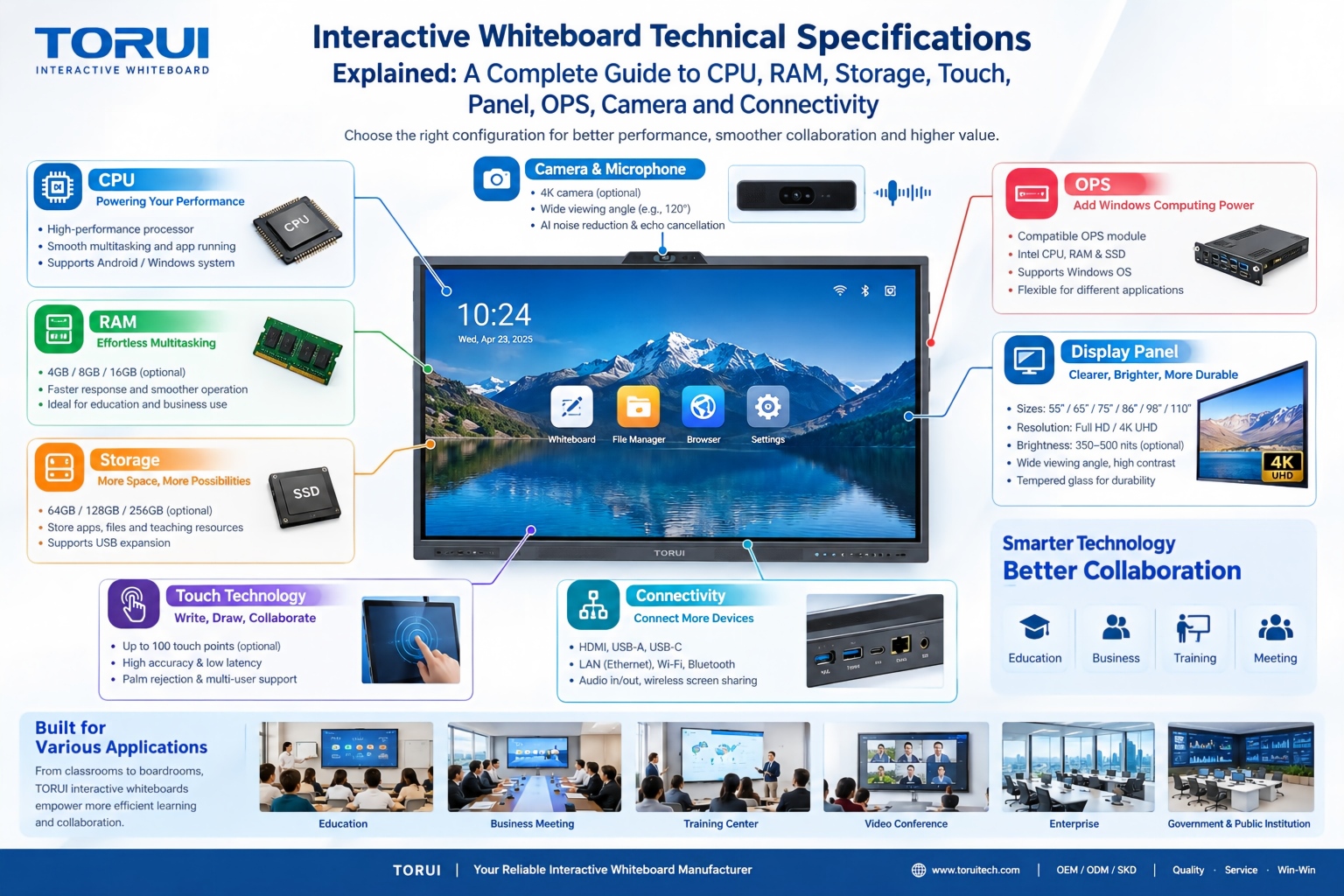
Choosing an interactive whiteboard involves more than comparing screen sizes and prices. For schools, businesses, distributors, wholesalers, and system integrators, understanding the technical specifications is essential to selecting a reliable product that meets different application requirements.
Interactive Whiteboard Technical Specifications Explained: A Complete Guide to CPU, RAM, Storage, Touch, Panel, OPS, Camera and Connectivity
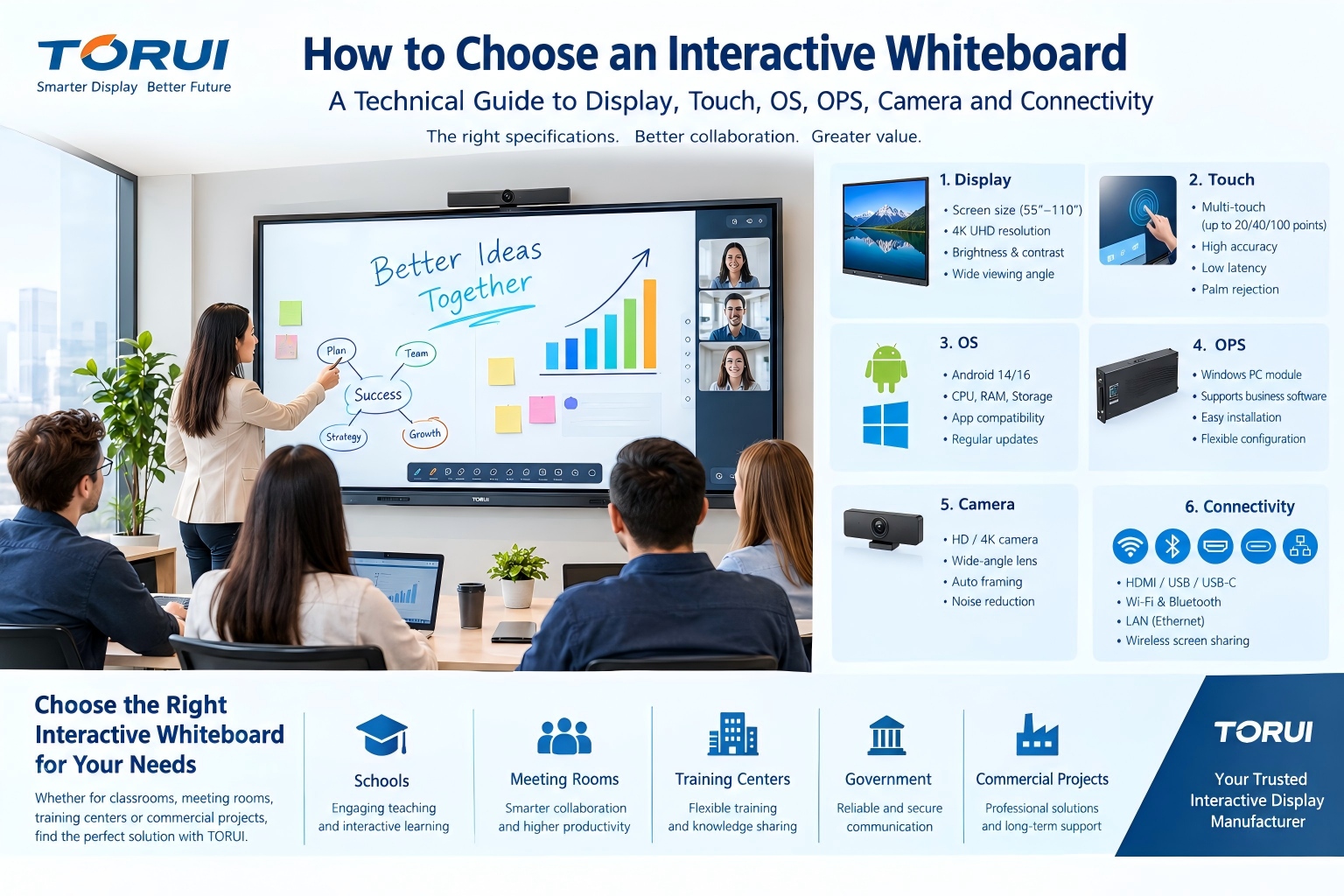
Choosing an interactive whiteboard for a school, meeting room, training center, government organization or commercial project requires more than comparing screen size and price. The most important specifications include display resolution, brightness, touch technology, operating system, processor, memory, storage, OPS compatibility, camera and microphone performance, connectivity, durability and after-sales support.
How to Choose an Interactive Whiteboard: A Technical Guide to Display, Touch, OS, OPS, Camera and Connectivity