
Analysis of the market prospects of smart interactive whiteboards
author: toruitech
2025-06-19

With the rapid development of science and technology and the in-depth advancement of modern education and enterprise digital transformation, smart interactive whiteboards (Interactive Whiteboard), as an innovative device that integrates multiple functions, are becoming an important part of education, business collaboration and even home smart devices. Its diverse functions and technical advantages make its market prospects full of opportunities. The following will comprehensively analyze the market prospects of smart interactive whiteboards from the aspects of industry status, driving factors, potential challenges and future trends.
1. Industry status and market size
Smart interactive whiteboards originated in the field of education and were originally used in classrooms as an upgraded version of traditional blackboards and whiteboards. With the continuous integration of technologies such as the Internet of Things, big data, and artificial intelligence, it has gradually expanded to the business field and home entertainment. According to relevant market research data, the global smart interactive whiteboard market size has maintained rapid growth in the past few years, and it is expected that by 2025, the annual compound annual growth rate will reach about 11%-15%.
At present, the North American and European markets are in a leading position, mainly due to the mature development of educational technology and its wide application in corporate conference collaboration scenarios. The Asia-Pacific market, especially China and India, has a rapid growth momentum and huge market potential due to the continuous investment in education, digital transformation and the popularization of smart hardware.
2. Market driving factors
1. Digital transformation in the field of education
Educational informatization has become a global trend. Governments and educational institutions are gradually increasing their investment in educational technology and focusing on cultivating students' interactive learning experience. Smart interactive whiteboards can achieve real-time content display, interactive teaching and increased student participation, meeting the needs of new-era education methods. Under the background of the "double reduction" policy, Chinese educational institutions also pay more attention to technology empowerment. Smart whiteboards can significantly improve classroom efficiency and teaching quality.
2. The surge in demand for corporate collaboration
The demand for efficient collaboration in the business field is becoming more and more urgent, especially driven by the trend of globalization and remote office. Smart whiteboards can make cross-regional collaboration more convenient for teams through touch, remote operation, content sharing and other functions, and improve the communication efficiency and decision-making ability of enterprises. For example, in a meeting scenario, smart whiteboards can be used to display file data and support real-time annotation and discussion by teams, becoming a standard equipment in modern meeting rooms.
3. Technological progress and hardware upgrades
With the gradual maturity and integration of display technology (such as touch screen, 4K resolution), artificial intelligence (recognition of handwritten content, voice control) and the Internet of Things, the functions of smart interactive whiteboards have become more powerful and their usage scenarios have become more diversified. This technological progress has further promoted the growth of consumer demand.
4. Policy support and popularization plan
The support policies of governments and enterprises are also a strong driving force for market development. Taking China as an example, in the context of educational informatization and the construction of "smart campus", many primary and secondary schools have begun to popularize smart whiteboard equipment. In addition, in the business field, more and more companies are beginning to accept smart collaboration tools to improve meeting efficiency.
III. Market challenges and obstacles
Despite the broad market prospects, the development of smart interactive whiteboards also faces some challenges:
1. Price cost restrictions
The high price of smart interactive whiteboards is still the main obstacle for small and medium-sized schools and enterprises to purchase. In addition, the cost of equipment maintenance and replacement is relatively high, which is an important consideration for users with limited budgets.
2. Intensified competition
With the increase in the number of companies entering the market, market competition has become extremely fierce. Competition between international giants such as Microsoft, Google and educational equipment manufacturers such as SMART Technologies and Chinese local brands continues to escalate. This requires companies to further increase investment in product technology innovation and market promotion.
3. Limited user penetration
Although the advantages of smart interactive whiteboards are significant, in some schools and enterprises, users' skills and acceptance of the equipment still need to be improved. Some institutions are still accustomed to traditional teaching tools or conference modes, and transitional education needs to be strengthened.
IV. Future development trends
1. Technological breakthroughs and multi-functional integration
Future smart interactive whiteboards will further integrate AR/VR technology, biometric technology, etc., to provide immersive experience and achieve deeper application in education and corporate decision-making. At the same time, artificial intelligence can enable devices to learn user behavior and provide customized solutions.
2. Market segmentation and scenario optimization
The smart whiteboard market will gradually be segmented, and more professional products will be designed for different scenarios such as education, business, and family. In the future large-scale smart home ecosystem, smart whiteboards may occupy the core position of home smart learning and entertainment by linking with other devices.
3. Price reduction and accelerated popularization
With technological advancement and reduced production costs, the price of equipment will become more affordable, which will significantly promote market popularization. Especially in small and medium-sized schools and enterprises, the use of smart whiteboards will be more extensive.
Conclusion
In general, the market prospects of smart interactive whiteboards are very broad, with diverse and strong driving factors, but it also faces certain challenges. With the continuous advancement of technology, the gradual enrichment of product functions, and the gradual decline in prices, smart interactive whiteboards will occupy an increasingly important position in the fields of digital education, enterprise collaboration, and home intelligence in the future, and will have a far-reaching impact. This is not only an iteration of traditional whiteboards and display devices, but also a revolution in the fields of education and business.
Overview of the configuration of the Android system of smart interactive whiteboard
Portable Smart Whiteboard: A New Milestone in Interactive Technology Innovation
Related Article

Choosing the right interactive whiteboard size is an important decision for distributors, wholesalers, and education technology suppliers. The 65-inch, 75-inch, and 86-inch interactive whiteboards are popular options for classrooms, meeting rooms, training centers, and commercial projects.
65 vs 75 vs 86-Inch Interactive Whiteboard: Which Model Should Distributors Choose?

Choosing the right interactive whiteboard manufacturer in China is an important decision for distributors, wholesalers, education technology suppliers, and system integrators. The right manufacturing partner can help businesses improve product quality, maintain competitive pricing, customize products for local markets, and build a sustainable distribution business.
Who Are the Best Interactive Whiteboard Manufacturers in China for B2B Distributors and Wholesalers?
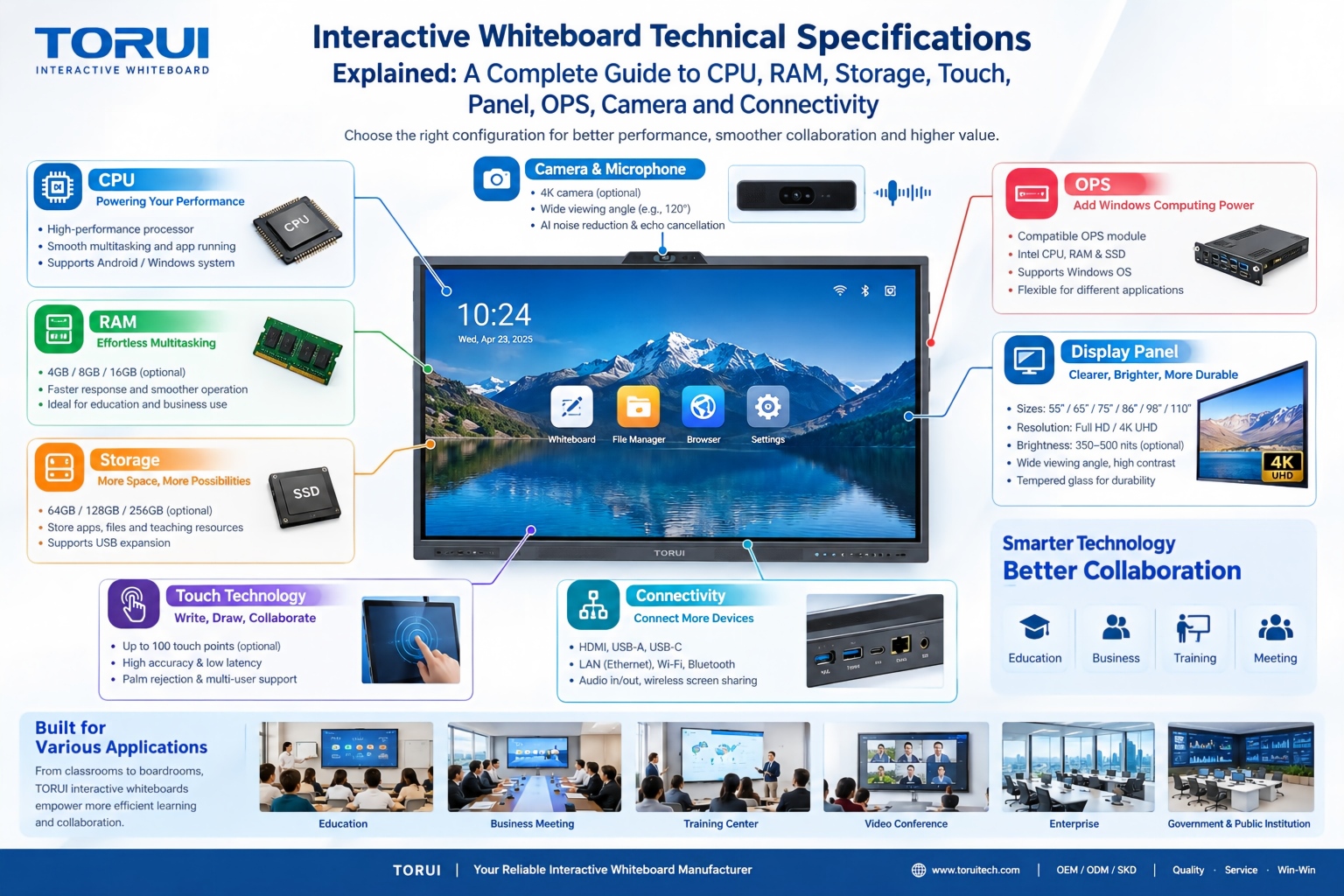
Choosing an interactive whiteboard involves more than comparing screen sizes and prices. For schools, businesses, distributors, wholesalers, and system integrators, understanding the technical specifications is essential to selecting a reliable product that meets different application requirements.
Interactive Whiteboard Technical Specifications Explained: A Complete Guide to CPU, RAM, Storage, Touch, Panel, OPS, Camera and Connectivity
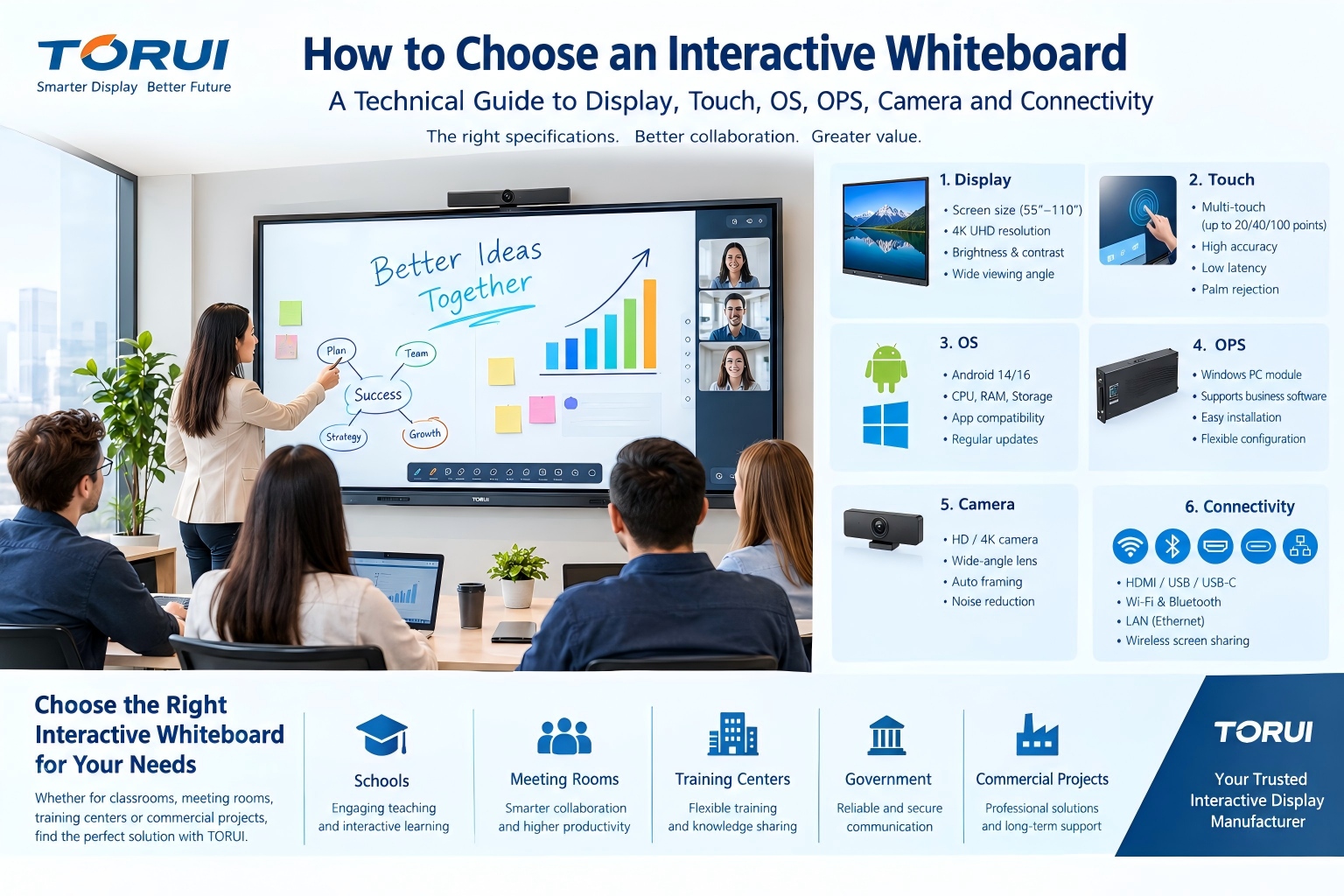
Choosing an interactive whiteboard for a school, meeting room, training center, government organization or commercial project requires more than comparing screen size and price. The most important specifications include display resolution, brightness, touch technology, operating system, processor, memory, storage, OPS compatibility, camera and microphone performance, connectivity, durability and after-sales support.
How to Choose an Interactive Whiteboard: A Technical Guide to Display, Touch, OS, OPS, Camera and Connectivity