
Boards for Schools | Evolution from Chalkboards to Interactive Whiteboards
author: toruitech
2025-09-20

The Role of Boards for Schools in Modern Education
In today’s classrooms, boards for schools are not just tools for writing—they are central to teaching, interaction, and learning efficiency. Over time, boards have evolved from traditional chalkboards to dust-free whiteboards, and now to advanced interactive whiteboards, reflecting the modernization of education.
From Chalkboards to Whiteboards
Chalkboards were once the standard choice due to their low cost and durability. However, chalk dust raised health concerns, especially regarding respiratory issues. This led schools to adopt whiteboards, which provide clear writing, easy erasing, and reduced dust. Whiteboards also allow the use of colorful markers, making subjects such as math and science easier to illustrate visually.
The Rise of Interactive Whiteboards
With the growth of digital learning, interactive whiteboards are increasingly popular in schools. They integrate large touchscreens with multimedia features, allowing teachers to display lessons, videos, and diagrams while writing or annotating directly on the board. Students can also interact with the screen, making lessons more engaging and collaborative. A key benefit is the ability to save and share lesson content, which supports revision and personalized learning.
Value in Remote and Hybrid Learning
Interactive whiteboards are highly effective in remote and hybrid classrooms. They connect seamlessly with video conferencing platforms and Learning Management Systems (LMS), enabling real-time collaboration across locations. This removes geographical barriers and broadens access to quality education.
Key Considerations for Schools
When choosing boards for schools, factors such as health and safety should come first. Whiteboards with anti-glare designs protect eyesight, while durable materials ensure longevity. For electronic whiteboards, resolution, touch sensitivity, system compatibility, and maintenance costs should all be considered to guarantee smooth teaching performance.
Conclusion
The evolution of boards for schools highlights the shift toward smarter, healthier, and more interactive learning environments. From chalkboards to interactive whiteboards, each upgrade improves teaching effectiveness and student engagement. By selecting the right type of board, schools can enhance learning outcomes and build classrooms that truly support modern education.
Smart Whiteboard Cost: A Complete Guide for Schools and Businesses
TORUI - Making Education and Business Smarter in Guangzhou, China
Related Article

Choosing the right interactive whiteboard size is an important decision for distributors, wholesalers, and education technology suppliers. The 65-inch, 75-inch, and 86-inch interactive whiteboards are popular options for classrooms, meeting rooms, training centers, and commercial projects.
65 vs 75 vs 86-Inch Interactive Whiteboard: Which Model Should Distributors Choose?

Choosing the right interactive whiteboard manufacturer in China is an important decision for distributors, wholesalers, education technology suppliers, and system integrators. The right manufacturing partner can help businesses improve product quality, maintain competitive pricing, customize products for local markets, and build a sustainable distribution business.
Who Are the Best Interactive Whiteboard Manufacturers in China for B2B Distributors and Wholesalers?
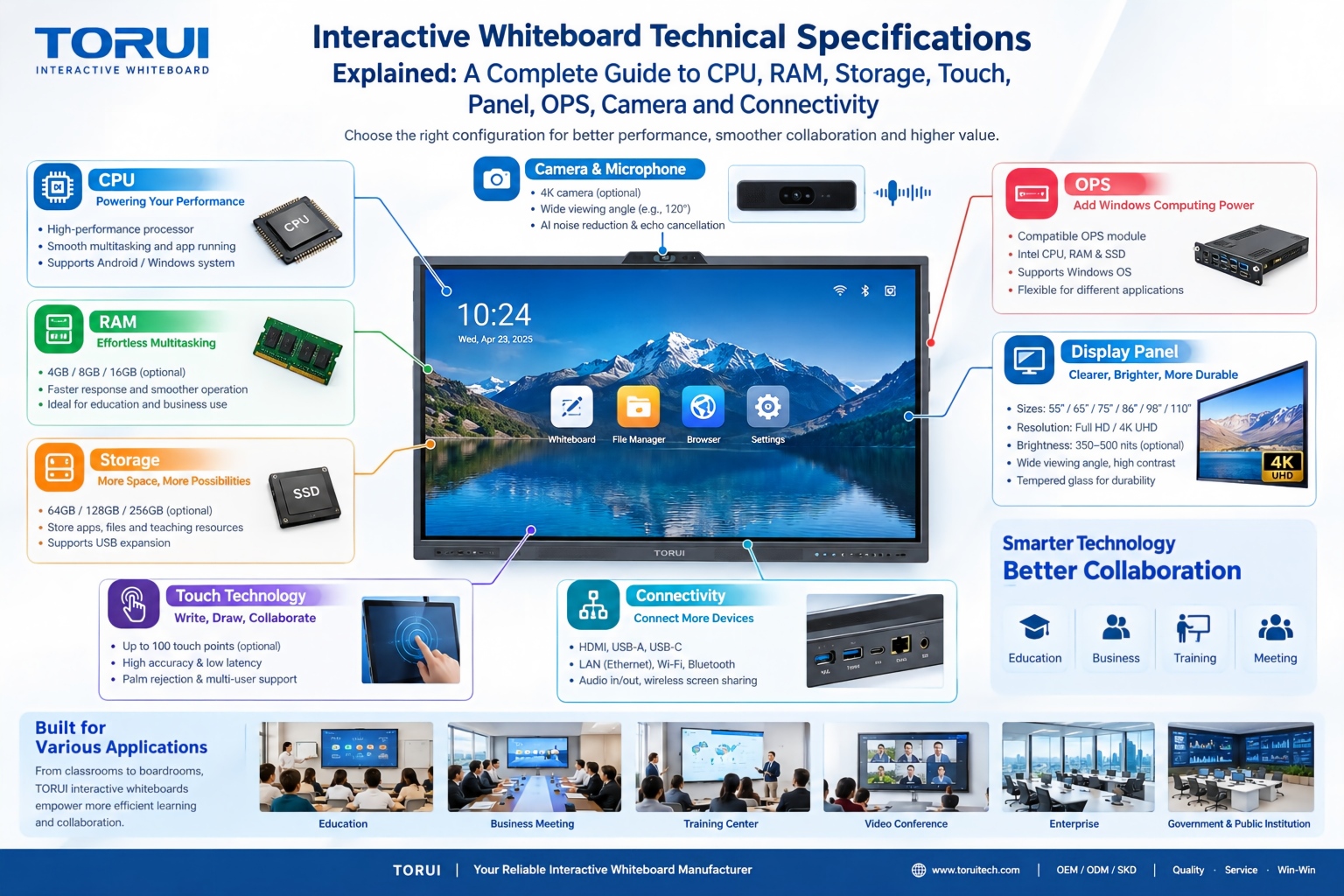
Choosing an interactive whiteboard involves more than comparing screen sizes and prices. For schools, businesses, distributors, wholesalers, and system integrators, understanding the technical specifications is essential to selecting a reliable product that meets different application requirements.
Interactive Whiteboard Technical Specifications Explained: A Complete Guide to CPU, RAM, Storage, Touch, Panel, OPS, Camera and Connectivity
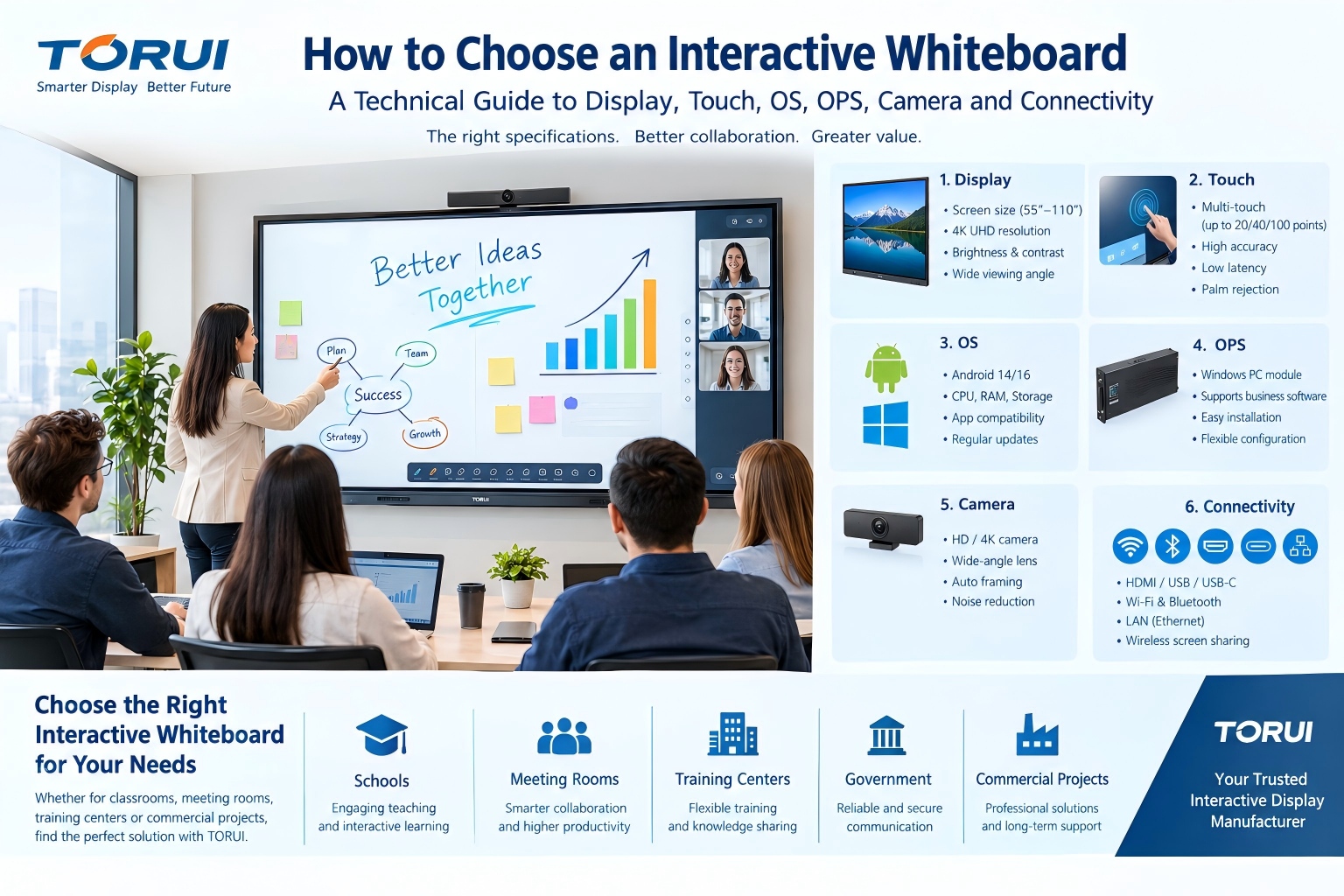
Choosing an interactive whiteboard for a school, meeting room, training center, government organization or commercial project requires more than comparing screen size and price. The most important specifications include display resolution, brightness, touch technology, operating system, processor, memory, storage, OPS compatibility, camera and microphone performance, connectivity, durability and after-sales support.
How to Choose an Interactive Whiteboard: A Technical Guide to Display, Touch, OS, OPS, Camera and Connectivity