What Specs to Check When Importing Interactive Whiteboards from China: Certifications, Shipping, and Quality Control

Importing interactive whiteboards (IWBs) from China can be a cost-effective way to expand your product line or upgrade your school and business solutions. However, choosing the right manufacturer and verifying the correct specifications is essential to avoid compliance issues, quality problems, or costly delays. Below is a practical guide explaining the key specs and requirements buyers should check before placing an order.
1. Certifications and Compliance Requirements
Certifications are among the most important specifications to confirm when importing IWBs. They ensure safety, legal compliance, and smooth customs clearance in your destination market.
✔ CE Certification (Europe)
For EU markets, CE is mandatory. It typically covers:
-
EMC (Electromagnetic Compatibility)
-
LVD (Low Voltage Directive)
-
RoHS for environmental compliance
Ensure the supplier provides authentic test reports issued by accredited labs, not just a CE “statement.”
✔ FCC Certification (United States)
FCC certification is required for electronic and digital devices entering the U.S. market. It verifies that the interactive whiteboard meets electromagnetic emission standards. Always request an FCC ID and related test documentation.
✔ UKCA, GCC, BIS, PSE, SAA (Depending on Market)
Different regions have their own regulations:
-
UKCA for the United Kingdom
-
GCC / G-Mark for Middle East countries
-
BIS for India
-
PSE for Japan
-
SAA / RCM for Australia
Request certificates in advance and confirm that the certification covers the exact models you intend to import.
✔ Additional Education or Safety Standards
Some institutions require:
-
Anti-glare safety glass standards
-
ISO 9001 / ISO 14001 factory management systems
-
National education equipment labels (optional depending on region)
2. Product Specifications to Verify Before Ordering
IWBs are technical products, so verifying hardware and functional specs is crucial.
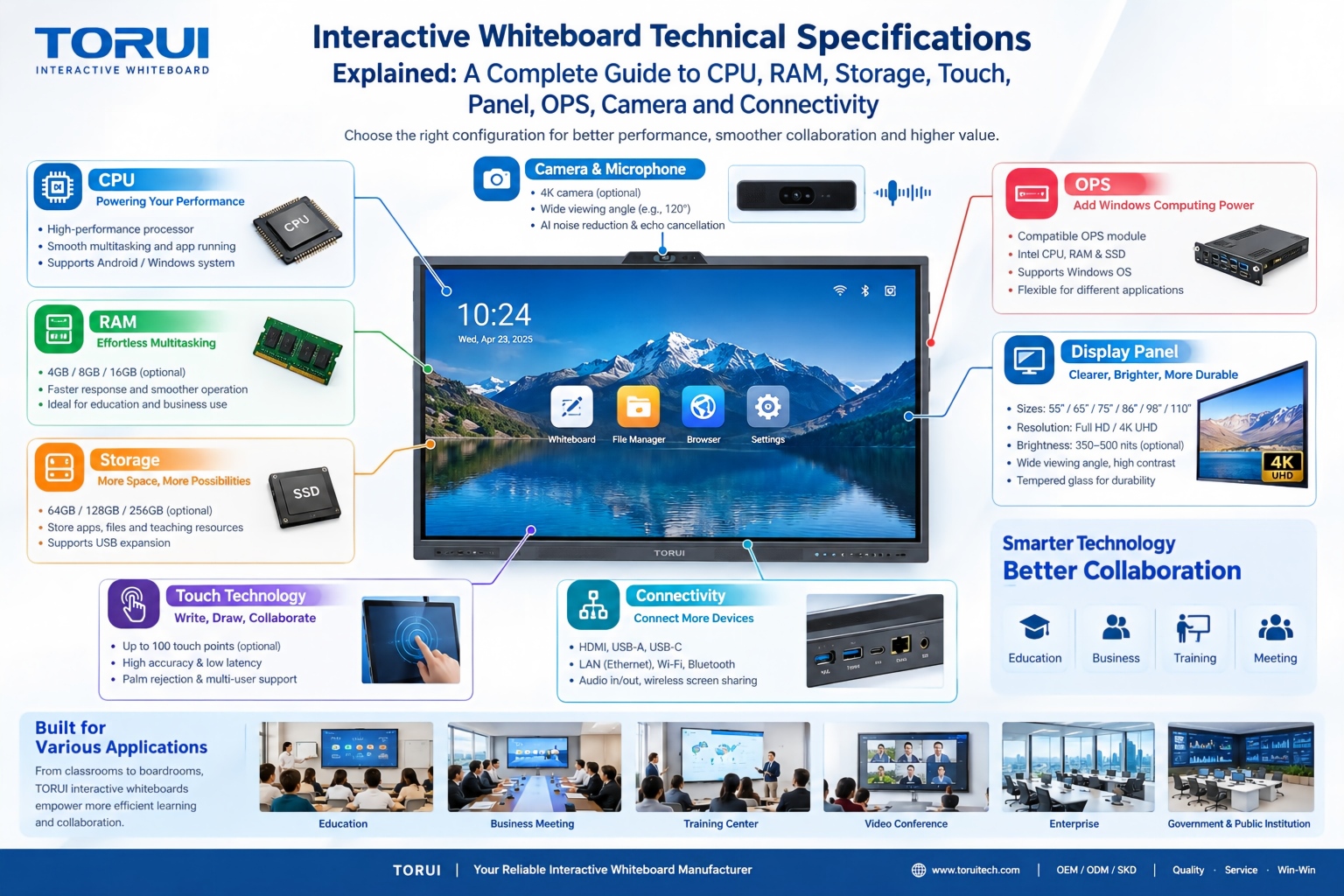
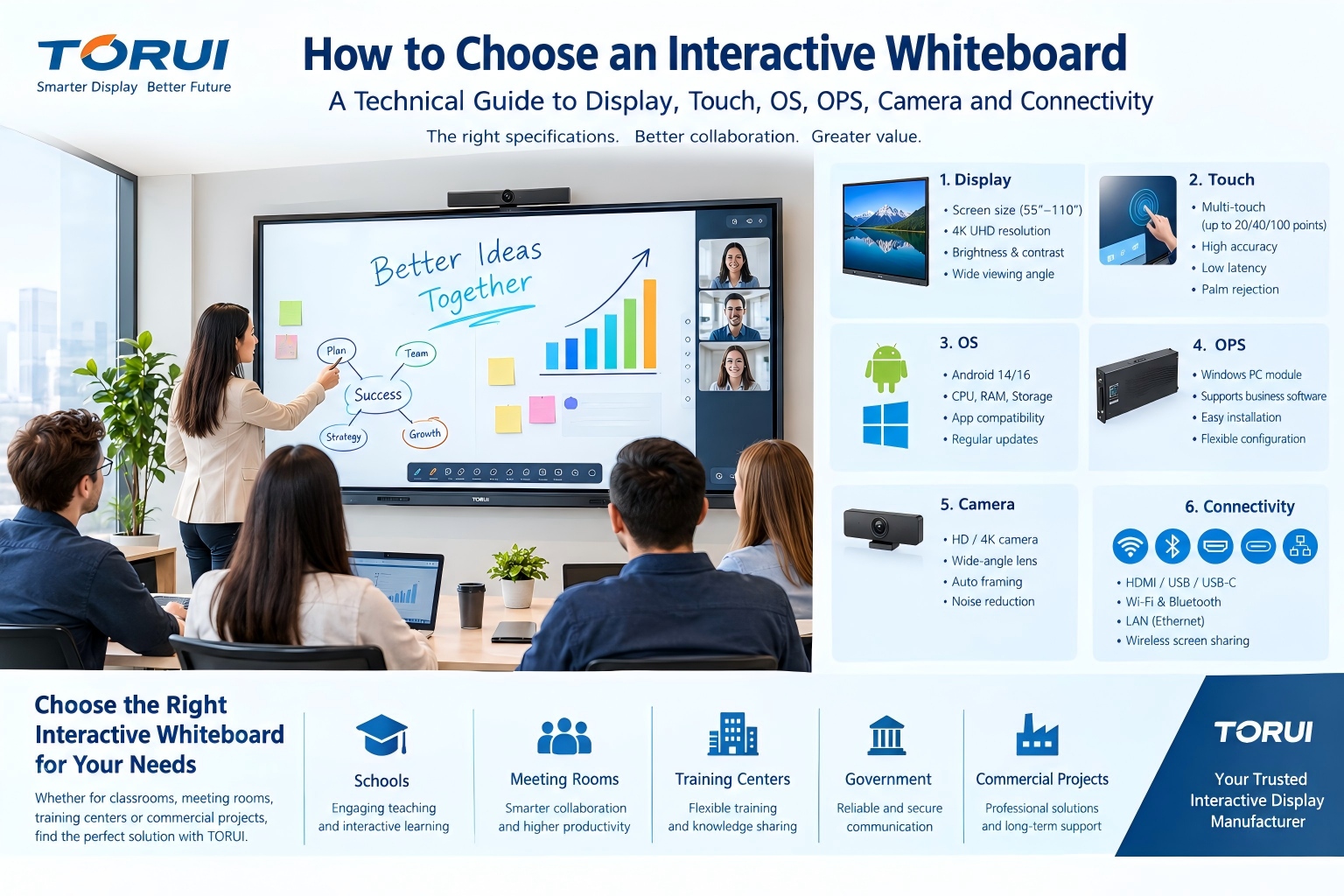
✔ Display Parameters
Key specs include:
-
Screen size (55″/65″/75″/86″ etc.)
-
Resolution (4K UHD is now standard)
-
Brightness (≥ 350–450 cd/m² for classrooms)
-
Color accuracy and contrast ratio
-
Glass type (4 mm tempered glass is common)
✔ Touch Technology
Popular touch technologies:
-
Infrared touch (IR) – cost-effective and widely used
-
Capacitive touch – more precise, premium feel
-
EMR / optical – available for specialized applications
Check:
-
Touch points (10/20/40 points)
-
Response speed (typically 5–10 ms)
-
Accuracy and anti-interference performance
✔ Operating System & Performance
Modern IWBs use dual systems:
-
Android OS (RAM/ROM, processor type, version)
-
Optional Windows OPS PC (CPU, RAM, SSD, GPU)
Ensure the configurations match your local requirements and user expectations.
✔ Connectivity & Ports
Confirm availability of:
-
HDMI, USB, Type-C ports
-
LAN, Wi-Fi, Bluetooth
-
Front I/O for classroom convenience
3. Quality Control Checklist
Before mass production, establish a clear QC process with your manufacturer.
✔ Pre-production sample approval
Study the sample’s:
-
Display quality
-
Touch performance
-
System stability
-
Build quality and materials
✔ In-process inspections
Request a third-party inspection for:
-
Component checks
-
Assembly quality
-
Cable management
-
Internal parts consistency
✔ Final Inspection (Pre-shipment)
Verify:
-
Packaging strength
-
Drop-test compliance
-
Function testing (writing, annotation, wireless sharing, apps)
-
Serial numbers and labeling
-
Accessories, cables, and manuals
Quality control dramatically reduces product returns and customer complaints.
4. Shipping, Packaging, and Logistics Considerations
Interactive whiteboards are large fragile items, so proper shipping specs are essential.
✔ Export Packaging
Look for:
-
5–7 layer export cartons
-
Internal foam protection
-
Optional wooden crate packaging
-
Corner protectors / shock-proof design
✔ Shipping Method
-
Sea freight: Most common for bulk shipments
-
Rail: Faster for Europe
-
Air freight: Suitable for urgent orders or sample delivery
Confirm CBM (cubic meter), weight, and loading quantity in 20GP/40HQ containers.
✔ Customs Documents
Essential paperwork includes:
-
Commercial invoice
-
Packing list
-
Bill of lading / airway bill
-
Certificates of origin
-
Product certifications (CE/FCC/etc.)
Conclusion
To successfully import interactive whiteboards from China, buyers must pay close attention to certifications, technical specifications, quality control processes, and shipping details. By verifying these key areas, you can ensure smoother customs clearance, stable product performance, and a higher return on investment. Choosing a reliable manufacturer and establishing a clear inspection system will significantly reduce risks and guarantee long-term success in your market.
Global Schools Accelerate Digital Transformation: Interactive Whiteboard Adoption Rate Hits Record High
Interactive Whiteboards: The Technology Behind the Scenes
Related Article