
China's Interactive Whiteboard Manufacturing Upgrades: Factory Automation Reaches New Milestones
author: toruitech
2025-12-08

In recent years, China’s interactive whiteboard (IWB) manufacturing sector has experienced a dramatic evolution, driven by the rapid advancement of technology and the push towards greater automation. The improvements in factory automation have significantly impacted production efficiency, product quality, and cost-effectiveness. As the demand for interactive whiteboards grows globally, particularly in the education and corporate sectors, manufacturers are increasingly relying on cutting-edge automation techniques to stay competitive in a dynamic market.
The Rise of Automation in Interactive Whiteboard Manufacturing
Automation in China’s interactive whiteboard factories has progressed by leaps and bounds. Traditionally, the production of these high-tech devices was labor-intensive, requiring extensive manual labor for assembly, testing, and quality control. However, the introduction of smart machines, robotics, and advanced artificial intelligence (AI) technologies has streamlined the entire process, allowing for more precision, speed, and consistency.
One of the key drivers behind this shift has been the integration of robotic arms and AI-based inspection systems in the assembly lines. These technologies enable precise component placement, ensuring a higher level of accuracy in the production process. Additionally, automated quality control systems equipped with machine vision can detect defects that might go unnoticed by human workers, further enhancing the reliability of the final product.
Benefits of Automation: Efficiency and Cost-Effectiveness
Factory automation has brought several notable benefits to interactive whiteboard manufacturers in China. One of the most significant advantages is the substantial reduction in production costs. Automated systems minimize the need for manual labor and increase throughput, allowing factories to produce more units within the same time frame. This increase in productivity also leads to lower unit costs, which is crucial in maintaining competitiveness in a market with tight profit margins.
Moreover, automation enhances operational efficiency by reducing human error, thus improving product quality. With automated processes, the likelihood of defects or inconsistencies in production is minimized, ensuring that each interactive whiteboard meets the high standards required by customers. This is particularly important for international markets, where customers demand products with precise specifications and consistent performance.
Innovation in Materials and Technology
Alongside the automation of production processes, there has been a notable upgrade in the materials and technologies used in interactive whiteboards. Modern IWBs are built with advanced touch-sensitive screens, high-resolution displays, and durable frames, all of which require state-of-the-art materials and precise manufacturing methods. Automation has enabled manufacturers to work with these advanced materials more effectively, ensuring that the final products are of the highest quality.
One of the key innovations has been the improvement in touch technology. Capacitive and infrared touch technologies, commonly used in interactive whiteboards, are now being optimized through automation to deliver faster response times and greater accuracy. This ensures a seamless user experience, whether the board is being used in a classroom for teaching or in a corporate setting for meetings and presentations.
Meeting Global Standards and Expanding Market Reach
China’s interactive whiteboard manufacturers are not only focusing on improving automation within their factories but also aligning their production processes with international standards. To expand their market reach, Chinese manufacturers must meet rigorous certification requirements for export markets, particularly in Europe and North America. Automation has played a critical role in ensuring that the manufacturing process complies with these high standards, such as CE and UL certifications.
In addition to compliance, automation has made it easier for Chinese manufacturers to customize interactive whiteboards to meet the specific needs of international clients. Whether it’s offering different screen sizes, customized software, or specific connectivity options, automated systems enable manufacturers to produce highly tailored products without sacrificing efficiency or quality.
Future Prospects: Smart Factories and AI Integration
Looking ahead, the future of China’s interactive whiteboard manufacturing lies in the continued development of smart factories and further integration of AI. Smart factories leverage Internet of Things (IoT) technology to connect machines, sensors, and production equipment in real-time. This creates a highly flexible and adaptive production environment where adjustments can be made on the fly, depending on market demands or customer specifications.
Furthermore, AI technologies will continue to evolve, enabling even more advanced predictive maintenance, inventory management, and quality control systems. With AI-driven decision-making, manufacturers will be able to anticipate potential issues before they occur, further improving operational efficiency and minimizing downtime.
Conclusion
The shift toward factory automation in China’s interactive whiteboard manufacturing industry has been transformative, resulting in enhanced productivity, cost-effectiveness, and product quality. As automation continues to evolve, manufacturers will be able to meet the increasing global demand for high-quality interactive whiteboards while maintaining competitive pricing. With ongoing advancements in AI, robotics, and smart manufacturing technologies, the future of China’s interactive whiteboard industry looks poised for even greater growth, making it an exciting time for both manufacturers and consumers alike.
Interactive Whiteboards: Revolutionizing Learning and Meetings
Global Schools Accelerate Digital Transformation: Interactive Whiteboard Adoption Rate Hits Record High
Related Article

Choosing the right interactive whiteboard size is an important decision for distributors, wholesalers, and education technology suppliers. The 65-inch, 75-inch, and 86-inch interactive whiteboards are popular options for classrooms, meeting rooms, training centers, and commercial projects.
65 vs 75 vs 86-Inch Interactive Whiteboard: Which Model Should Distributors Choose?

Choosing the right interactive whiteboard manufacturer in China is an important decision for distributors, wholesalers, education technology suppliers, and system integrators. The right manufacturing partner can help businesses improve product quality, maintain competitive pricing, customize products for local markets, and build a sustainable distribution business.
Who Are the Best Interactive Whiteboard Manufacturers in China for B2B Distributors and Wholesalers?
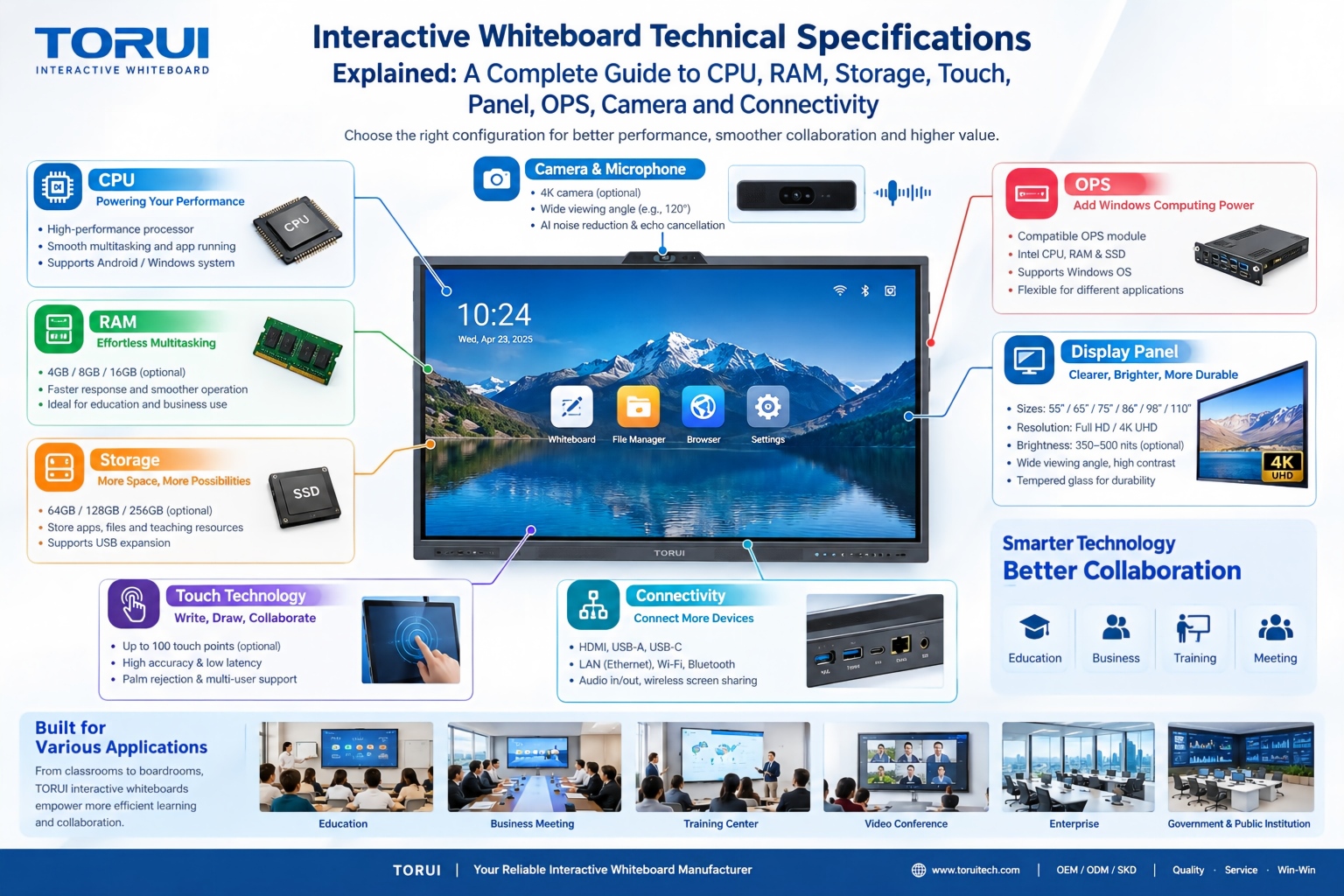
Choosing an interactive whiteboard involves more than comparing screen sizes and prices. For schools, businesses, distributors, wholesalers, and system integrators, understanding the technical specifications is essential to selecting a reliable product that meets different application requirements.
Interactive Whiteboard Technical Specifications Explained: A Complete Guide to CPU, RAM, Storage, Touch, Panel, OPS, Camera and Connectivity
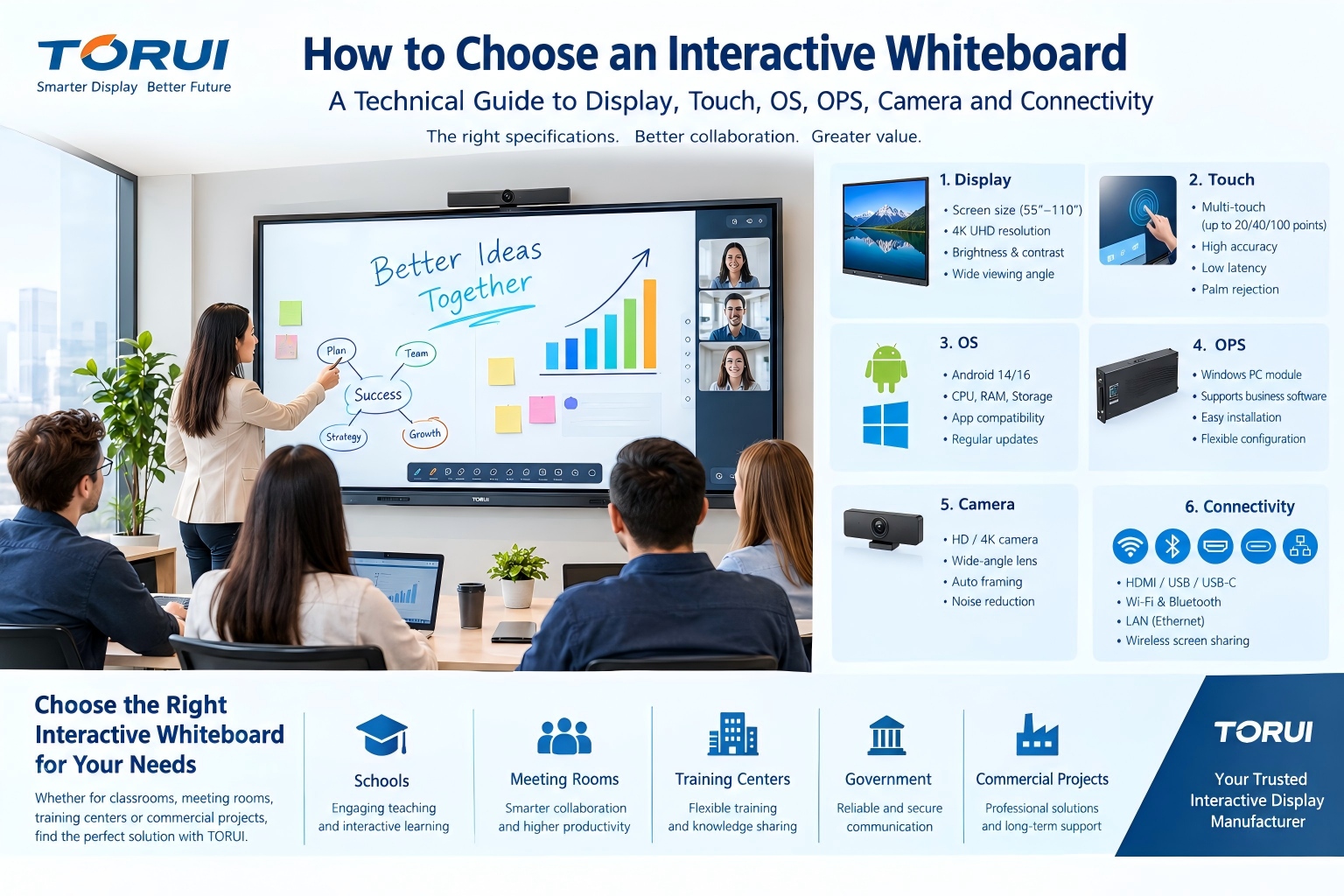
Choosing an interactive whiteboard for a school, meeting room, training center, government organization or commercial project requires more than comparing screen size and price. The most important specifications include display resolution, brightness, touch technology, operating system, processor, memory, storage, OPS compatibility, camera and microphone performance, connectivity, durability and after-sales support.
How to Choose an Interactive Whiteboard: A Technical Guide to Display, Touch, OS, OPS, Camera and Connectivity