
Government Support and Promotion of Education
author: toruitech
2025-09-25

Education is the foundation of national development and a key driver of social progress. Governments worldwide generally recognize that education not only fosters talent but also directly impacts economic development, technological innovation, and national competitiveness. Consequently, countries around the world are increasingly supporting education, demonstrating their high regard for education, from fiscal investment to policymaking.
First, the most direct form of government support is financial investment. Many countries annually include education as a significant component of their budgets, allocating funds for school construction, teacher training, textbook development, and the development of educational informatization. For example, Nordic countries universally implement free education, ensuring that every child has equal access to high-quality learning resources. Some developing countries, through international cooperation and dedicated funding, are introducing advanced educational facilities and concepts to narrow educational disparities between urban and rural areas and across regions.
Second, policy support is also a crucial means of promoting educational development. Governments provide direction for the education system through legislation and policy planning. For example, the United States emphasizes "educational equity" and has enacted numerous laws to protect the right to education for disadvantaged groups. China has adopted an "education modernization" strategy, encouraging the use of smart education and information technology in the classroom. Singapore has implemented a "bilingual policy" in basic education to cultivate globally competitive talent. Different countries formulate policies based on their own national conditions, but the common goal is to improve the quality and equity of education.
Furthermore, government support is also reflected in the development of the teaching workforce. Teachers are the core of education, and many countries enhance their social status and career appeal through training, salary increases, and honor systems. For example, Finland places great emphasis on teacher development, using a rigorous selection and training system to ensure that education quality remains a world leader.
Finally, the digitalization of education has become a key area of support for governments worldwide. With the advancement of technology, more and more countries are investing in smart campuses, promoting the use of devices such as interactive whiteboards, tablets, and online learning platforms, enabling students to learn in more flexible and diverse environments. This not only improves teaching efficiency but also opens up new paths for future educational development.
In short, government support for education encompasses not only financial investment but also institutional guarantees and innovation. Through sustained efforts, educational equity and quality are continuously improving, laying a solid foundation for social progress and long-term national development.
Smart Board Interactive Whiteboard: A Comprehensive Guide
Teaching Equipment Upgrade Solutions
Related Article

Choosing the right interactive whiteboard size is an important decision for distributors, wholesalers, and education technology suppliers. The 65-inch, 75-inch, and 86-inch interactive whiteboards are popular options for classrooms, meeting rooms, training centers, and commercial projects.
65 vs 75 vs 86-Inch Interactive Whiteboard: Which Model Should Distributors Choose?

Choosing the right interactive whiteboard manufacturer in China is an important decision for distributors, wholesalers, education technology suppliers, and system integrators. The right manufacturing partner can help businesses improve product quality, maintain competitive pricing, customize products for local markets, and build a sustainable distribution business.
Who Are the Best Interactive Whiteboard Manufacturers in China for B2B Distributors and Wholesalers?
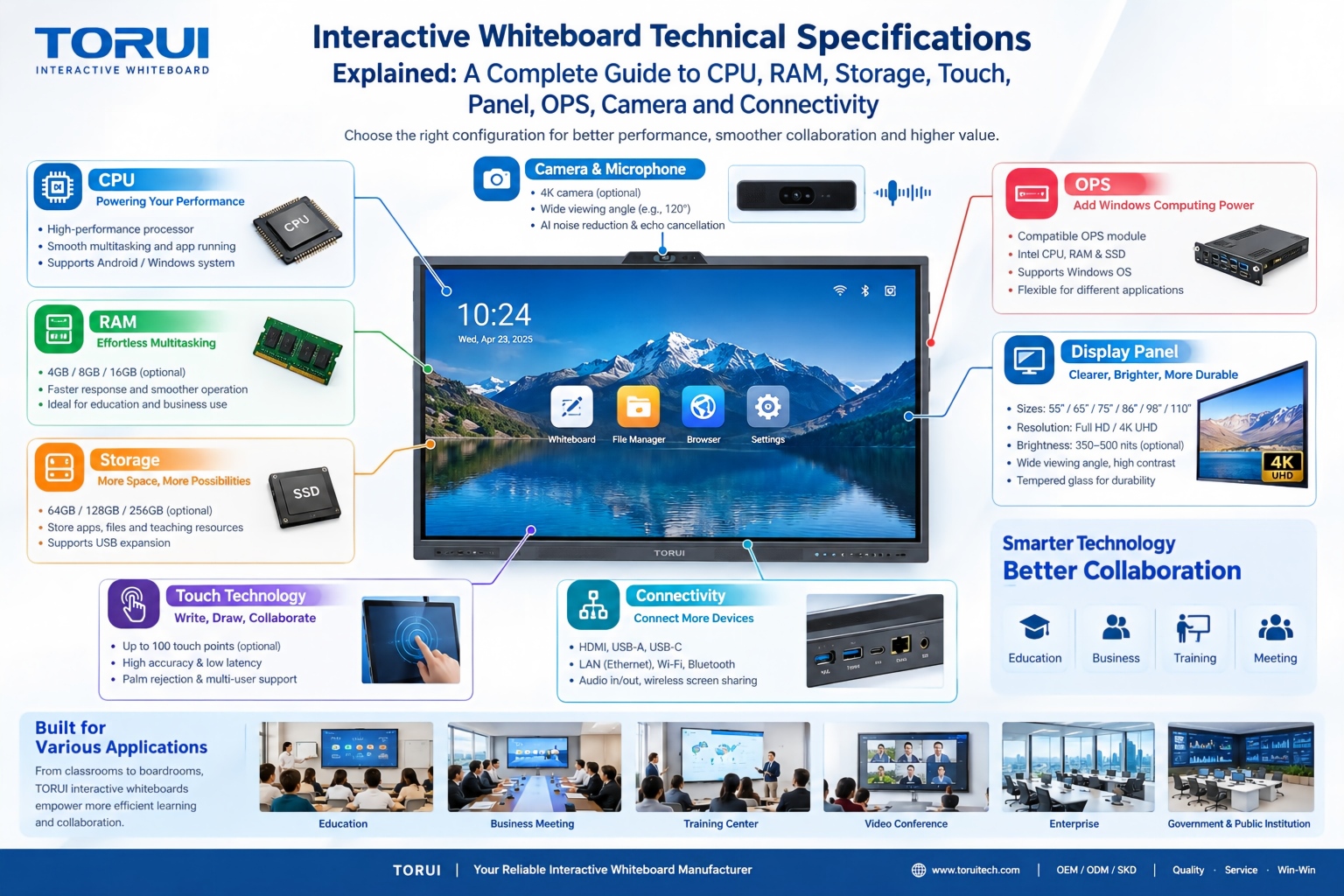
Choosing an interactive whiteboard involves more than comparing screen sizes and prices. For schools, businesses, distributors, wholesalers, and system integrators, understanding the technical specifications is essential to selecting a reliable product that meets different application requirements.
Interactive Whiteboard Technical Specifications Explained: A Complete Guide to CPU, RAM, Storage, Touch, Panel, OPS, Camera and Connectivity
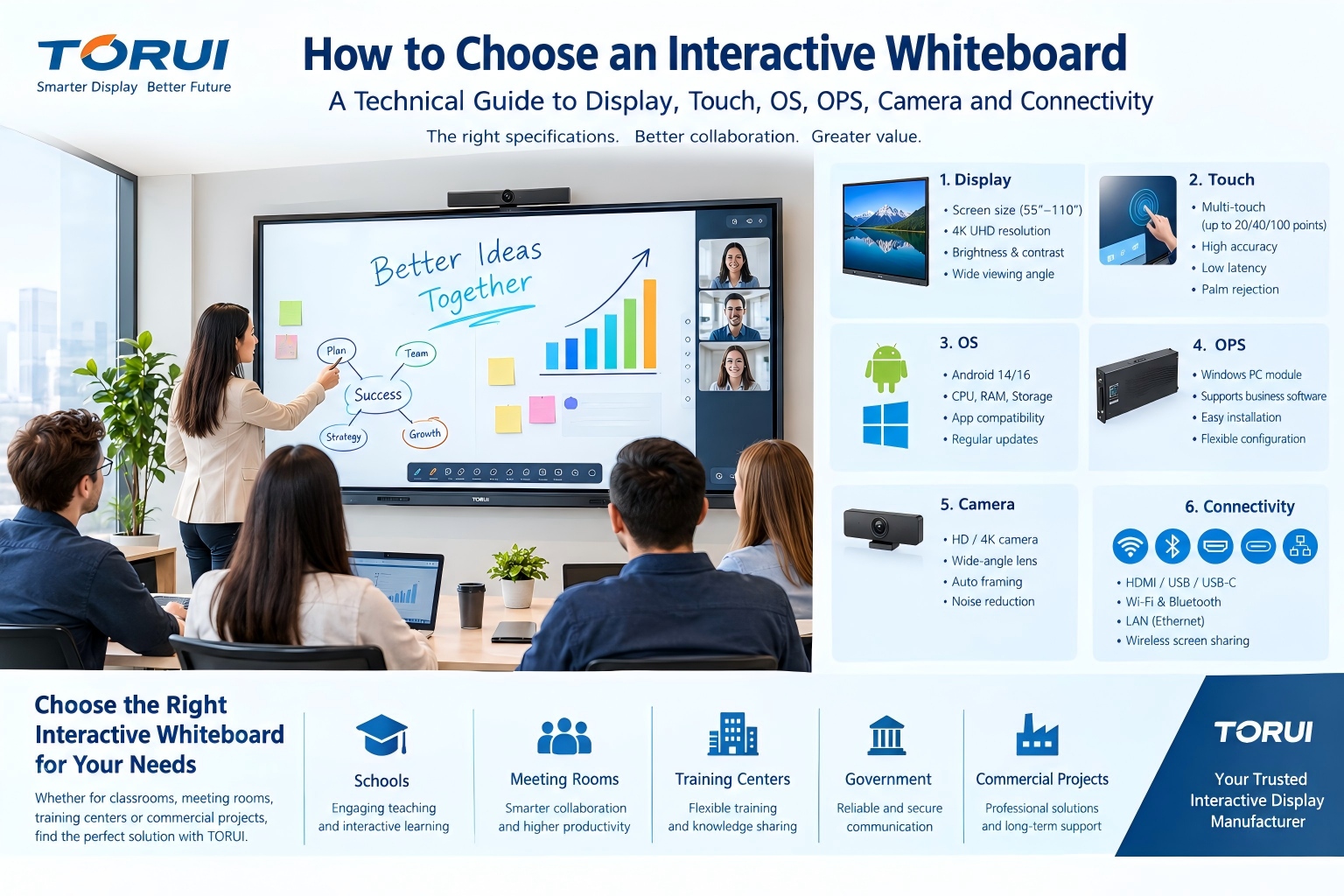
Choosing an interactive whiteboard for a school, meeting room, training center, government organization or commercial project requires more than comparing screen size and price. The most important specifications include display resolution, brightness, touch technology, operating system, processor, memory, storage, OPS compatibility, camera and microphone performance, connectivity, durability and after-sales support.
How to Choose an Interactive Whiteboard: A Technical Guide to Display, Touch, OS, OPS, Camera and Connectivity