
How Interactive Whiteboards Transform Mathematics Teaching
author: toruitech
2025-10-23

Introduction:
In the era of digital education, interactive whiteboards (IWBs) are reshaping how mathematics is taught and learned. By integrating visual tools, real-time feedback, and multimedia interaction, they make lessons more dynamic, understandable, and student-centered.
Visualizing Complex Math Concepts
Interactive whiteboards turn abstract math ideas into visual and dynamic learning experiences. Teachers can use software like GeoGebra to plot graphs, manipulate equations, and animate geometric transformations in real time.
Example: When adjusting a quadratic function’s coefficient, students can instantly see how the parabola changes — improving comprehension of formulas and parameters.
Engaging Students Through Interactive Learning
IWBs promote two-way communication in the classroom. Teachers can run quick polls, drag-and-drop exercises, or problem-solving sessions where students directly interact with the screen.
This boosts student engagement, encourages teamwork, and helps teachers quickly assess understanding.
Integrating Multimedia for Real-World Applications
Through videos, 3D models, and animations, interactive whiteboards help connect mathematics to everyday life and STEM fields.
Example: Rotating 3D models of pyramids or cylinders helps explain surface area and volume — making learning more tangible and relevant.
Saving Lessons and Enabling Continuous Learning
Every whiteboard session can be saved, replayed, and shared online. Students can revisit problem-solving steps anytime, creating a complete learning loop.
This feature supports distance learning and review before exams, strengthening long-term retention.
Building Smart, Data-Driven Classrooms
Modern IWBs connect with cloud-based teaching systems to analyze learning data, track participation, and personalize instruction.
Schools adopting this approach gain insights into student progress and improve teaching strategies using real-time analytics.
Why Math Teachers Prefer Interactive Whiteboards
-
Simplify complex topics with visual demonstrations
-
Improve student participation and collaboration
-
Support hybrid and online learning environments
-
Enable data tracking and performance analysis
Conclusion
Interactive whiteboards are revolutionizing mathematics education by combining visualization, collaboration, and technology. They empower teachers to teach smarter and help students learn with greater confidence and curiosity.
Interactive Whiteboard Applications in Corporate Training and Meetings
Interactive Whiteboard Market Analysis in Europe and North America
Related Article

Choosing the right interactive whiteboard size is an important decision for distributors, wholesalers, and education technology suppliers. The 65-inch, 75-inch, and 86-inch interactive whiteboards are popular options for classrooms, meeting rooms, training centers, and commercial projects.
65 vs 75 vs 86-Inch Interactive Whiteboard: Which Model Should Distributors Choose?

Choosing the right interactive whiteboard manufacturer in China is an important decision for distributors, wholesalers, education technology suppliers, and system integrators. The right manufacturing partner can help businesses improve product quality, maintain competitive pricing, customize products for local markets, and build a sustainable distribution business.
Who Are the Best Interactive Whiteboard Manufacturers in China for B2B Distributors and Wholesalers?
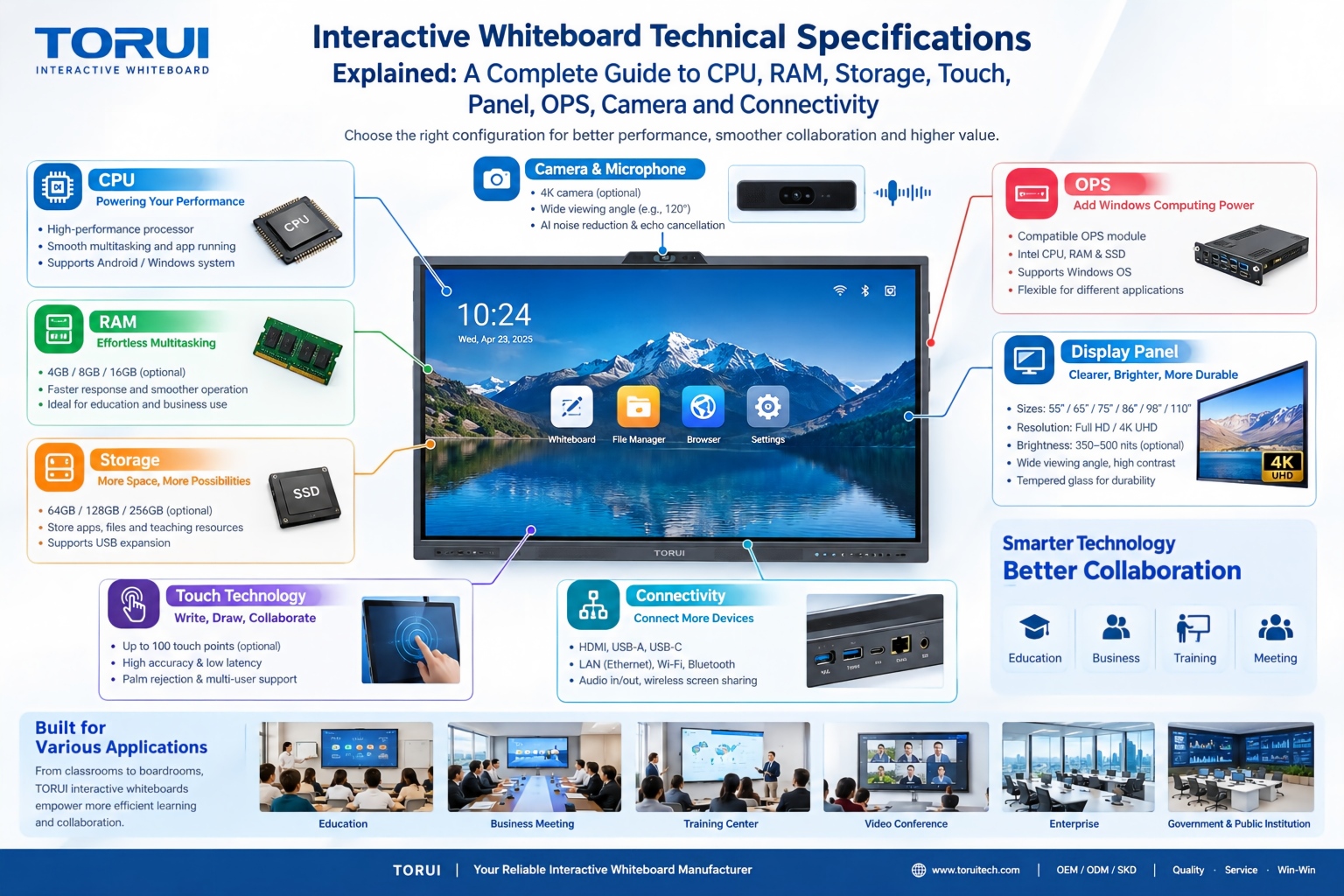
Choosing an interactive whiteboard involves more than comparing screen sizes and prices. For schools, businesses, distributors, wholesalers, and system integrators, understanding the technical specifications is essential to selecting a reliable product that meets different application requirements.
Interactive Whiteboard Technical Specifications Explained: A Complete Guide to CPU, RAM, Storage, Touch, Panel, OPS, Camera and Connectivity
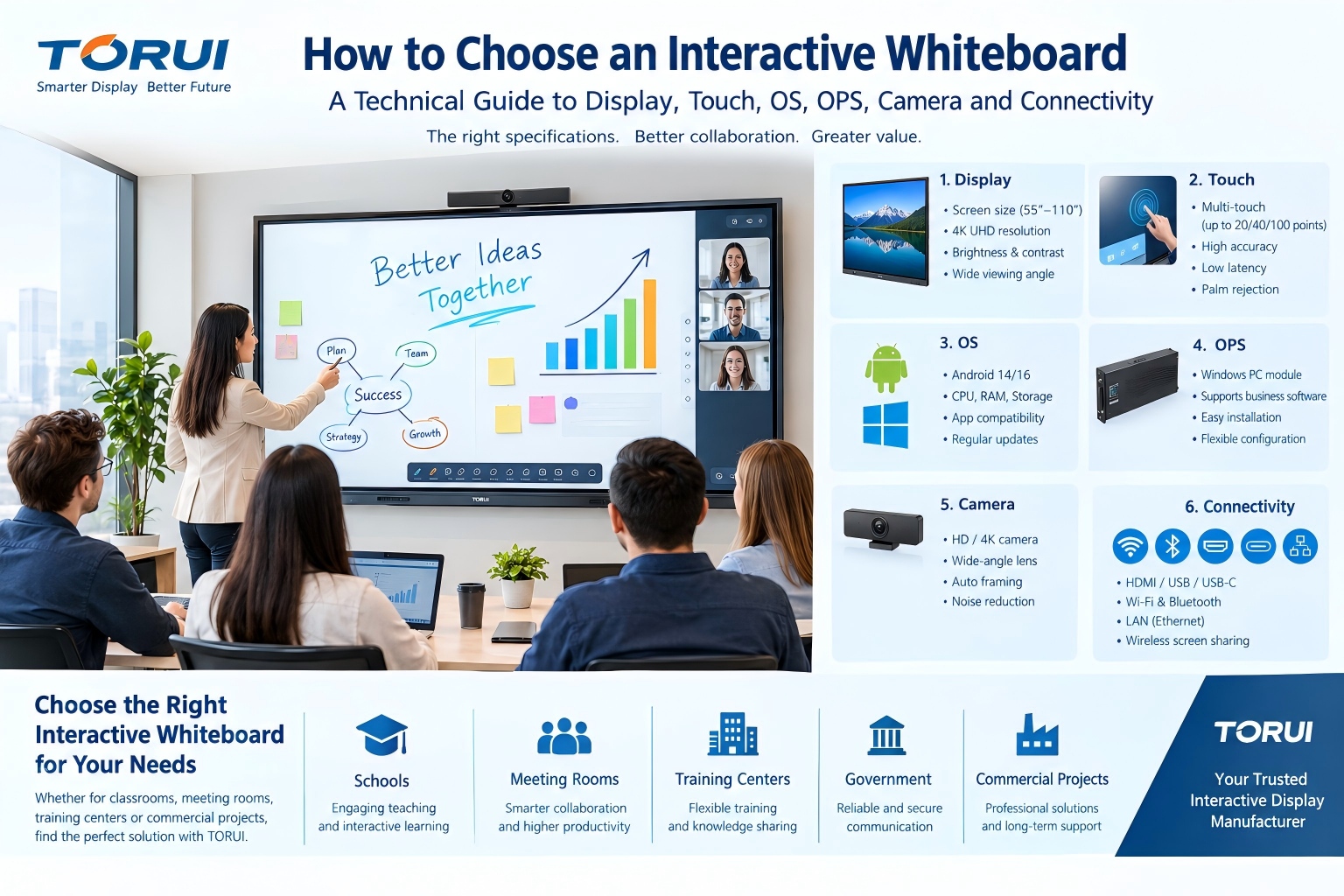
Choosing an interactive whiteboard for a school, meeting room, training center, government organization or commercial project requires more than comparing screen size and price. The most important specifications include display resolution, brightness, touch technology, operating system, processor, memory, storage, OPS compatibility, camera and microphone performance, connectivity, durability and after-sales support.
How to Choose an Interactive Whiteboard: A Technical Guide to Display, Touch, OS, OPS, Camera and Connectivity