How to Choose an Interactive Whiteboard Manufacturer for Your Market: A B2B Buyer’s Guide

Choosing the right interactive whiteboard manufacturer is one of the most important decisions for distributors, wholesalers, system integrators, schools, and commercial technology buyers. The lowest quotation does not always provide the lowest total cost, and a manufacturer with attractive product specifications may not be the right long-term partner for your market.
A reliable interactive whiteboard manufacturer should provide consistent product quality, flexible customization, stable production capacity, certifications, technical support, competitive pricing, and dependable after-sales service.
This B2B buyer’s guide explains the key factors to evaluate before choosing an interactive whiteboard manufacturer, especially when purchasing from China.
1. Check Whether the Supplier Is a Real Manufacturer
The first question is simple: Are you buying directly from a manufacturer or from a trading company?
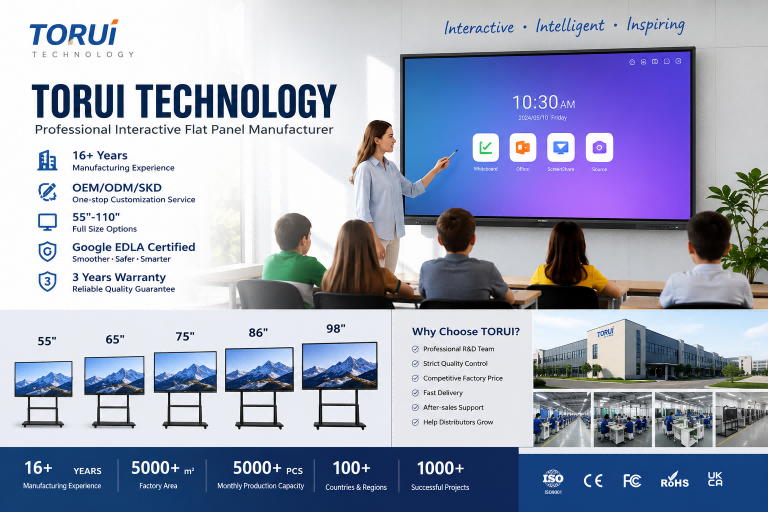
A real interactive whiteboard manufacturer should be able to provide clear information about its factory, production process, quality control, engineering team, product development, and manufacturing capabilities.
Before placing a bulk order, ask the supplier:
-
Where is your factory located?
-
How many years have you manufactured interactive whiteboards?
-
What is your monthly production capacity?
-
Can I visit your factory?
-
Do you support OEM and ODM?
-
Which markets do you currently export to?
Factory transparency is particularly important for distributors and system integrators because a long-term supply relationship requires more than a competitive initial quotation.
2. Evaluate Manufacturing Experience
Manufacturing experience is an important indicator, but it should not be evaluated by years alone.
An experienced interactive whiteboard manufacturer should understand the complete product lifecycle, including hardware selection, assembly, software integration, touch performance, quality inspection, packaging, shipping, installation, and after-sales support.
For example, TORUI has more than 16 years of interactive whiteboard manufacturing experience and focuses on OEM/ODM cooperation for international B2B customers.
When comparing suppliers, look for evidence of actual manufacturing experience rather than relying only on statements such as “professional supplier” or “leading factory.”
3. Compare Product Specifications Carefully
Two interactive whiteboards can have the same screen size but significantly different performance.
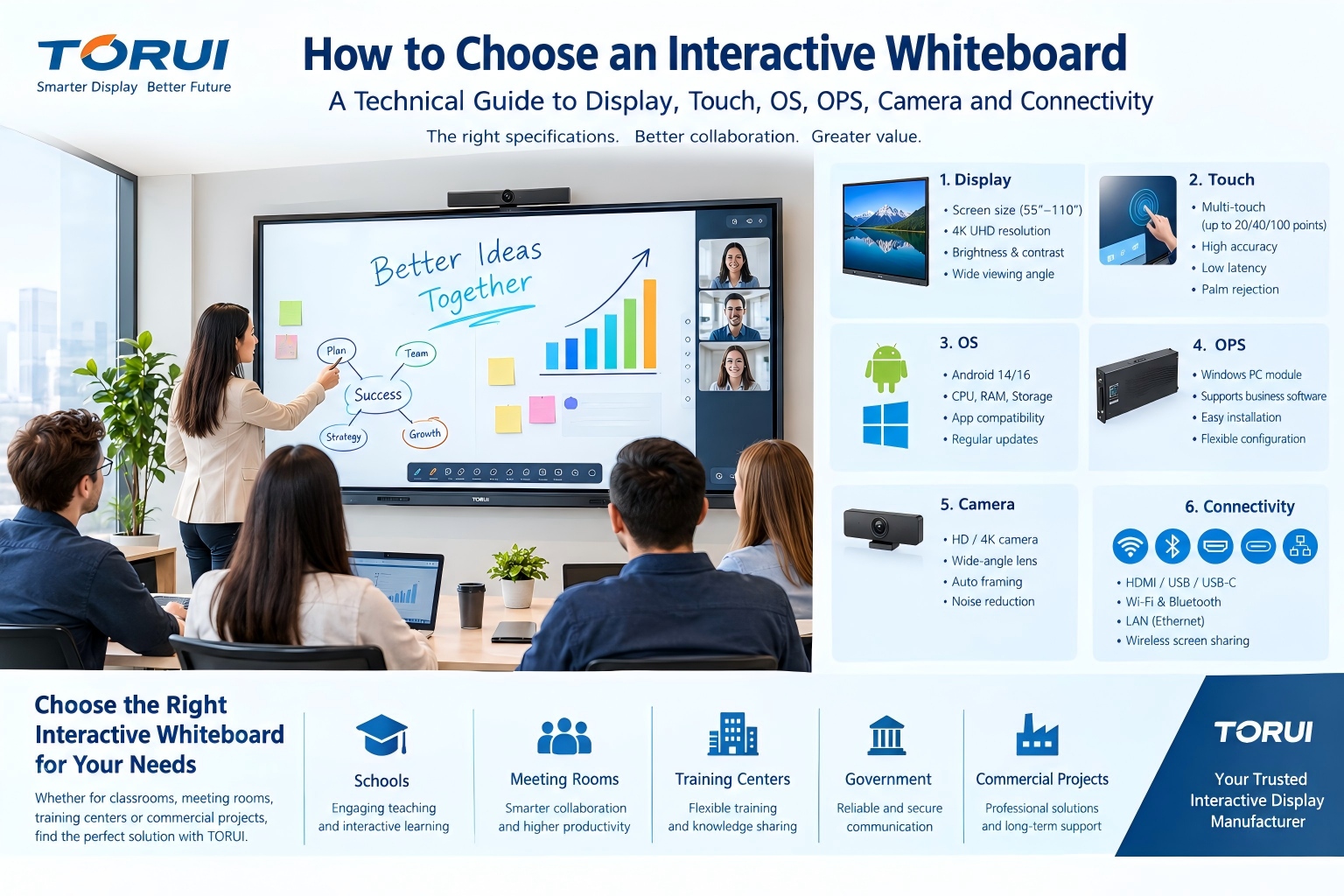
B2B buyers should compare at least the following specifications:
-
Screen size
-
Resolution
-
Brightness
-
Contrast
-
Touch technology
-
Number of touch points
-
Writing latency
-
Processor
-
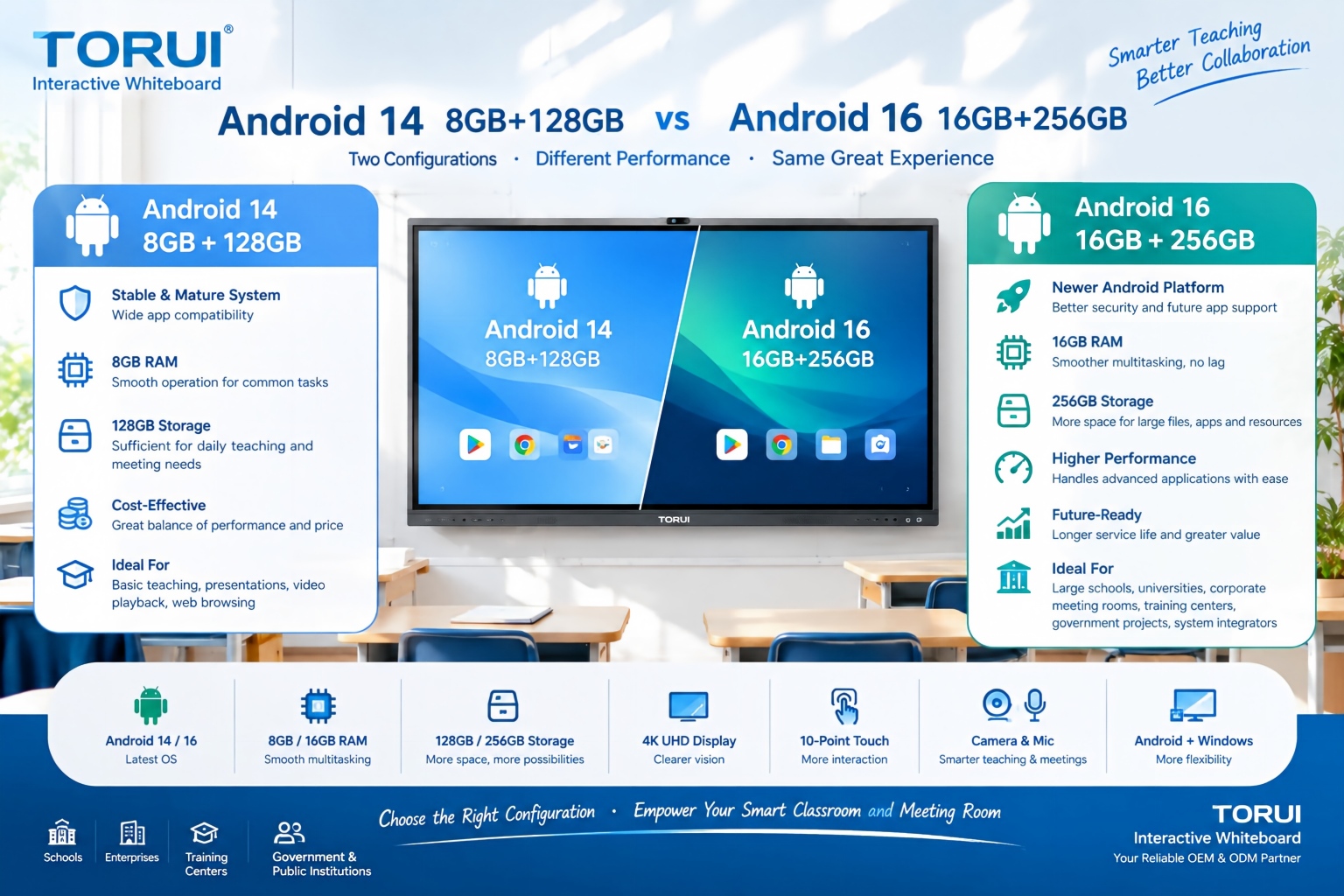
RAM and storage
-
Operating system
-
Camera and microphone
-
Speakers
-
Wi-Fi and Bluetooth
-
HDMI, USB and other interfaces
-
OPS compatibility
-
Android and Windows compatibility
For example, a school may prioritize smooth writing and classroom software compatibility, while a corporate customer may care more about video conferencing, camera quality, microphones, wireless presentation, and meeting-room integration.
Therefore, the best interactive whiteboard is not necessarily the one with the highest specification. It is the model that best matches the application and target market.
4. Check Quality Control Before Ordering
Quality control is one of the most important factors in bulk interactive whiteboard procurement.
A professional manufacturer should have inspection procedures covering components, assembly, display quality, touch performance, software stability, connectivity, audio, thermal performance, and final product inspection.
Ask the supplier:
What tests are performed before shipment?
A strong quality-control process may include:
-
Incoming component inspection
-
Display inspection
-
Touch accuracy testing
-
Writing performance testing
-
Interface testing
-
Audio testing
-
Camera and microphone testing
-
Software stability testing
-
Aging testing
-
Final quality inspection
-
Packaging inspection
-
Pre-shipment inspection
For large orders, buyers should also consider third-party inspection or an agreed factory inspection procedure.
5. Verify Certifications for Your Target Market
Certification requirements vary by country and application.
Depending on the destination market, buyers may need certifications or compliance documentation such as CE, FCC, RoHS, CCC, or other local requirements.
Do not simply ask, “Do you have certificates?”
Instead, ask the manufacturer to provide the actual certificates and corresponding product information.
You should also confirm whether the certification applies to the exact model you intend to purchase.
This is especially important for distributors importing products into regulated markets because missing or incorrect compliance documentation can create customs, sales, or after-sales problems.
6. Consider OEM and ODM Capabilities
For distributors and private-label businesses, OEM and ODM capability can be a major competitive advantage.
OEM services may include:
-
Company logo
-
Customized packaging
-
User manuals
-
Product labels
-
Boot animation
-
Software settings
-
Accessories
ODM can go further by allowing customers to customize hardware configurations, appearance, functions, or product specifications according to specific market requirements.
Before cooperation, ask about MOQ, customization costs, development time, sample approval, packaging requirements, and production lead time.
A manufacturer that understands OEM/ODM can become more than a supplier—it can become a long-term product development partner.
7. Evaluate Production Capacity and Delivery Reliability
Price is important, but delivery reliability can be even more important for distributors.
If your business receives a large school project or government procurement order, the manufacturer must be able to deliver the required quantity consistently.
Ask for information about:
-
Monthly production capacity
-
Current production schedule
-
Standard lead time
-
Peak-season capacity
-
Component availability
-
Quality inspection time
-
Packaging capability
You should also ask how the manufacturer handles urgent orders or unexpected increases in demand.
A supplier that can provide a low quotation but cannot maintain stable delivery may create higher costs for your business.
8. Understand Warranty and After-Sales Support
Interactive whiteboards are electronic products, so after-sales service should be considered before placing an order.
Ask the manufacturer:
-
What is the standard warranty period?
-
What parts are covered?
-
How are defective units handled?
-
Is remote technical support available?
-
Can the manufacturer provide installation guidance?
-
Are spare parts available?
-
How quickly can technical problems be resolved?
For distributors, good after-sales support can reduce service costs and protect relationships with local customers.
9. Compare Total Cost, Not Just Unit Price
The cheapest quotation is not necessarily the best deal.
Your actual purchasing cost may include:
Product price + customization + accessories + packaging + inspection + spare parts + shipping + warranty cost + after-sales cost.
A manufacturer with slightly higher unit pricing may provide better components, lower defect rates, stronger packaging, and better technical support.
Therefore, B2B buyers should compare the total cost of ownership, not simply the FOB unit price.
10. Choose a Manufacturer That Fits Your Market
Different markets require different interactive whiteboard strategies.
A distributor serving schools may need reliable 65-inch, 75-inch, or 86-inch models with strong classroom functionality.
A corporate AV integrator may need large displays, cameras, microphones, wireless presentation, and video-conferencing integration.
A wholesaler may prioritize competitive pricing, standardized models, stable supply, and fast delivery.
A government project may place greater emphasis on certifications, documentation, durability, and long-term support.
The right manufacturer should therefore be able to recommend suitable configurations instead of simply selling the same product to every customer.
Final Checklist: 10 Questions to Ask an Interactive Whiteboard Manufacturer
Before choosing your supplier, ask these ten questions:
-
Are you a direct manufacturer?
-
How many years of manufacturing experience do you have?
-
What is your monthly production capacity?
-
Which interactive whiteboard sizes and configurations do you offer?
-
What quality-control tests do you perform?
-
Which certifications are available?
-
Do you support OEM and ODM?
-
What is your MOQ and standard lead time?
-
What warranty and technical support do you provide?
-
Can I visit your factory or inspect production before placing a bulk order?
Conclusion
Choosing an interactive whiteboard manufacturer should be based on more than price. A reliable B2B supplier should combine manufacturing experience, consistent quality, competitive specifications, production capacity, certification support, OEM/ODM flexibility, delivery reliability, and responsive after-sales service.
For distributors, wholesalers, schools, and system integrators, the best supplier is the one that can support your current project and future market growth.
Before placing a large order, compare at least three manufacturers, request samples, verify certifications, evaluate quality-control procedures, and clarify warranty and customization terms.
A careful supplier evaluation at the beginning can significantly reduce product risk, service costs, and supply-chain problems later.
15 B2B FAQs About Choosing an Interactive Whiteboard Manufacturer
1. What should I look for in an interactive whiteboard manufacturer?
Look for a manufacturer with proven production experience, stable quality control, relevant certifications, OEM/ODM capabilities, reliable delivery, technical support, and responsive after-sales service. Factory transparency is also important for long-term B2B cooperation.
2. Is it better to buy interactive whiteboards directly from a manufacturer?
Buying directly from a manufacturer can provide better communication, customization flexibility, production visibility, and supply-chain efficiency. However, buyers should verify factory capabilities, product quality, certifications, warranty terms, and export experience before placing an order.
3. How do I verify whether an interactive whiteboard supplier is a real factory?
Ask for factory photos, production-line information, business and certification documents, production capacity, product samples, and OEM/ODM examples. A factory visit or video inspection can provide additional evidence of actual manufacturing capabilities.
4. What certifications should an interactive whiteboard manufacturer provide?
Certification requirements depend on the destination market and product configuration. Common certifications may include CE, FCC, RoHS, and CCC. Buyers should request the actual certificates and verify that they apply to the exact model being purchased.
5. What quality checks should be performed before buying interactive whiteboards in bulk?
Bulk buyers should check display quality, touch accuracy, writing performance, operating-system stability, ports, audio, camera, microphone, wireless connectivity, thermal performance, aging tests, packaging, and final inspection procedures before shipment.
6. What is the difference between OEM and ODM for interactive whiteboards?
OEM generally means producing interactive whiteboards according to the customer's branding or specified requirements. ODM can involve deeper customization of product design, hardware configuration, appearance, functions, or software. The exact scope depends on the manufacturer's capabilities.
7. What interactive whiteboard sizes are commonly used in schools?
Common sizes include 65, 75, and 86 inches, although the ideal size depends on classroom dimensions, viewing distance, student numbers, and installation conditions. Larger models such as 98 or 110 inches may be suitable for larger teaching spaces.
8. What interactive whiteboard specifications should B2B buyers compare?
Key specifications include screen size, resolution, brightness, touch technology, touch points, writing latency, processor, RAM, storage, operating system, connectivity, camera, microphone, speakers, and OPS compatibility. Buyers should compare complete configurations rather than one specification.
9. What is the typical MOQ for interactive whiteboard OEM orders?
MOQ varies by manufacturer, product model, customization level, packaging requirements, and market. Standard products may have lower MOQs, while customized hardware, software, packaging, or appearance can require higher quantities.
10. How long does it take to manufacture an interactive whiteboard order?
Lead time depends on model availability, order quantity, customization requirements, component availability, and production schedules. Standard products are usually faster than customized OEM/ODM projects, so buyers should confirm the production schedule before issuing a purchase order.
11. What warranty should I expect from an interactive whiteboard manufacturer?
Warranty terms vary between manufacturers and markets. Buyers should confirm the warranty period, covered components, replacement or repair procedures, technical support, spare-parts policy, and exclusions in writing before placing a bulk order.
12. Can an interactive whiteboard manufacturer customize the logo and packaging?
Yes. Many OEM manufacturers can customize logos, product labels, packaging, user manuals, boot animations, and selected software settings. The available options, MOQ, costs, and lead time should be confirmed before production.
13. How should distributors choose an interactive whiteboard supplier?
Distributors should evaluate product quality, market positioning, pricing, customization, production capacity, certifications, delivery reliability, warranty, spare parts, and after-sales support. The supplier should also be able to maintain consistent quality as order volumes increase.
14. How should system integrators evaluate an interactive whiteboard manufacturer?
System integrators should focus on hardware compatibility, software integration, connectivity, OPS support, camera and microphone performance, wireless presentation, technical documentation, customization capabilities, and long-term technical support.
15. What questions should I ask before placing a bulk interactive whiteboard order?
Ask about product configuration, MOQ, unit price, OEM/ODM options, certifications, production lead time, packaging, payment terms, inspection procedures, shipping terms, warranty, spare parts, and after-sales support. Confirm all critical specifications in the quotation or purchase contract.
How to Choose an Interactive Whiteboard: A Technical Guide to Display, Touch, OS, OPS, Camera and Connectivity
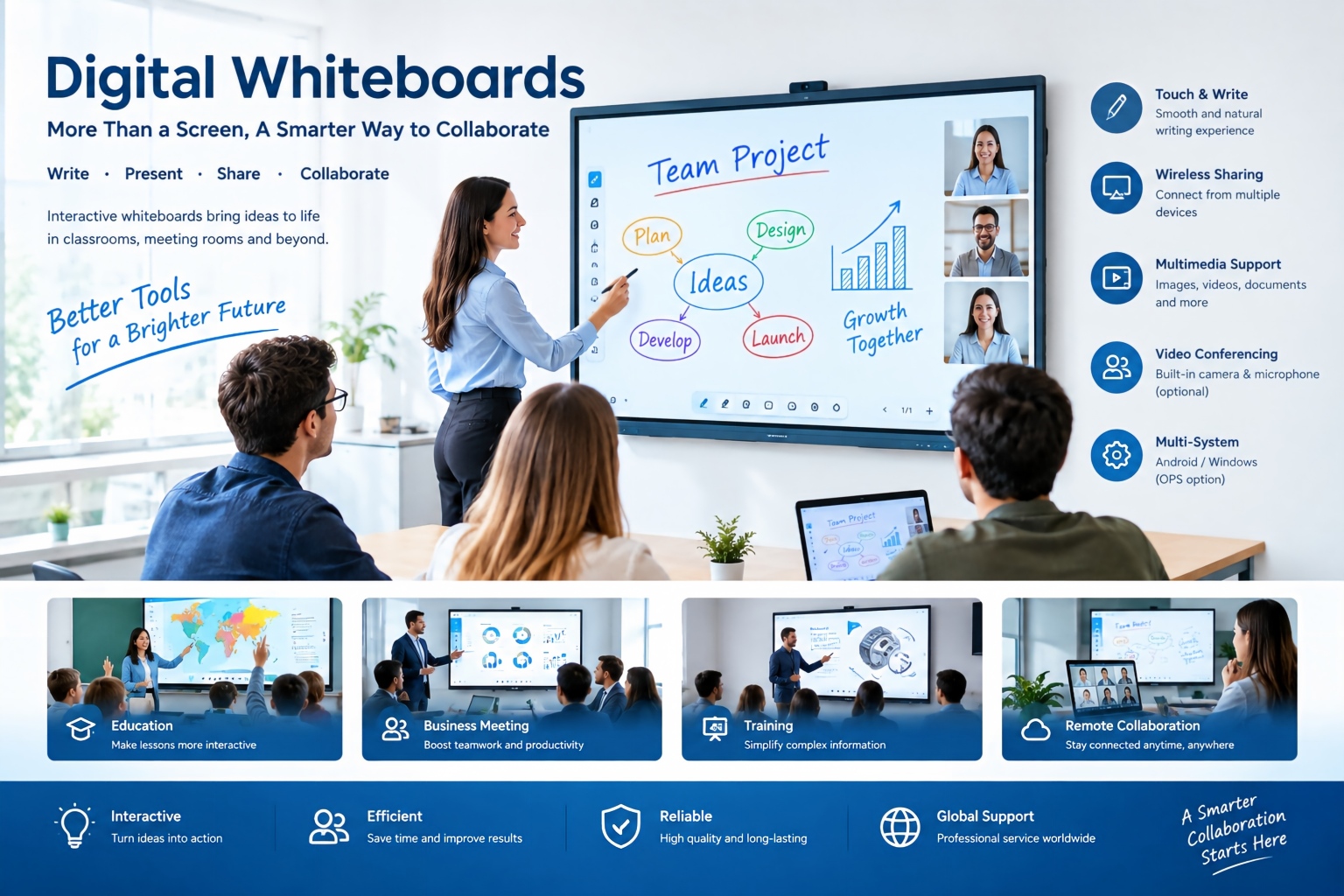
How to Choose an Interactive Whiteboard for Schools, Meeting Rooms and Business Use
Related Article