
interactive display software
author: toruitech
2025-09-12

interactive display software
Interactive display software (IDS) is an indispensable tool in modern education and corporate offices. By integrating with hardware such as interactive tablets and electronic whiteboards, it provides users with more intuitive and efficient communication and collaboration methods. Compared to traditional presentation software, it not only displays text and graphics but also emphasizes touch-based operation, real-time interaction, and resource sharing, thereby comprehensively improving teaching and work efficiency.
In educational settings, interactive display software allows teachers to easily annotate, draw, and demonstrate. For example, teachers can directly mark up courseware, play audio and video, and even engage students in class discussions through group interaction. This real-time interactive approach makes the classroom atmosphere more lively and increases student engagement. Furthermore, some software offers lesson recording and playback functions, facilitating post-class review and enabling teachers to optimize their lessons. This demonstrates that it not only improves classroom efficiency but also promotes personalized learning.
Interactive display software also plays a vital role in enterprise applications. It seamlessly integrates with common video conferencing platforms (such as Zoom and Microsoft Teams) and office documents (such as PowerPoint, Word, and PDF), enabling wireless screen projection, multi-person collaborative annotation, and remote file sharing. This functionality significantly enhances meeting interactivity and decision-making efficiency, making it particularly suitable for cross-regional, multi-team collaboration.
Furthermore, excellent interactive display software prioritizes ease of use and compatibility. Its intuitive interface reduces the learning curve, making it easy for even non-technical users to quickly master it. Furthermore, the software typically supports multiple platforms, including Windows, Android, and cloud-based systems, ensuring smooth operation across various devices and environments.
Overall, interactive display software, integrating high-definition presentations, real-time interaction, and multi-device collaboration, fully meets the diverse needs of teaching and office work. When choosing, users should prioritize feature richness, system compatibility, and after-sales support to ensure long-term value and an optimal experience.
Interactive Digital Whiteboard
interactive flat panel display
Related Article
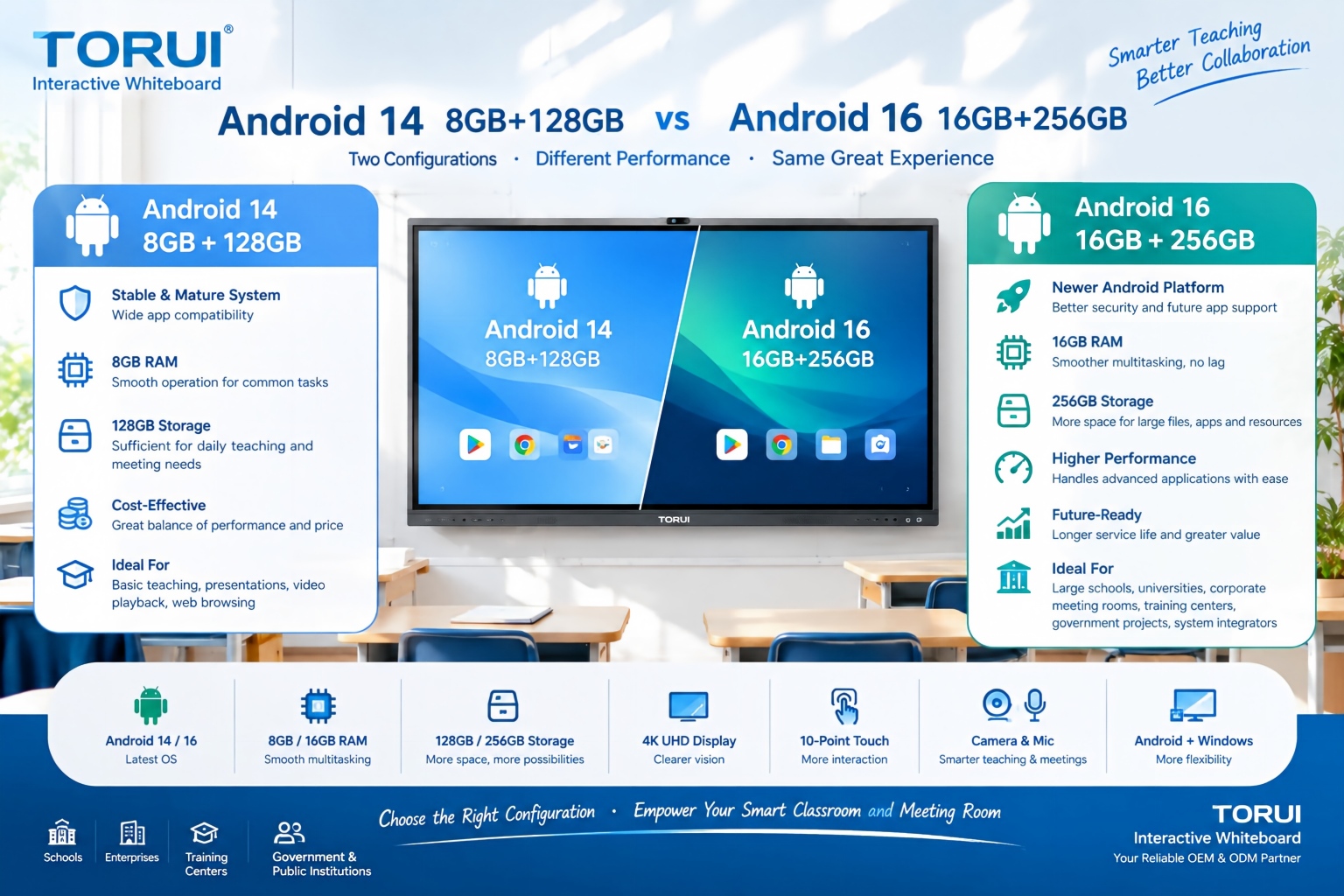
When choosing an interactive whiteboard for a school, training center, meeting room, or commercial project, the Android version and hardware configuration can significantly affect user experience. Two common configurations are Android 14 with 8GB RAM and 128GB storage and Android 16 with 16GB RAM and 256GB storage.
Android 14 8GB+128GB vs Android 16 16GB+256GB: Which Interactive Whiteboard Is Better?

Buying an interactive whiteboard is not simply about choosing the right screen size, resolution, or operating system. For B2B buyers, distributors, system integrators, schools, and corporate procurement teams, quality control is one of the most important factors affecting long-term reliability, user experience, warranty costs, and customer satisfaction.
Interactive Whiteboard Quality Control: What Should Buyers Check?
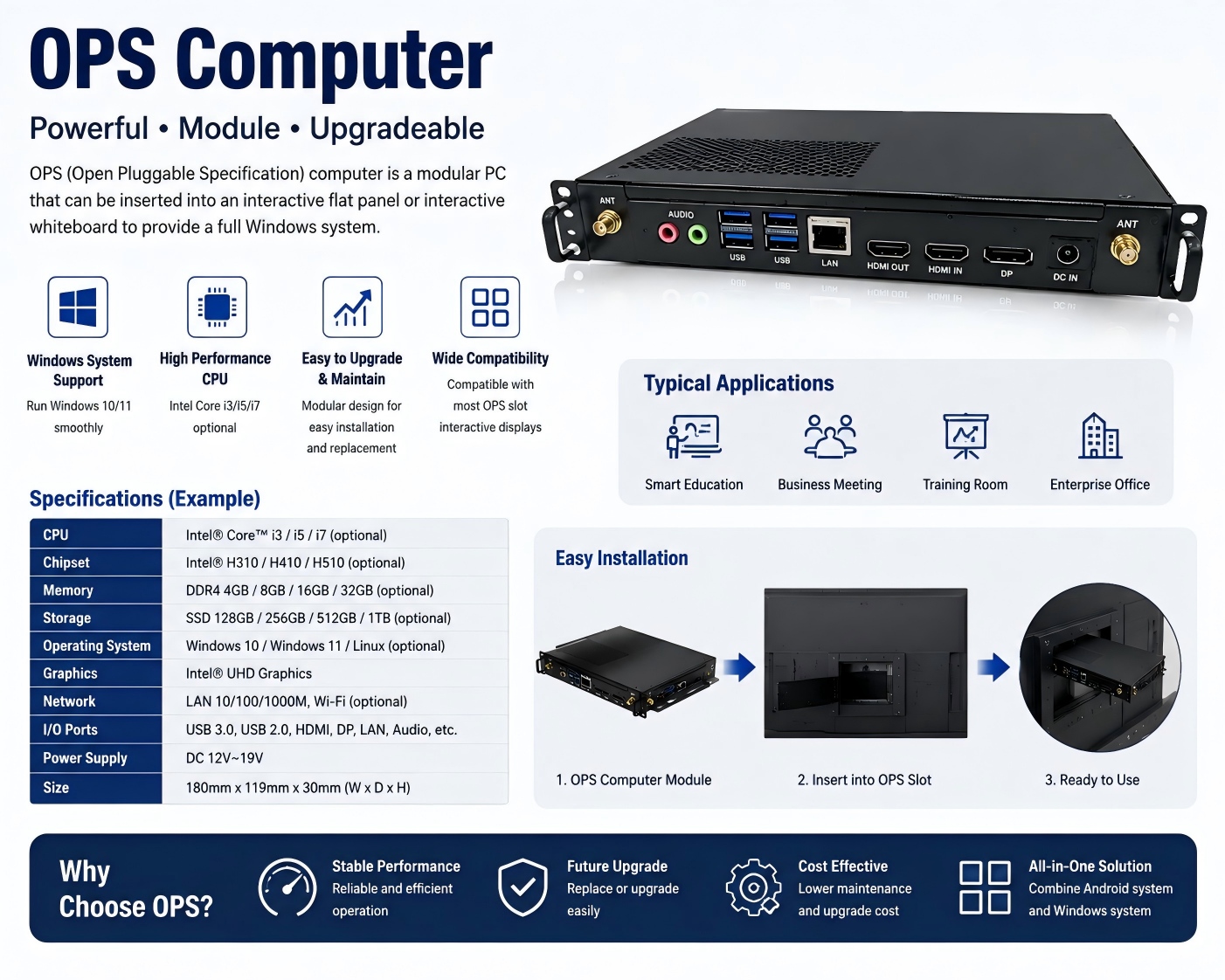
An OPS computer for an interactive whiteboard is a modular plug-in PC designed to add Windows-based computing power to an interactive display. OPS stands for Open Pluggable Specification, a standardized form factor originally developed for commercial interactive displays.
What Is an OPS Computer for Interactive Whiteboards?

Choosing the right chipset is an important decision when sourcing an interactive whiteboard for schools, conference rooms, training centers, government projects, or commercial applications. Among Rockchip platforms, RK3588 and RK3576 are two powerful options for modern Android interactive displays.
RK3588 vs RK3576: Which Chip Is Better for Interactive Whiteboards?