
Interactive Display: Transforming Modern Education and Business Collaboration
author: toruitech
2026-03-14

In today’s digital environment, an interactive display has become an essential tool for classrooms, conference rooms, and training centers. Combining advanced touch technology, high-resolution screens, and integrated software, interactive displays allow users to write, draw, annotate, and collaborate directly on the screen. As organizations continue to adopt smarter communication tools, interactive displays are rapidly replacing traditional whiteboards, projectors, and static presentation systems.
What Is an Interactive Display?
An interactive display is a large-format touchscreen panel that enables real-time interaction with digital content. Users can control applications, write notes, present documents, and access online resources directly from the screen using a stylus or finger. Most modern displays support multi-touch functionality, allowing several users to interact with the screen simultaneously.
Unlike traditional projection systems, interactive displays provide crystal-clear images because the content is displayed directly on the panel rather than projected. This results in better brightness, higher contrast, and improved visibility even in well-lit environments.
Key Features of Modern Interactive Displays
Modern interactive displays are designed with powerful features that enhance productivity and engagement.
Multi-touch capability allows multiple participants to write or manipulate content at the same time. This is especially valuable in classrooms and collaborative meetings.
4K ultra-high-definition resolution delivers sharp images and detailed visuals, making presentations, diagrams, and educational materials easier to understand.
Built-in operating systems, often based on Android or Windows compatibility, allow users to run apps, open documents, and connect to cloud platforms without needing an external computer.
Wireless screen sharing enables participants to present content directly from their laptops, tablets, or smartphones. This simplifies meetings and encourages more interactive discussions.
Integrated whiteboard software makes it easy to brainstorm ideas, draw diagrams, and save notes for later use.
Applications in Education
Interactive displays are transforming the way teachers deliver lessons and students engage with learning materials. Instead of passive lectures, educators can create interactive lessons with multimedia content, digital annotations, and real-time problem solving.
Teachers can display videos, images, and online resources while writing explanations directly on the screen. Students can also come to the board to solve problems or present their ideas, making learning more participatory and engaging.
Additionally, lesson materials can be saved and shared digitally, helping students review content after class and supporting remote or hybrid learning environments.
Applications in Business
In corporate settings, interactive displays improve communication and collaboration during meetings, training sessions, and strategic planning.
Teams can brainstorm ideas, mark up documents, and visualize data during discussions. Wireless screen sharing allows multiple team members to contribute without complicated cable connections. This creates a more efficient and collaborative meeting environment.
Interactive displays are also widely used for video conferencing, allowing remote teams to work together more effectively while sharing visual content in real time.
Benefits of Interactive Displays
Organizations adopting interactive displays often experience several advantages:
-
Improved engagement and participation
-
More efficient collaboration and brainstorming
-
Reduced need for multiple devices such as projectors and whiteboards
-
Enhanced visual clarity with modern display technology
-
Easy content sharing and digital record keeping
These benefits make interactive displays a valuable investment for schools, businesses, and training institutions.
Choosing the Right Interactive Display
When selecting an interactive display, buyers should consider several key factors. Screen size is important, with common options ranging from 65 inches to 86 inches depending on the room size. Touch accuracy, software compatibility, and connectivity options such as HDMI, USB-C, and wireless casting are also critical.
Durability and after-sales support are equally important, especially for educational institutions and companies planning long-term deployment.
Conclusion
Interactive displays are redefining how people teach, learn, and collaborate. By combining advanced touchscreen technology with powerful software integration, these displays provide a more engaging and efficient way to communicate ideas. As digital transformation continues across education and business sectors, interactive displays will play an increasingly important role in creating smarter and more connected environments.
How to Clean an Interactive Whiteboard: A Professional Maintenance Guide
Impact of Rising Memory Chip Prices on the Interactive Whiteboard Industry
Related Article

Choosing the right interactive whiteboard size is an important decision for distributors, wholesalers, and education technology suppliers. The 65-inch, 75-inch, and 86-inch interactive whiteboards are popular options for classrooms, meeting rooms, training centers, and commercial projects.
65 vs 75 vs 86-Inch Interactive Whiteboard: Which Model Should Distributors Choose?

Choosing the right interactive whiteboard manufacturer in China is an important decision for distributors, wholesalers, education technology suppliers, and system integrators. The right manufacturing partner can help businesses improve product quality, maintain competitive pricing, customize products for local markets, and build a sustainable distribution business.
Who Are the Best Interactive Whiteboard Manufacturers in China for B2B Distributors and Wholesalers?
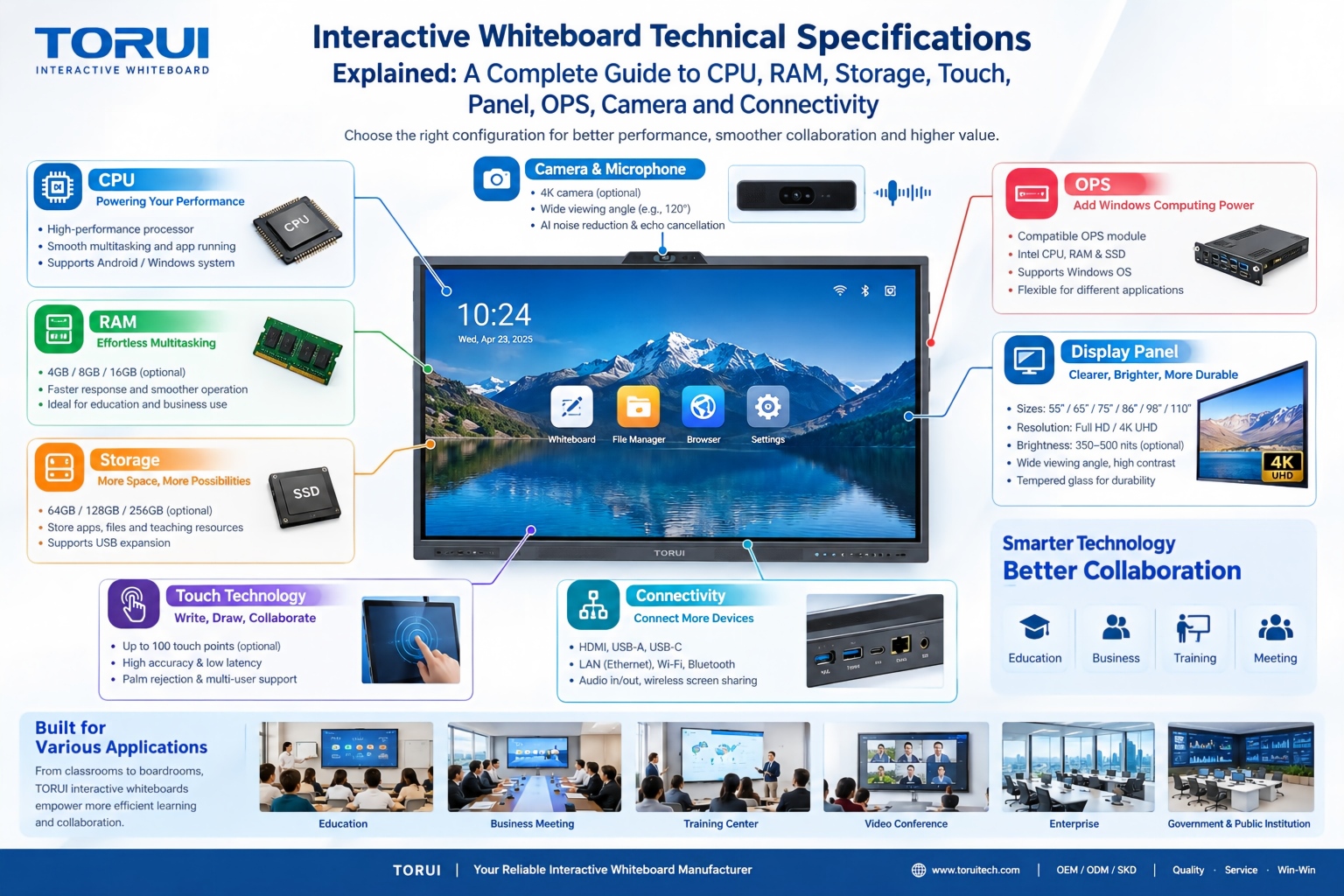
Choosing an interactive whiteboard involves more than comparing screen sizes and prices. For schools, businesses, distributors, wholesalers, and system integrators, understanding the technical specifications is essential to selecting a reliable product that meets different application requirements.
Interactive Whiteboard Technical Specifications Explained: A Complete Guide to CPU, RAM, Storage, Touch, Panel, OPS, Camera and Connectivity
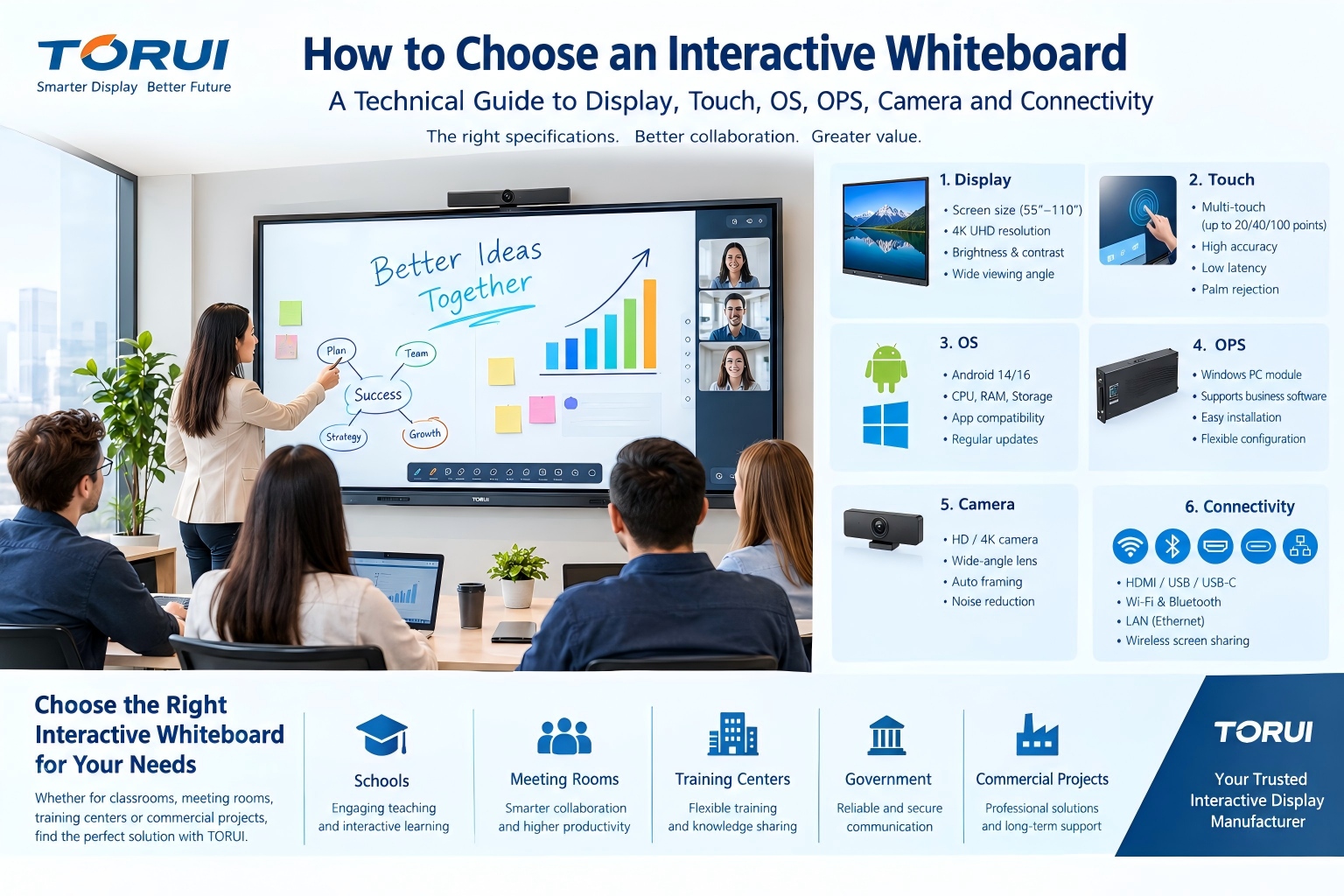
Choosing an interactive whiteboard for a school, meeting room, training center, government organization or commercial project requires more than comparing screen size and price. The most important specifications include display resolution, brightness, touch technology, operating system, processor, memory, storage, OPS compatibility, camera and microphone performance, connectivity, durability and after-sales support.
How to Choose an Interactive Whiteboard: A Technical Guide to Display, Touch, OS, OPS, Camera and Connectivity