
interactive flat panel display
author: toruitech
2025-09-11

Interactive flat panel displays (IFPDs) are intelligent terminal devices that integrate high-definition display, touch interaction, and multimedia processing. They are widely used in education, business, and public information display. Compared with traditional projectors or electronic whiteboards, IFPDs offer significant advantages in clarity, interactivity, and ease of use, effectively improving teaching and office efficiency.
First, their core advantage is display quality. Most interactive flat panels feature 4K ultra-high-definition screens with anti-glare and high brightness, ensuring crisp images even in bright sunlight and accurate presentation of text, images, and videos. This feature is particularly important in classroom teaching, business presentations, or remote training, facilitating efficient information delivery.
Second, touch performance significantly enhances the interactive experience. IFPDs generally utilize infrared or capacitive touch technology, supporting multi-touch and precise writing, allowing users to annotate, erase, and zoom directly on the screen. The ability to support multiple simultaneous operations enhances student engagement and promotes team collaboration and discussion.
In terms of functionality and compatibility, IFPDs typically come with Windows or Android operating systems built-in, seamlessly integrating with office software, teaching platforms, and video conferencing tools such as Zoom and Teams. They also support wireless screen projection, remote collaboration, and file sharing, meeting the diverse application needs of education and enterprises.
Further advantages include ease of use and integration. Most devices are equipped with speakers, microphones, and cameras, reducing reliance on external devices. The intuitive and simple user interface allows users to quickly get started without extensive training.
In summary, interactive flat panel displays, with their high-definition display, sensitive touch, and wide compatibility, provide efficient and intuitive solutions for education and enterprises. When purchasing, users should focus on display quality, touch sensitivity, system compatibility, and after-sales support to ensure long-term stable operation and maximize the value of the device.
interactive display software
interactive whiteboards in the classroom
Related Article

Choosing the right interactive whiteboard size is an important decision for distributors, wholesalers, and education technology suppliers. The 65-inch, 75-inch, and 86-inch interactive whiteboards are popular options for classrooms, meeting rooms, training centers, and commercial projects.
65 vs 75 vs 86-Inch Interactive Whiteboard: Which Model Should Distributors Choose?

Choosing the right interactive whiteboard manufacturer in China is an important decision for distributors, wholesalers, education technology suppliers, and system integrators. The right manufacturing partner can help businesses improve product quality, maintain competitive pricing, customize products for local markets, and build a sustainable distribution business.
Who Are the Best Interactive Whiteboard Manufacturers in China for B2B Distributors and Wholesalers?
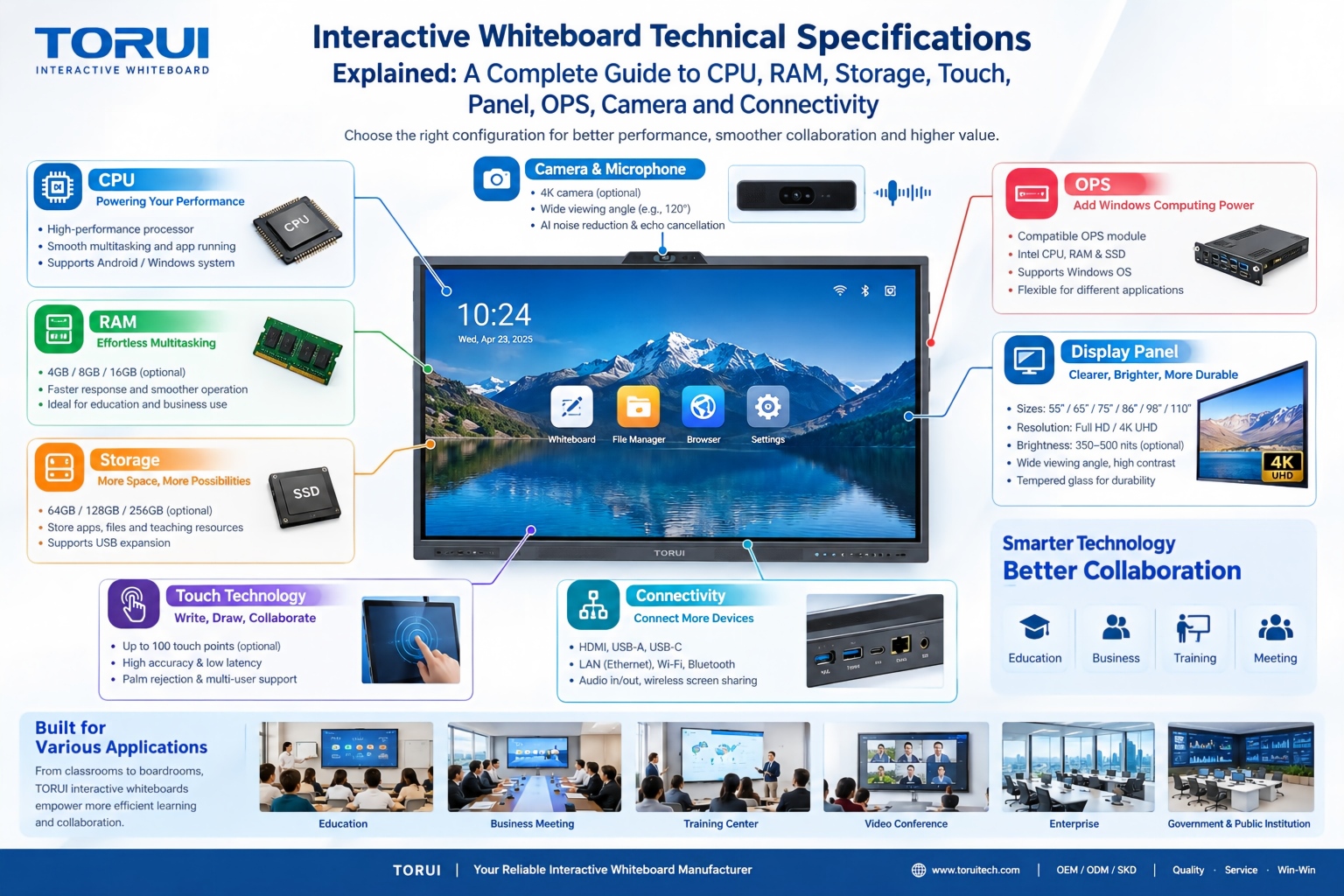
Choosing an interactive whiteboard involves more than comparing screen sizes and prices. For schools, businesses, distributors, wholesalers, and system integrators, understanding the technical specifications is essential to selecting a reliable product that meets different application requirements.
Interactive Whiteboard Technical Specifications Explained: A Complete Guide to CPU, RAM, Storage, Touch, Panel, OPS, Camera and Connectivity
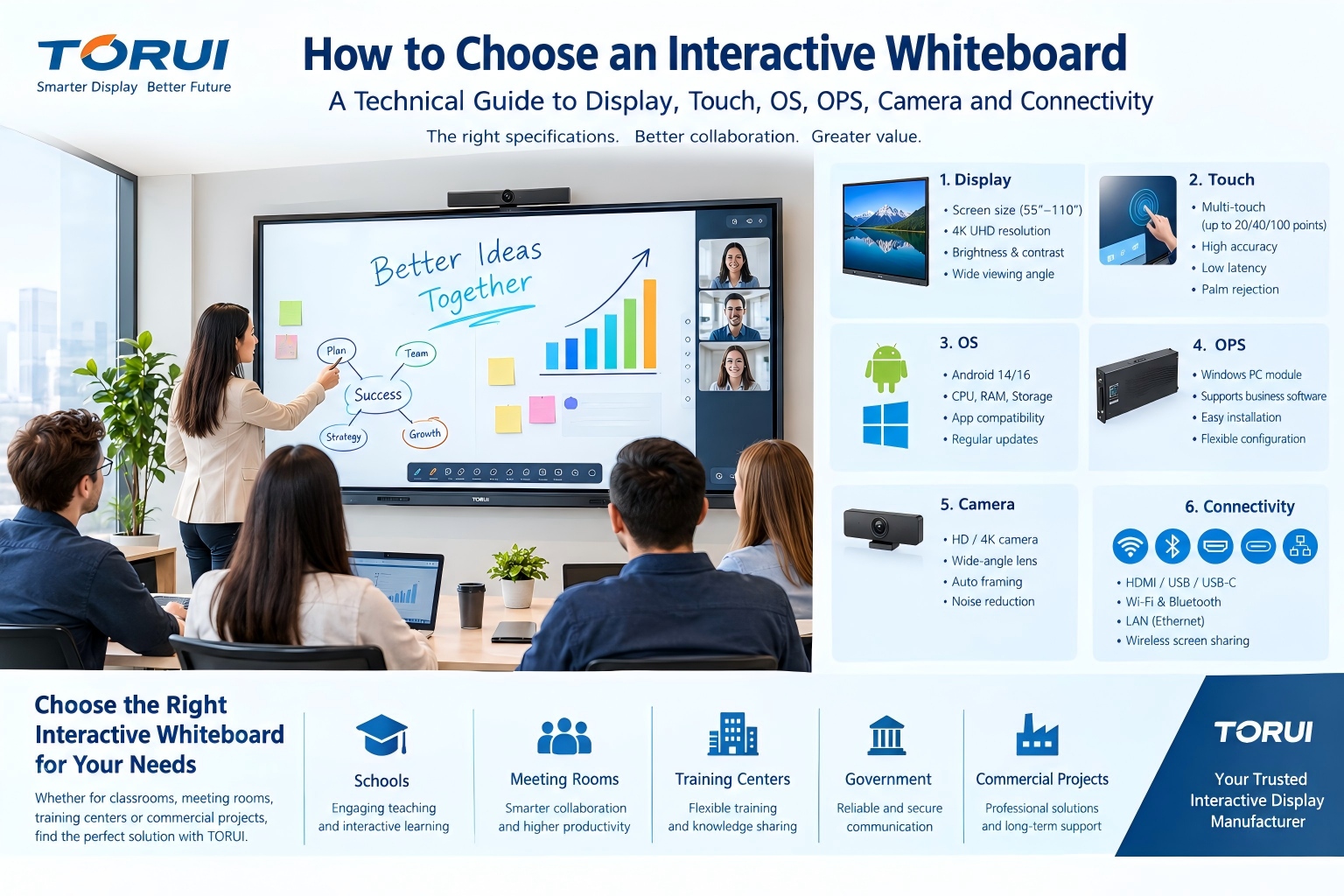
Choosing an interactive whiteboard for a school, meeting room, training center, government organization or commercial project requires more than comparing screen size and price. The most important specifications include display resolution, brightness, touch technology, operating system, processor, memory, storage, OPS compatibility, camera and microphone performance, connectivity, durability and after-sales support.
How to Choose an Interactive Whiteboard: A Technical Guide to Display, Touch, OS, OPS, Camera and Connectivity