
Interactive Flat Panels: Leading the New Trend in Smart Education and Efficient Office Work
author: toruitech
2025-09-07

With the rapid development of information technology, traditional teaching and office methods are undergoing profound changes. Interactive flat panels (interactive flat panels), as innovative devices integrating display, touch, and interactivity, are gradually becoming core tools in modern education, corporate meetings, and public services. This article will systematically explain the value and prospects of interactive flat panels, including their definition, core functions, application scenarios, purchasing recommendations, and future developments.
I. What is an Interactive Flat Panel?
An interactive flat panel, often called an interactive smart tablet in Chinese, is a multifunctional, all-in-one device that integrates touch and high-definition display technology. Also known as an interactive intelligent panel (IIP), it enables human-computer interaction through touch control of content displayed on LCD, LED, and other display panels. Compared to traditional projectors and electronic whiteboards, interactive flat panels offer higher display clarity, a smoother touch experience, and richer intelligent functions.
II. Core Functions and Technical Advantages
Multi-touch and Intelligent Writing
Supporting simultaneous touch and writing by multiple users, teachers or meeting moderators can freely annotate and draw, greatly improving interactive efficiency.
High-Definition Display and Multimedia Integration
The 4K high-definition display delivers vibrant colors and rich details. It seamlessly plays multimedia content, including images, videos, and audio, enhancing information delivery.
Wireless Screen Projection and Remote Collaboration
Supports wireless screen projection, allowing users to project content from their phones, tablets, computers, and other devices to the large screen with a single click. Select high-end models also support remote video conferencing and cloud collaboration, breaking down space limitations.
Rich Application Software and Open System
This system includes a variety of built-in teaching, office, and presentation software, with support for third-party application expansion. Examples include mathematical geometry demonstrations, meeting recording, and interactive quizzes, meeting diverse needs.
Easy Installation and Maintenance
The integrated design allows for easy installation with both wall-mounted and mobile brackets. The system is stable, low-maintenance, and suitable for long-term, frequent use.
III. Main Application Scenarios
Education: Core Equipment for Smart Classrooms
Interactive Flat Panels are widely used in primary and secondary schools, universities, and training institutions. Teachers can stimulate student interest and enhance classroom engagement through interactive demonstrations, real-time annotation, and group discussions. Students can answer questions and draw directly on the tablet, promoting in-depth learning. Interactive flat panels are essential for new educational models like distance learning and recorded classrooms.
Enterprise Office: Efficient Meetings and Collaborative Innovation
In corporate conference rooms, interactive flat panels enable paperless meetings and efficient collaboration. Team members can present plans, highlight key points, and brainstorm at any time, saving and sharing meeting content with a single click. Remote video conferencing facilitates efficient communication across multiple regions. Interactive flat panels are particularly indispensable for departments like design, R&D, and sales that require frequent presentations and discussions.
Public Service and Commercial Display
Interactive flat panels are used for information dissemination, business processing, and product displays in government offices, hospitals, exhibition halls, and retail stores. Smart touchscreens and multimedia displays enhance service efficiency and user experience.
IV. Purchasing Recommendations and Market Price Reference
When choosing an interactive flat panel, consider factors such as size (common options include 65, 75, and 86 inches), number of touch points, system compatibility, and after-sales service based on your specific needs. According to online searches, mainstream prices currently range from US$800 to US$5,000, with significant price variations depending on brand, size, and configuration. For example, some Chinese manufacturers' entry-level products cost around $800 each, while high-end models can reach thousands of dollars.
V. Future Development Trends
With the convergence of technologies such as AI, big data, and the Internet of Things, interactive flat panels will enable even more intelligent teaching and office experiences. For example, innovative features such as intelligent voice recognition, automated homework grading, classroom data analysis, and personalized learning push notifications will continue to emerge. Device interoperability and cloud-based collaboration capabilities will also be further enhanced, promoting educational equity and enterprise digital transformation.
Conclusion
As the "new infrastructure" of smart education and efficient office work, interactive flat panels are profoundly changing the way we learn, work, and communicate. Choosing the right product and applying it effectively in real-world scenarios will significantly improve efficiency and drive innovation for organizations. In the future, as technology advances and its applications deepen, interactive flat panels will undoubtedly become a key tool for digital upgrades in many industries.
Daily Use and Maintenance of Interactive Whiteboards
TORUI Interactive Whiteboards Empower Interactive Education
Related Article
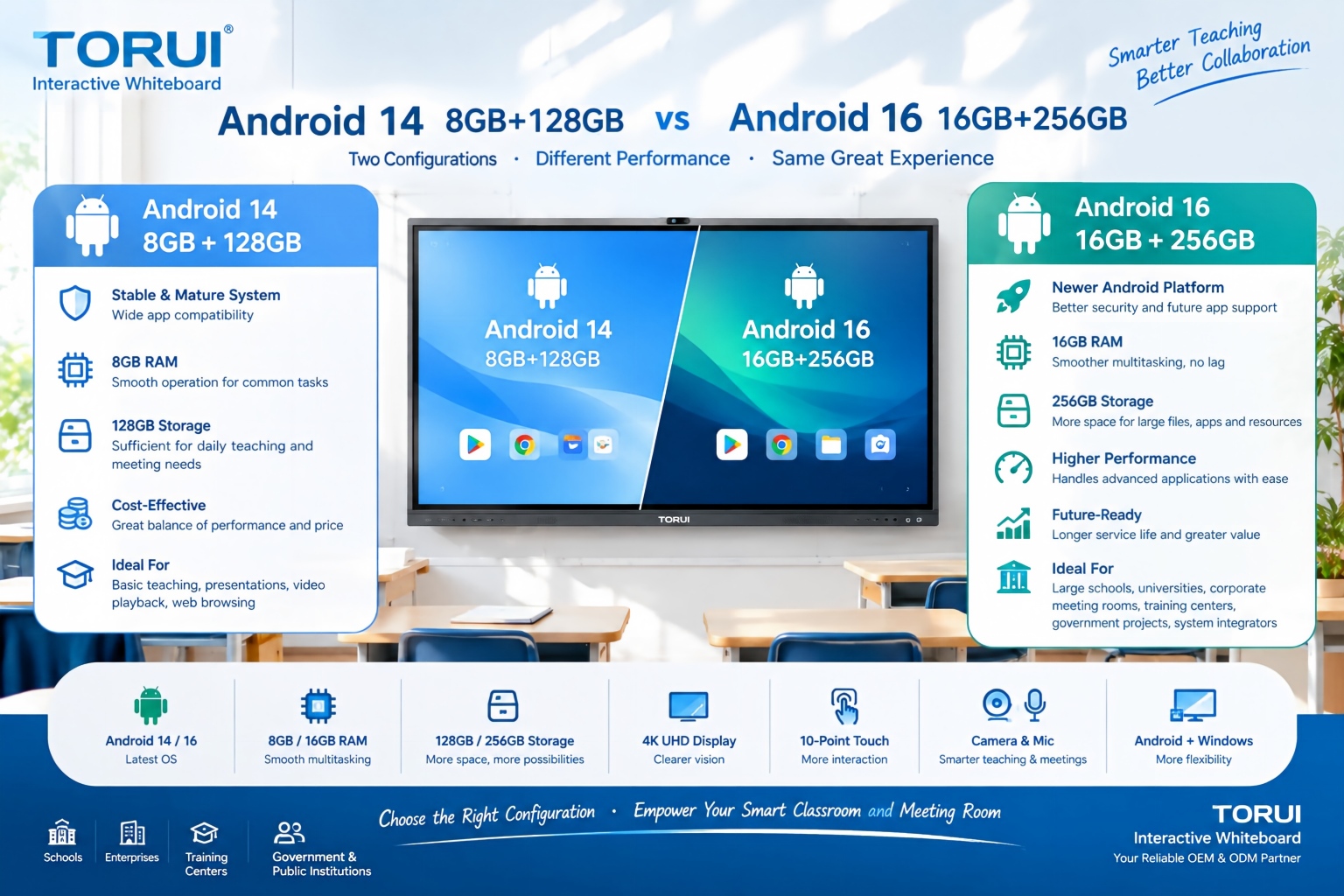
When choosing an interactive whiteboard for a school, training center, meeting room, or commercial project, the Android version and hardware configuration can significantly affect user experience. Two common configurations are Android 14 with 8GB RAM and 128GB storage and Android 16 with 16GB RAM and 256GB storage.
Android 14 8GB+128GB vs Android 16 16GB+256GB: Which Interactive Whiteboard Is Better?

Buying an interactive whiteboard is not simply about choosing the right screen size, resolution, or operating system. For B2B buyers, distributors, system integrators, schools, and corporate procurement teams, quality control is one of the most important factors affecting long-term reliability, user experience, warranty costs, and customer satisfaction.
Interactive Whiteboard Quality Control: What Should Buyers Check?
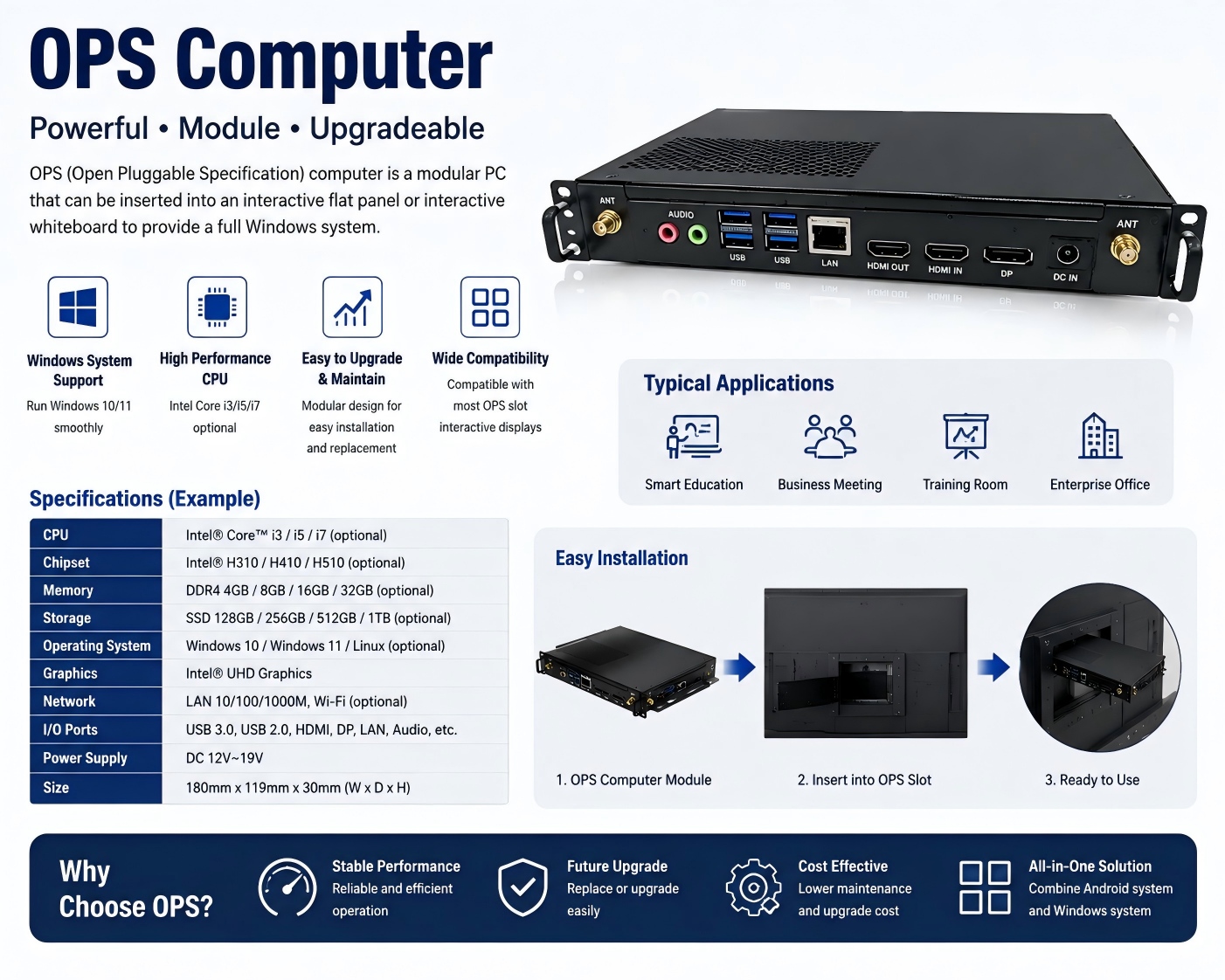
An OPS computer for an interactive whiteboard is a modular plug-in PC designed to add Windows-based computing power to an interactive display. OPS stands for Open Pluggable Specification, a standardized form factor originally developed for commercial interactive displays.
What Is an OPS Computer for Interactive Whiteboards?

Choosing the right chipset is an important decision when sourcing an interactive whiteboard for schools, conference rooms, training centers, government projects, or commercial applications. Among Rockchip platforms, RK3588 and RK3576 are two powerful options for modern Android interactive displays.
RK3588 vs RK3576: Which Chip Is Better for Interactive Whiteboards?