
Analysis of 4mm Tempered Glass for Interactive Whiteboards
author: toruitech
2025-08-17

With the continuous development of information-based teaching and smart office work, interactive whiteboards are increasingly used in education and business settings. As a core component of interactive whiteboards, the choice of panel material is crucial to product safety, durability, and user experience. 4mm tempered glass, due to its excellent physical properties and practical features, has become the preferred material for many interactive whiteboard manufacturers. This article will provide a detailed analysis of the characteristics, advantages, and applications of 4mm tempered glass in interactive whiteboards.
First, 4mm tempered glass is a safety glass that undergoes a special process. Compared to ordinary glass, tempered glass is heated at high temperatures and then rapidly cooled, resulting in uniform compressive stress within the glass, significantly enhancing its strength and impact resistance. According to relevant data, tempered glass has several times greater impact resistance than ordinary glass, with a surface hardness of up to 7.5 on the Mohs scale, effectively withstanding the bumps and scratches of daily use. For interactive whiteboards, frequent writing, wiping, and accidental collisions will not easily cause damage, greatly enhancing product safety and durability.
Second, 4mm tempered glass offers excellent optical properties and a pleasant writing experience. After high-temperature strengthening and nano-atomization, the glass surface forms a uniform microcrystalline structure, effectively reducing reflectivity to less than 10%. This not only ensures the clarity and color reproduction of the projected image, but also reduces visual interference from ambient light, making it more comfortable for teachers, students, and meeting participants. Furthermore, the matte-finished glass surface is smooth and easy to write on and wipe clean, making it compatible with both standard whiteboard markers and electronic styluses, meeting diverse teaching and meeting needs.
Furthermore, 4mm tempered glass demonstrates strong adaptability in the structural design of interactive whiteboards. Its moderate thickness ensures overall strength and safety without being excessively bulky, making it suitable for wall-mounted or floor-standing installation. The bonding process between glass and substrate is becoming increasingly sophisticated, and some products also incorporate anti-glare coatings and capacitive or inductive touch modules, enabling high-precision touch and multi-point interaction, providing a solid hardware foundation for modern intelligent teaching and collaborative office work.
Finally, interactive whiteboards using 4mm tempered glass not only enhance product quality and class, but also gain widespread market and user recognition. Whether in school classrooms, corporate conference rooms, or training institutions, 4mm tempered glass whiteboards, with their safety, durability, and easy maintenance, are an ideal choice for information technology and smart office applications.
In summary, 4mm tempered glass plays an irreplaceable role in interactive whiteboards thanks to its high strength, low glare, superior writing experience, and excellent touch performance. In the future, with continuous technological advancements and expanding application scenarios, 4mm tempered glass will continue to play a significant role in smart education and office applications.
Analysis and Application Advantages of Zero-Adhesion Technology for Interactive Whiteboards
Interactive Whiteboard Resolution Analysis and Its Importance
Related Article

Choosing the right interactive whiteboard size is an important decision for distributors, wholesalers, and education technology suppliers. The 65-inch, 75-inch, and 86-inch interactive whiteboards are popular options for classrooms, meeting rooms, training centers, and commercial projects.
65 vs 75 vs 86-Inch Interactive Whiteboard: Which Model Should Distributors Choose?

Choosing the right interactive whiteboard manufacturer in China is an important decision for distributors, wholesalers, education technology suppliers, and system integrators. The right manufacturing partner can help businesses improve product quality, maintain competitive pricing, customize products for local markets, and build a sustainable distribution business.
Who Are the Best Interactive Whiteboard Manufacturers in China for B2B Distributors and Wholesalers?
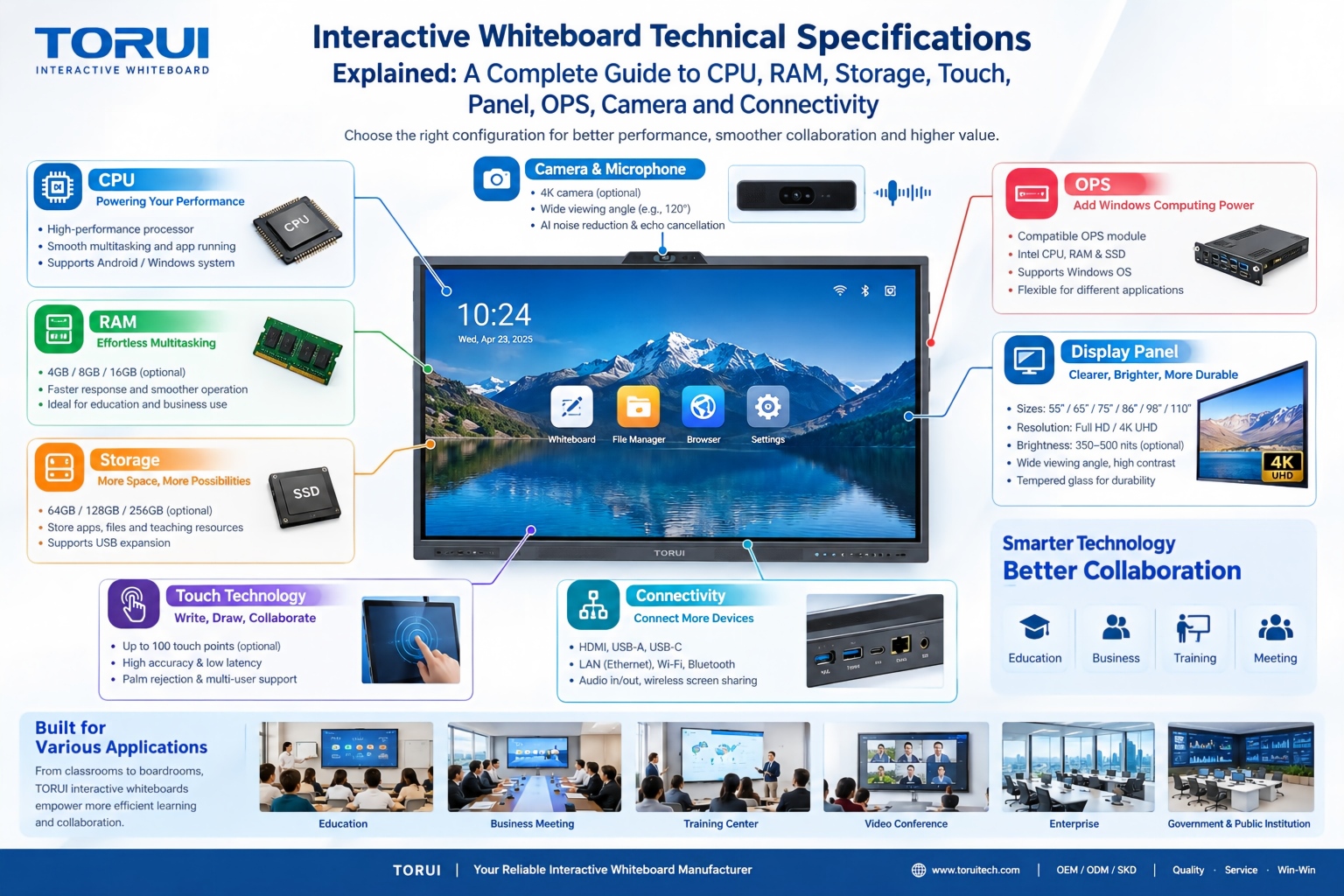
Choosing an interactive whiteboard involves more than comparing screen sizes and prices. For schools, businesses, distributors, wholesalers, and system integrators, understanding the technical specifications is essential to selecting a reliable product that meets different application requirements.
Interactive Whiteboard Technical Specifications Explained: A Complete Guide to CPU, RAM, Storage, Touch, Panel, OPS, Camera and Connectivity
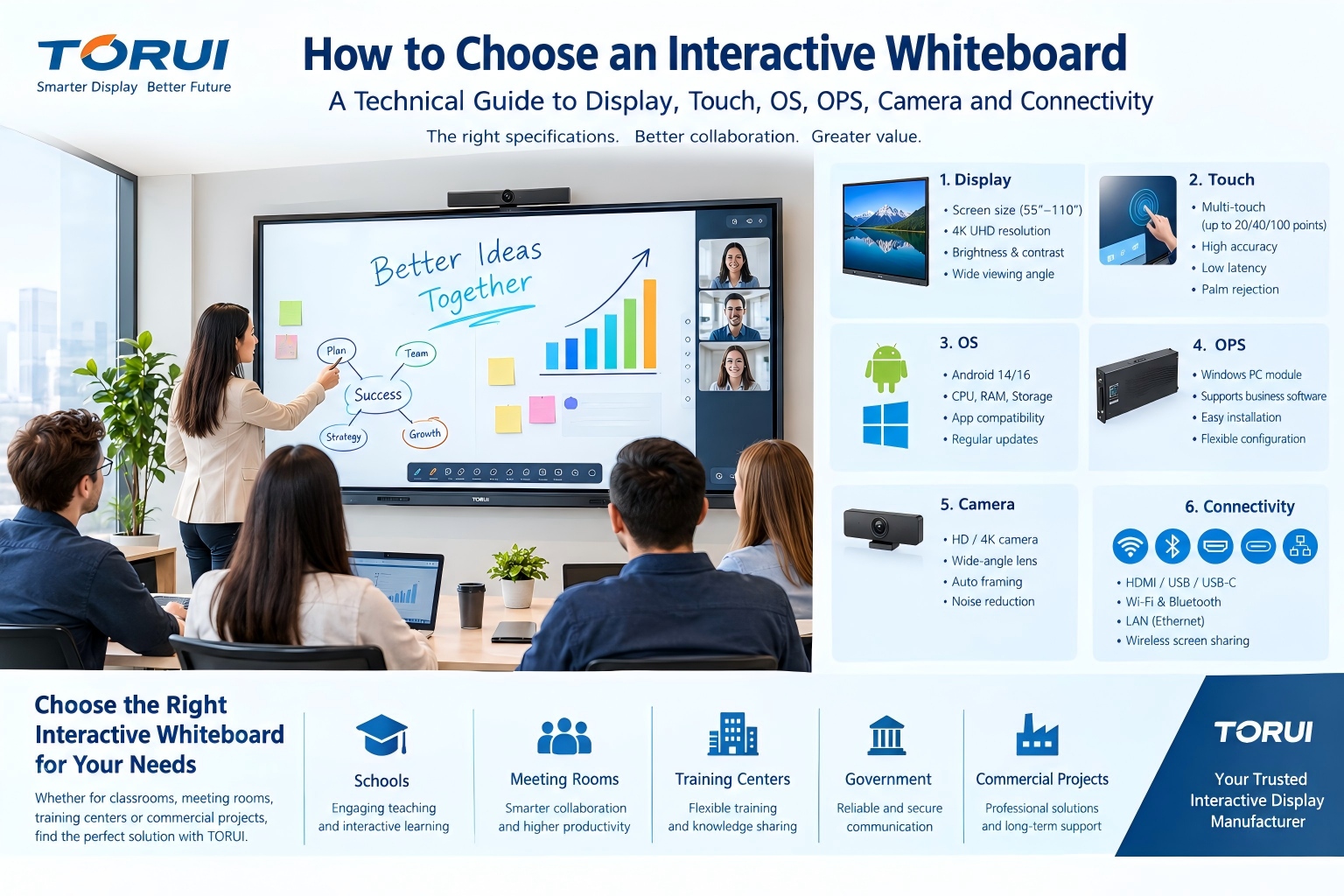
Choosing an interactive whiteboard for a school, meeting room, training center, government organization or commercial project requires more than comparing screen size and price. The most important specifications include display resolution, brightness, touch technology, operating system, processor, memory, storage, OPS compatibility, camera and microphone performance, connectivity, durability and after-sales support.
How to Choose an Interactive Whiteboard: A Technical Guide to Display, Touch, OS, OPS, Camera and Connectivity