
A Detailed Explanation of Infrared Touch Points on Interactive Whiteboards
author: toruitech
2025-08-03

With the continuous development of multimedia and intelligent technologies, interactive electronic whiteboards have become an indispensable tool in modern education, corporate meetings, and collaborative work environments. Infrared touch technology, as one of the mainstream interaction methods, has gained widespread adoption due to its cost-effectiveness, ease of maintenance, and excellent user experience. This article will provide a detailed introduction to the principles, characteristics, applications, and development trends of infrared touch points on interactive whiteboards.
1. How Infrared Touch Points Work
Interactive whiteboard infrared touch points are created by placing a large number of infrared emitting and receiving diodes around the whiteboard, forming a dense infrared light network. When a user touches the whiteboard surface with a finger, pointer, or other opaque object, the infrared light at that location is blocked. The system detects the blocked horizontal and vertical infrared light to accurately determine the coordinates of the touch point, enabling real-time response to user input. Infrared touch point technology eliminates the need for a dedicated pen and supports multi-touch, significantly improving user convenience and interactive experience.
II. Key Features of Infrared Touch Points
Flexible Operation: Infrared touch points support a variety of touch methods, including fingers, pointers, and gloved hands, greatly facilitating the needs of diverse users.
High Durability: Since infrared sensing doesn't rely on physical pressure, scratches on the whiteboard surface won't affect normal operation, resulting in a long device lifespan.
High Precision and Response Speed: Modern infrared touch technology can achieve resolutions of 4096×4096 or even higher, with fast response times and smooth, natural writing and drawing.
Low Cost: Compared to other touch technologies like capacitive and electromagnetic, infrared touch whiteboards have lower manufacturing and maintenance costs, making them suitable for large-scale adoption.
Easy Maintenance: The simple structure allows for easy detection and replacement of faults, reducing maintenance complexity and costs.
III. Practical Application Scenarios
Infrared touch points are widely used in various fields, including education, business, and government. In education, teachers can write, annotate, and demonstrate courseware directly on the whiteboard, greatly enhancing classroom interactivity and student engagement. In corporate meetings, infrared interactive whiteboards support simultaneous operation by multiple people, facilitating brainstorming and collaborative discussions. Furthermore, with the rise of remote work and online education, infrared touch whiteboards are becoming a crucial infrastructure for smart conference rooms and classrooms.
IV. Development Trends and Challenges
With technological advancements, infrared touch points are evolving towards higher precision, stronger anti-interference capabilities, and multi-touch capabilities. The new generation of infrared touch whiteboards can effectively overcome strong light interference and support complex gesture recognition, providing users with a more natural and smooth interactive experience. At the same time, improving touch accuracy, reducing latency, and compatibility with a wider range of application scenarios are also key areas of ongoing industry research.
In summary, infrared touch points in interactive whiteboards, with their unique technological advantages and broad application prospects, are continuously driving the upgrade of information-based teaching and smart office. In the future, with the further integration of artificial intelligence and the Internet of Things, infrared touch points will play an even greater role in even more intelligent scenarios.
TORUI Technology's interactive whiteboards utilize advanced infrared touch technology and support up to 20 infrared touch points, meeting the needs of multiple people writing and operating simultaneously. Some models support up to 40 touch points, significantly improving collaboration efficiency and interactive experience. Users can write and touch smoothly using their fingers, pens, or other opaque objects, without the need for a dedicated pen, making operation easy. With its high-precision positioning and fast response, the TORUI interactive whiteboard is ideal for a variety of scenarios, including education and conferences, providing a solid technical foundation for team collaboration and intelligent teaching.
Smart Boards: Opening a New Chapter in Smart Education and Efficient Collaboration
What after-sales service options are available for interactive whiteboards?
Related Article

Choosing the right interactive whiteboard size is an important decision for distributors, wholesalers, and education technology suppliers. The 65-inch, 75-inch, and 86-inch interactive whiteboards are popular options for classrooms, meeting rooms, training centers, and commercial projects.
65 vs 75 vs 86-Inch Interactive Whiteboard: Which Model Should Distributors Choose?

Choosing the right interactive whiteboard manufacturer in China is an important decision for distributors, wholesalers, education technology suppliers, and system integrators. The right manufacturing partner can help businesses improve product quality, maintain competitive pricing, customize products for local markets, and build a sustainable distribution business.
Who Are the Best Interactive Whiteboard Manufacturers in China for B2B Distributors and Wholesalers?
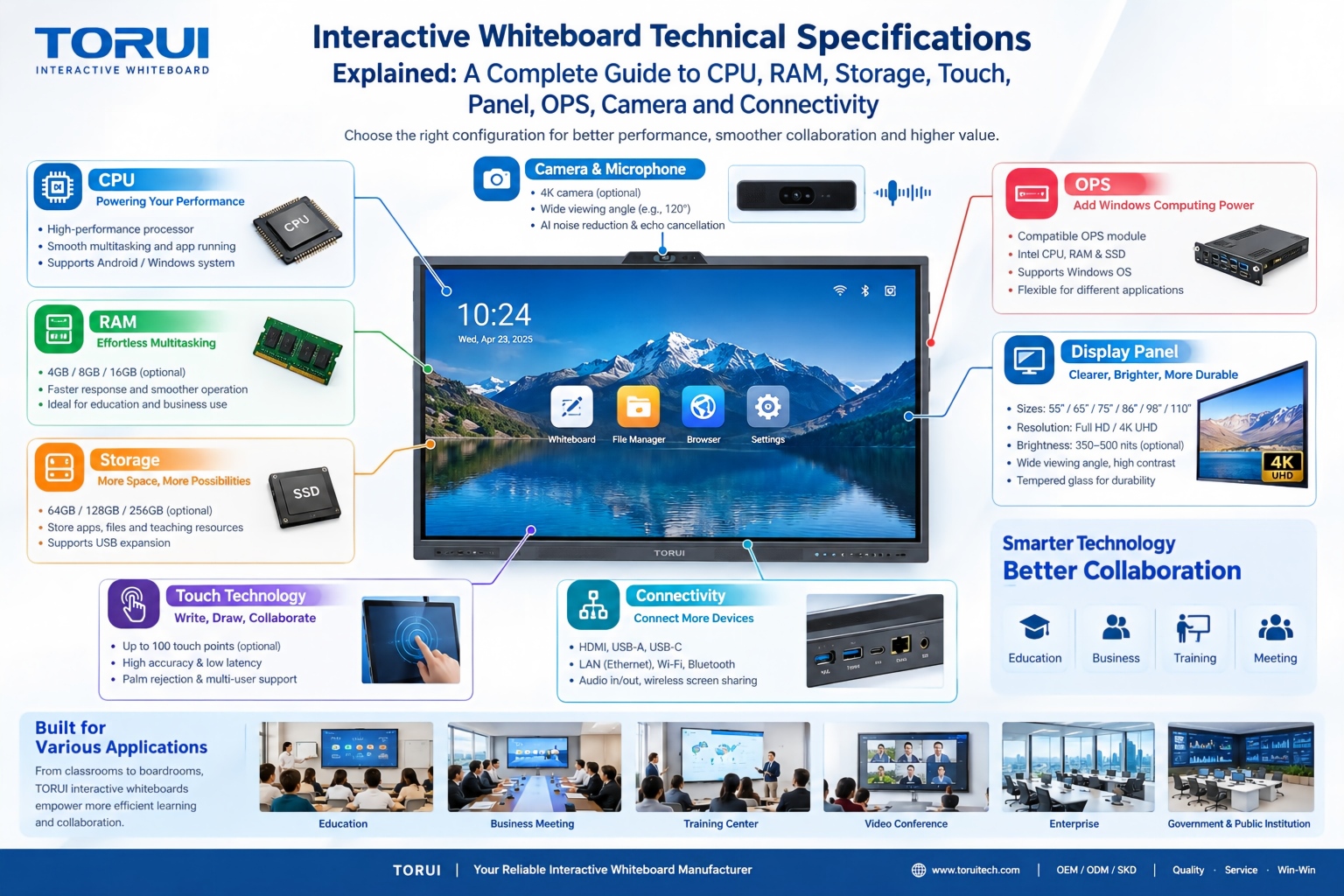
Choosing an interactive whiteboard involves more than comparing screen sizes and prices. For schools, businesses, distributors, wholesalers, and system integrators, understanding the technical specifications is essential to selecting a reliable product that meets different application requirements.
Interactive Whiteboard Technical Specifications Explained: A Complete Guide to CPU, RAM, Storage, Touch, Panel, OPS, Camera and Connectivity
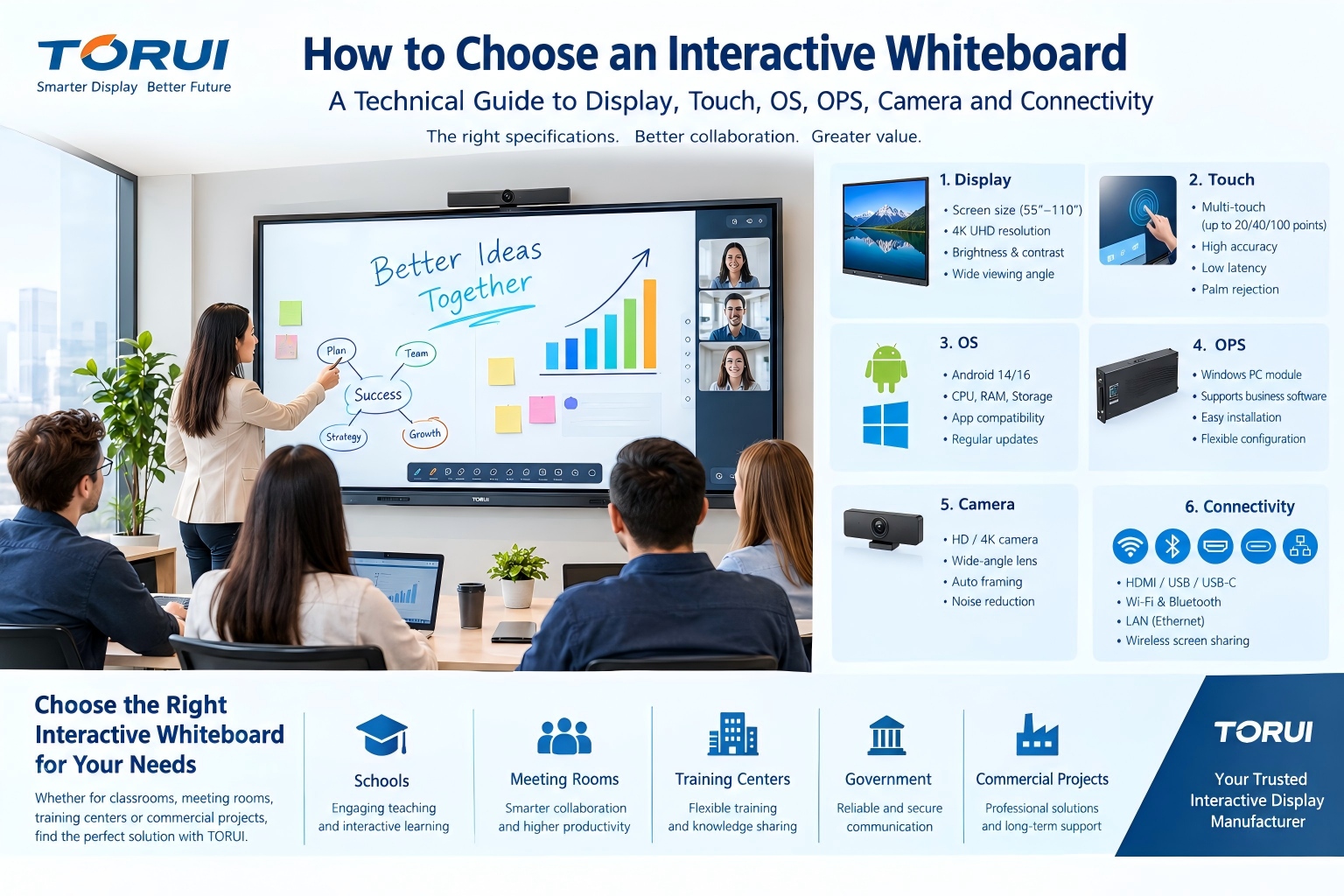
Choosing an interactive whiteboard for a school, meeting room, training center, government organization or commercial project requires more than comparing screen size and price. The most important specifications include display resolution, brightness, touch technology, operating system, processor, memory, storage, OPS compatibility, camera and microphone performance, connectivity, durability and after-sales support.
How to Choose an Interactive Whiteboard: A Technical Guide to Display, Touch, OS, OPS, Camera and Connectivity