
Interactive Whiteboard Quality Control and Production Process
author: toruitech
2025-08-08
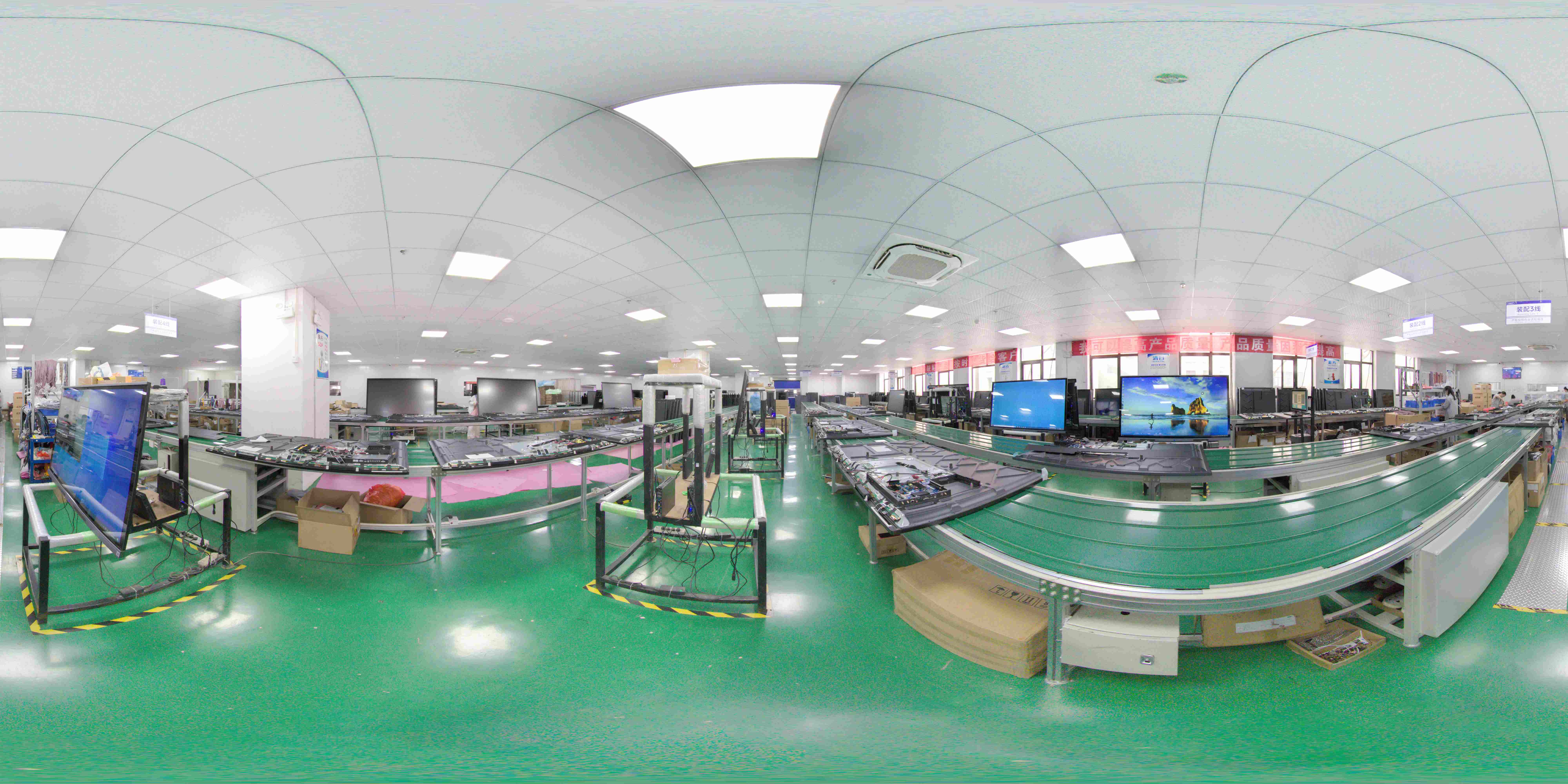
With the increasing prevalence of information-based education and smart office work, interactive whiteboards, as essential tools for modern teaching and conferencing, have placed higher demands on their quality. A comprehensive quality control system is key to ensuring the stable performance, safe use, and long life of interactive whiteboard products. This article systematically outlines the quality control and production process for interactive whiteboards, covering every step from design and development, raw material procurement, manufacturing, in-process inspection, finished product testing, and factory acceptance inspection, to help companies and users gain a deeper understanding of the entire quality assurance process.
1. Quality Control During the Design and Development Phase
Product quality begins with design. During the design phase of an interactive whiteboard, full consideration must be given to the product's functional requirements, user experience, performance standards, and safety regulations. Excellent design not only determines the product's fundamental quality but also serves as the basis for subsequent manufacturing processes and testing. The design team typically uses professional electronic design software to create circuit schematics and PCB layouts, repeatedly verifying the feasibility of the structure, materials, and process. After completion, the design undergoes rigorous review and evaluation to ensure its scientific and feasible design. Furthermore, during the new product development phase, small-batch trial production and process validation (such as DOE experiments) are conducted to confirm the effectiveness of various process parameters and production plans, laying a solid foundation for subsequent mass production.
II. Raw Material Procurement and Inspection
High-quality raw materials are a prerequisite for manufacturing high-quality interactive whiteboards. Companies must establish a comprehensive supplier management system and select reputable and qualified raw material suppliers. Key components such as displays, touch modules, main control boards, and power modules must be strictly inspected in accordance with design requirements and industry standards. This typically includes visual inspections, functional testing, and performance spot checks to ensure that each component meets quality standards. Any substandard components must be promptly returned or disposed of to prevent defective products from entering the production process.
III. Quality Control During the Manufacturing Process
Process Management
The interactive whiteboard production process is complex, encompassing multiple steps, including PCB assembly, component soldering, touch frame installation, complete unit assembly, and software programming. Companies must develop detailed production control procedures, process inspection procedures, and equipment management procedures tailored to their specific needs to ensure that each process follows a well-defined protocol. During the production process, strict adherence to process parameters is essential to prevent product quality issues caused by operational errors or process deviations.
Process Inspection and Monitoring
Quality inspection points should be established at key production nodes, implementing first-article inspection, patrol inspection, and final-article inspection. For example, PCB boards undergo automated optical inspection (AOI) after soldering, and touch modules undergo functional testing after assembly. During assembly, structural integrity, appearance flawlessness, and reliable interface connections should be checked. Through comprehensive process inspections, potential quality issues can be promptly identified and corrected, ensuring that every batch of products meets standard requirements.
Equipment and Personnel Management
High-quality production relies on advanced production equipment and highly qualified operators. Companies should regularly maintain and calibrate production equipment to ensure operational stability and accuracy. Furthermore, they should strengthen skills training and quality awareness education for front-line employees to enhance their operational standards and sense of responsibility, thereby reducing the impact of human error on product quality.
IV. Finished Product Testing and Factory Inspection
Functional and Performance Testing
After assembly, interactive whiteboards undergo comprehensive functional testing, including display quality, touch sensitivity, multi-touch accuracy, interface compatibility, and audio and video playback. Some high-end products also undergo anti-interference, durability, and extreme environment testing to ensure reliability in various application scenarios.
Appearance and Safety Testing
The product's appearance must be free of scratches, stains, deformation, and other defects, and structural components must fit tightly and without looseness. Safety testing includes electrical insulation, power supply stability, lightning protection, and anti-static protection to ensure the personal and property safety of users during use.
Factory Acceptance and Packaging
All qualified products undergo final factory acceptance and are issued a certificate of conformity by the quality inspection department. Qualified products are packaged according to standards to prevent damage during transportation and come with complete instructions and an after-sales service card.
V. Quality Traceability and After-Sales Service
To ensure product quality throughout the entire lifecycle, companies must establish a comprehensive quality traceability system. Each interactive whiteboard has a unique serial number, and all production, inspection, and factory data are traceable. When quality issues arise, the cause can be quickly identified and effective measures implemented. Furthermore, companies should provide timely and professional after-sales service, regularly visit users, collect feedback, and continuously improve product quality.
6. Continuous Improvement and System Optimization
Companies must also regularly evaluate and improve their quality management systems in accordance with quality management system standards such as ISO9001. Through data analysis, internal audits, and customer feedback, they can identify weaknesses in their processes, continuously optimize processes and management, and continuously improve product quality and user satisfaction.
Conclusion
The quality control and production process for interactive whiteboards is a systematic project encompassing design, procurement, manufacturing, testing, traceability, and improvement. Only by strictly controlling every step can we ensure high product quality and reliability. With technological advancements and rising market demand, interactive whiteboard companies must continuously improve their quality control systems to provide users with higher-quality, safer, and more intelligent products and services.
TORUI Technology has been specializing in interactive whiteboard manufacturing for 15 years and has always prioritized product quality as the core of its development. The company implements a strict quality control system throughout its production process, striving for excellence in every step, from raw material selection and production processes to finished product testing. By introducing advanced automated production equipment and continuously optimizing process flows, we ensure that each interactive whiteboard has stable performance and excellent quality. TORUI Technology has also established a comprehensive quality traceability and testing mechanism, conducting real-time monitoring and data analysis throughout the entire production process to promptly identify and resolve potential issues and ensure product consistency and reliability. This commitment to quality and rigorous management processes has earned TORUI Technology the trust and praise of its customers.
Smart Whiteboard Cost: Influencing Factors and Investment Value Analysis
Interactive Whiteboard Applications in Meetings
Related Article

Choosing the right interactive whiteboard size is an important decision for distributors, wholesalers, and education technology suppliers. The 65-inch, 75-inch, and 86-inch interactive whiteboards are popular options for classrooms, meeting rooms, training centers, and commercial projects.
65 vs 75 vs 86-Inch Interactive Whiteboard: Which Model Should Distributors Choose?

Choosing the right interactive whiteboard manufacturer in China is an important decision for distributors, wholesalers, education technology suppliers, and system integrators. The right manufacturing partner can help businesses improve product quality, maintain competitive pricing, customize products for local markets, and build a sustainable distribution business.
Who Are the Best Interactive Whiteboard Manufacturers in China for B2B Distributors and Wholesalers?
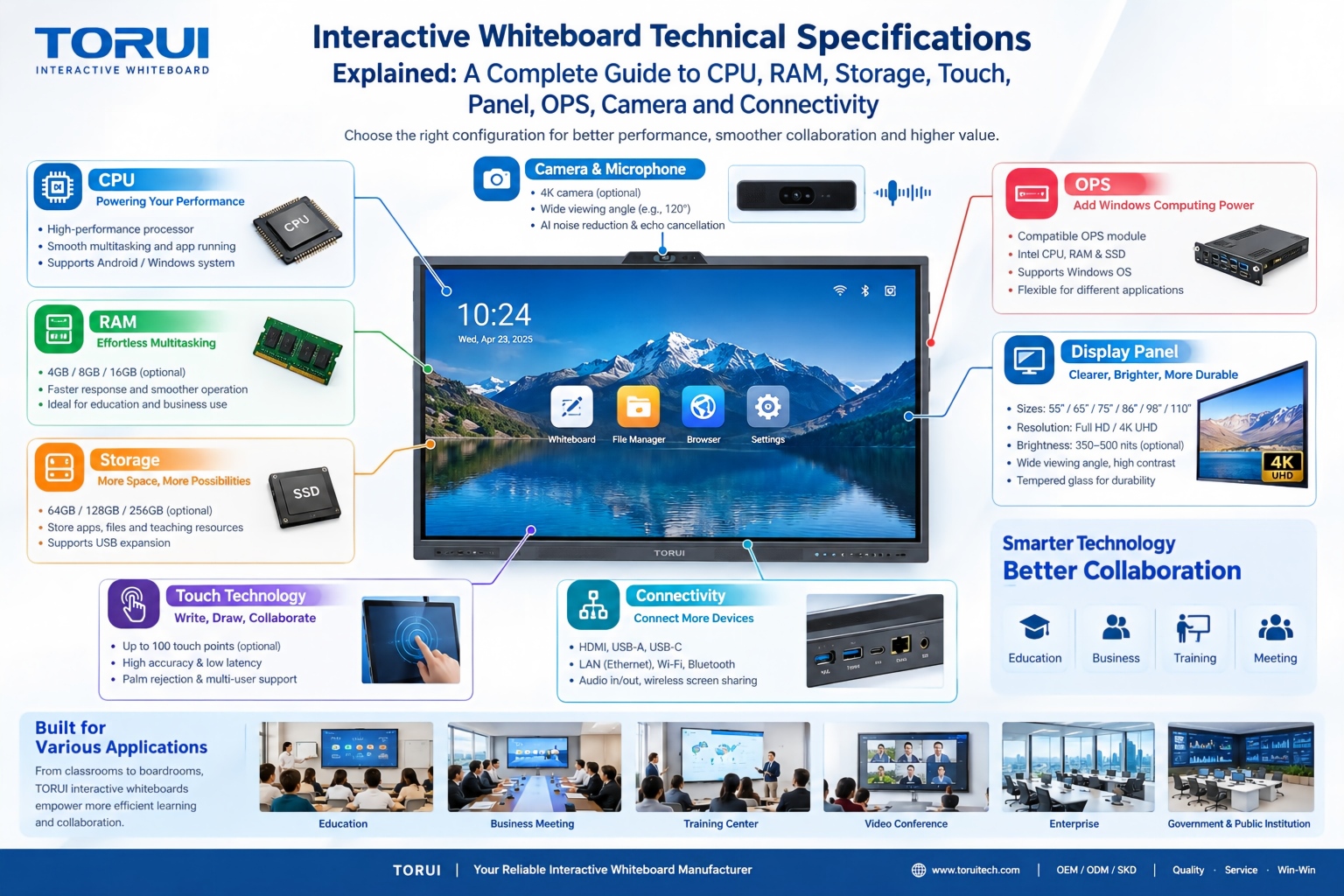
Choosing an interactive whiteboard involves more than comparing screen sizes and prices. For schools, businesses, distributors, wholesalers, and system integrators, understanding the technical specifications is essential to selecting a reliable product that meets different application requirements.
Interactive Whiteboard Technical Specifications Explained: A Complete Guide to CPU, RAM, Storage, Touch, Panel, OPS, Camera and Connectivity
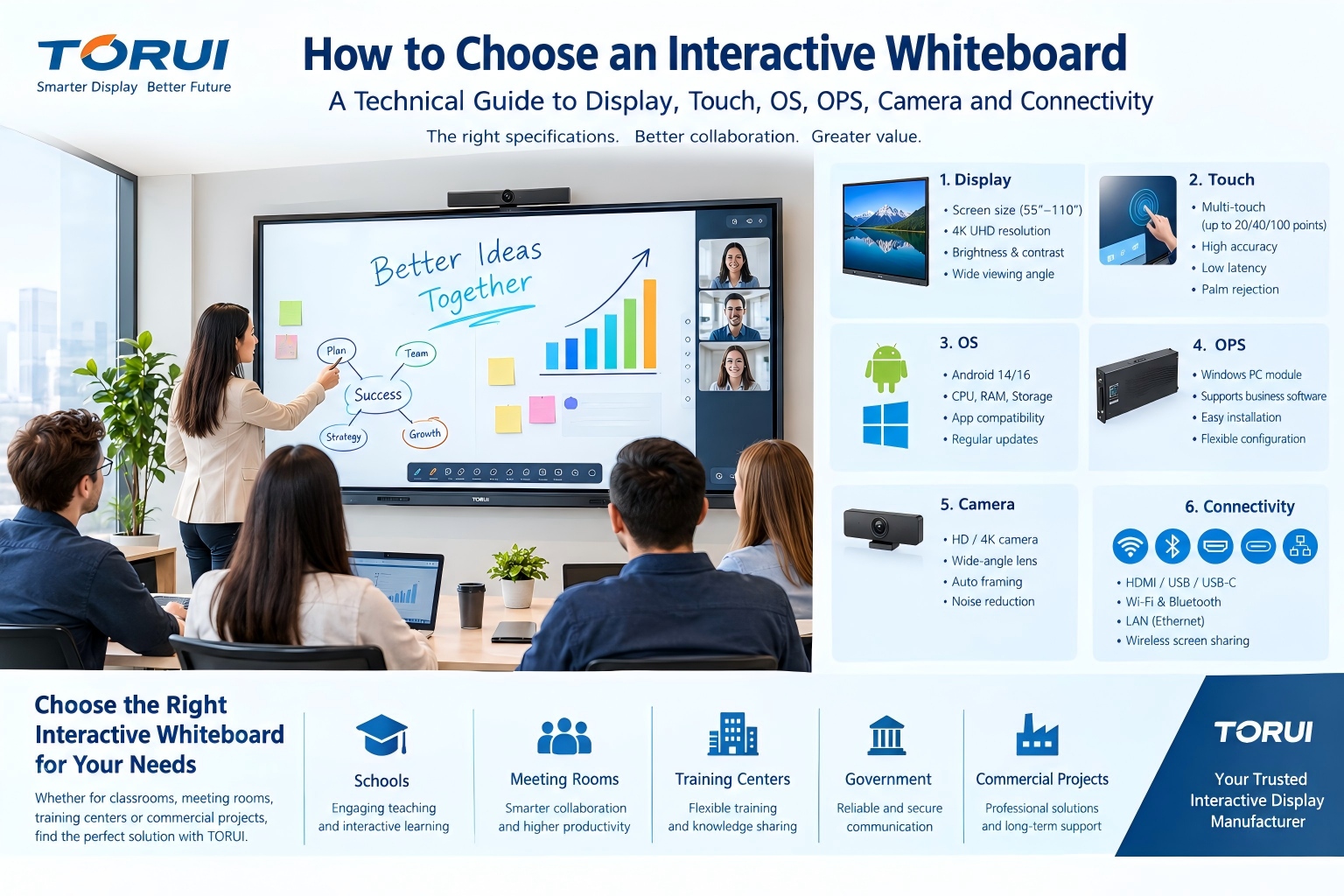
Choosing an interactive whiteboard for a school, meeting room, training center, government organization or commercial project requires more than comparing screen size and price. The most important specifications include display resolution, brightness, touch technology, operating system, processor, memory, storage, OPS compatibility, camera and microphone performance, connectivity, durability and after-sales support.
How to Choose an Interactive Whiteboard: A Technical Guide to Display, Touch, OS, OPS, Camera and Connectivity