Interactive Whiteboard Quality Control: What Should Buyers Check?

Buying an interactive whiteboard is not simply about choosing the right screen size, resolution, or operating system. For B2B buyers, distributors, system integrators, schools, and corporate procurement teams, quality control is one of the most important factors affecting long-term reliability, user experience, warranty costs, and customer satisfaction.
A professional interactive whiteboard manufacturer should have a systematic quality control process covering components, display performance, touch accuracy, motherboard stability, software, connectivity, aging tests, packaging, and pre-shipment inspection.
So, what should buyers check before purchasing interactive whiteboards in bulk?
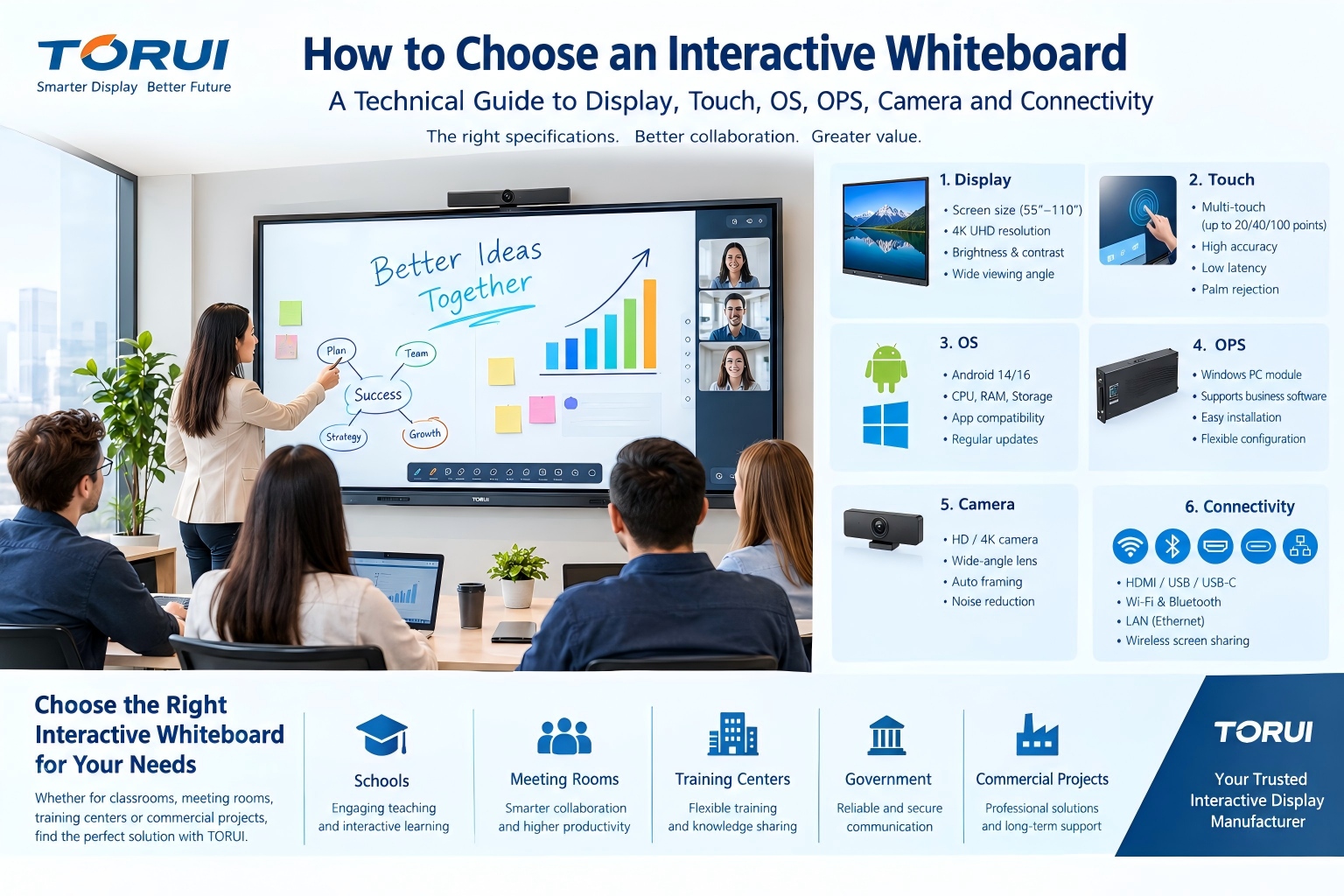
1. Display Quality and Panel Inspection
The display panel is one of the most important components of an interactive whiteboard.
B2B buyers should check:
- Resolution: 4K UHD is recommended for modern professional applications.
- Brightness: Higher brightness improves visibility in classrooms and meeting rooms.
- Contrast ratio: A higher contrast ratio can provide better image depth.
- Viewing angle: Wide viewing angles are important when users sit at different positions.
- Color consistency: The screen should display accurate and consistent colors.
- Dead pixels: Buyers should confirm the manufacturer's acceptable dead-pixel standard.
- Backlight uniformity: Uneven brightness can negatively affect the viewing experience.
For large-scale procurement, buyers should request the manufacturer's display inspection standards and quality acceptance criteria before placing an order.
2. Touchscreen Accuracy and Responsiveness
Touch performance directly affects how teachers, presenters, and meeting participants interact with the display.
A reliable interactive whiteboard should provide accurate and responsive touch recognition across the entire screen.
Buyers should evaluate:
- Touch accuracy
- Touch response time
- Multi-touch capability
- Writing smoothness
- Palm rejection
- Edge and corner touch accuracy
- Touch calibration stability
For example, a 100-point touch specification may look impressive, but the actual user experience also depends on touch latency, software optimization, sensor quality, and system performance.
Therefore, B2B buyers should test the real touch performance, rather than evaluating a product only by its maximum touch-point specification.
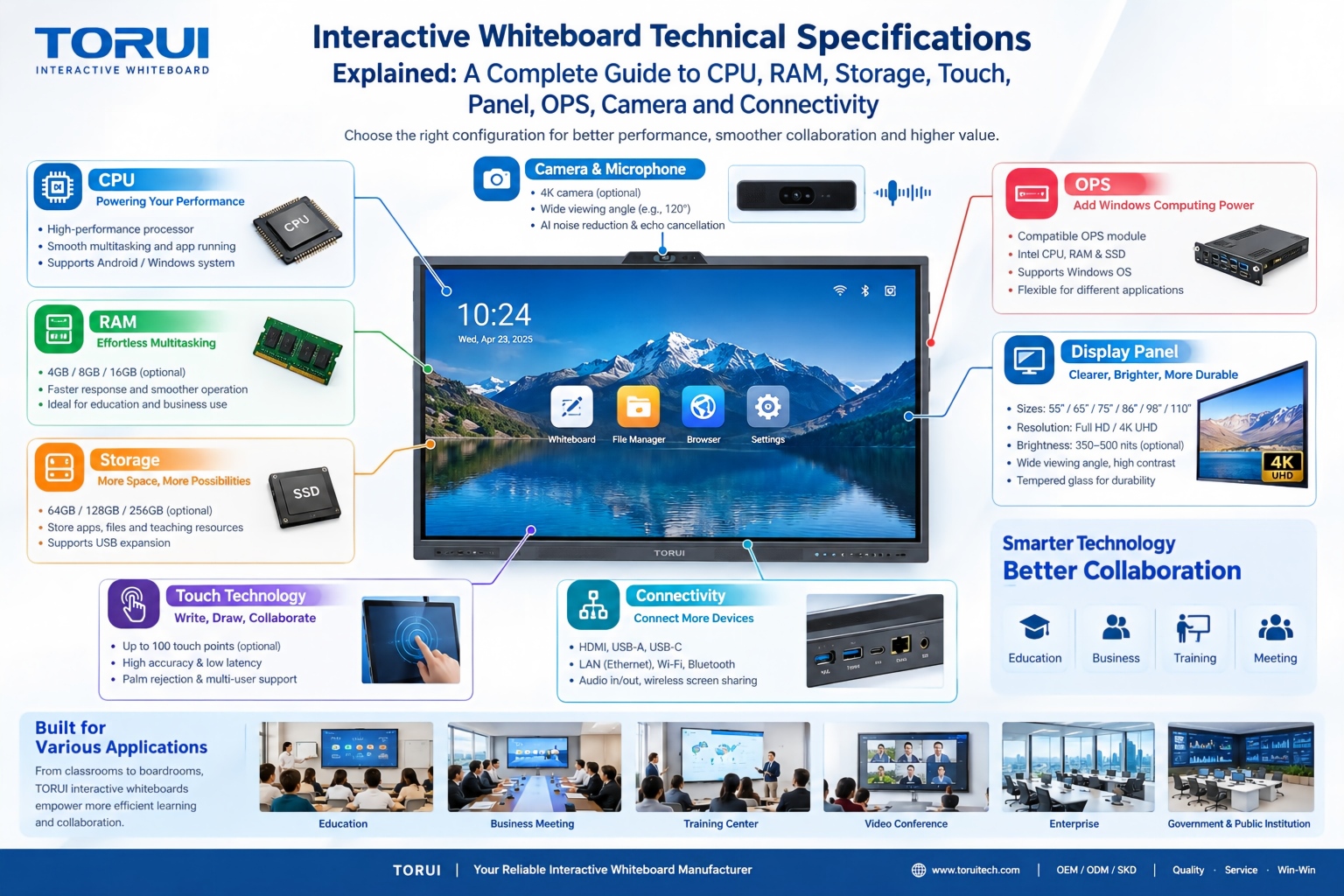
3. Motherboard and Processor Stability
The motherboard is essentially the control center of an interactive whiteboard.
The processor, RAM, storage, GPU, NPU, and other components influence system performance, application compatibility, AI functions, and long-term stability.
Buyers should confirm:
- Processor model
- RAM capacity
- Internal storage
- Android version
- GPU performance
- NPU capability when AI functions are required
- Wi-Fi and Bluetooth specifications
- Expansion and interface compatibility
For example, higher-performance platforms such as RK3588 may be appropriate for demanding applications involving AI, advanced multimedia processing, or intensive multitasking, while other platforms may provide a better cost-performance balance for mainstream applications.
The key is to match the hardware configuration with the intended application instead of simply choosing the highest specification.
4. OPS Computer Compatibility
For buyers requiring Windows-based applications, OPS compatibility should be checked carefully.
An OPS computer can provide a convenient way to add Windows computing capabilities to an interactive display, but compatibility between the OPS module and the interactive whiteboard is critical.
Buyers should check:
- OPS interface compatibility
- CPU configuration
- RAM and SSD
- Windows compatibility
- Graphics performance
- Heat dissipation
- Wi-Fi connectivity
- Driver compatibility
- Upgrade options
A professional manufacturer should be able to provide clear specifications and compatibility information for the recommended OPS configurations.
5. Connectivity and Interface Testing
Interactive whiteboards are often connected to laptops, cameras, microphones, external displays, USB devices, and other conference or classroom equipment.
Therefore, every major interface should be tested before shipment.
Typical interfaces include:
- HDMI
- USB
- USB-C
- LAN
- Audio input/output
- Display output
- Wi-Fi
- Bluetooth
Buyers should verify not only whether an interface exists, but whether it works reliably under actual operating conditions.
For B2B projects, interface compatibility should also be tested with the customer's intended external devices.
6. Software and System Stability
Hardware quality alone does not guarantee a good interactive whiteboard.
The operating system, firmware, touch driver, whiteboard software, screen-sharing software, and other applications must work together reliably.
Quality control should include testing for:
- System booting
- Touch functionality
- Screen mirroring
- Annotation
- Whiteboard software
- Video playback
- Audio
- Camera and microphone
- Wi-Fi connectivity
- Bluetooth
- USB devices
- System updates
- Factory reset
For Google EDLA-based products, buyers should also verify the required Google services, certification status, application compatibility, and software configuration.
7. Aging and Reliability Testing
Aging testing is particularly important for B2B buyers purchasing interactive whiteboards in large quantities.
An aging test allows manufacturers to operate products for a defined period under controlled conditions to identify potential early-stage failures.
Depending on the manufacturer's quality system, testing may include:
- Continuous power-on testing
- Display testing
- Touch testing
- Audio testing
- Network testing
- System stability testing
- Temperature monitoring
The purpose is not simply to prove that a product can turn on. The objective is to identify potential reliability problems before the products reach the customer.
8. Thermal and Temperature Testing
Interactive whiteboards contain processors, power supplies, display components, and other electronic hardware that generate heat during operation.
Poor thermal management can contribute to performance degradation or premature component failure.
Buyers should ask manufacturers about:
- Internal heat dissipation design
- Operating temperature range
- CPU temperature
- Power supply temperature
- Long-duration operation
- Thermal protection
- Ventilation design
For projects operating in hot climates, environmental conditions should be considered during product selection and testing.
9. Power Supply and Electrical Safety
Power-related problems can cause serious reliability issues.
Manufacturers should inspect power boards, adapters, cables, connectors, grounding, and other electrical components.
Depending on the target market, buyers should also verify applicable certifications and compliance requirements, such as:
- CE
- FCC
- RoHS
- CCC
- ISO 9001-related quality management requirements
- Local market certifications where applicable
Certification requirements vary by country and product configuration, so buyers should confirm the exact requirements for their destination market before ordering.
10. Final Quality Inspection Before Shipment
Before bulk shipment, a professional manufacturer should perform a final inspection on finished products.
A practical pre-shipment inspection checklist can include:
- Product appearance
- Screen condition
- Dead-pixel inspection
- Touch accuracy
- Audio
- Camera and microphone
- HDMI and USB ports
- Wi-Fi and Bluetooth
- Operating system
- Whiteboard software
- Screen mirroring
- Accessories
- Serial numbers
- Product labels
- Packaging
- Carton condition
For larger B2B projects, buyers can also arrange third-party inspection or request factory inspection reports before shipment.
11. Packaging and Transportation Protection
Quality control should not stop after the product passes the functional test.
An interactive whiteboard is a large electronic device, and improper packaging can cause damage during transportation.
Buyers should check:
- Protective foam
- Screen protection
- Corner protection
- Carton strength
- Wooden crate requirements
- Accessory packaging
- Shipping marks
- Moisture protection
- Container loading method
For international B2B shipments, packaging should be selected according to transportation method, destination, and project requirements.
12. What Should B2B Buyers Ask an Interactive Whiteboard Manufacturer?
Before placing a large order, buyers should ask the supplier these questions:
1. What quality control process do you use?
2. Do you perform aging tests before shipment?
3. How do you test touchscreen accuracy?
4. What is your acceptable dead-pixel standard?
5. How do you test HDMI, USB, Wi-Fi, and Bluetooth interfaces?
6. Can you provide factory inspection photos or videos?
7. Can we conduct pre-shipment inspection?
8. What certifications are available for our target market?
9. What warranty and after-sales support do you provide?
10. Can you support OEM, ODM, or customized configurations?
A manufacturer's answers to these questions can reveal much more about its production capabilities than a product catalog alone.
How TORUI Controls Interactive Whiteboard Quality
As a professional interactive whiteboard manufacturer in China, TORUI Technology focuses on quality control throughout the manufacturing and delivery process.
Our quality approach covers component inspection, production-line testing, touchscreen testing, system testing, aging testing, functional inspection, packaging inspection, and pre-shipment quality control.
TORUI supports interactive whiteboard solutions for schools, training centers, corporate meeting rooms, government projects, distributors, wholesalers, and system integrators.
With support for different screen sizes, hardware configurations, OPS computers, OEM/ODM requirements, and international certifications, TORUI aims to provide B2B customers with stable and scalable interactive display solutions.
For buyers comparing interactive whiteboard manufacturers, the most important question is not simply “What features does this product have?”
The better question is:
“How does the manufacturer prove that every unit will work reliably after delivery?”
A strong quality control system reduces product defects, minimizes after-sales problems, protects the buyer's investment, and creates a more reliable foundation for long-term B2B cooperation.
Interactive Whiteboard Quality Control FAQ
What is quality control in interactive whiteboard manufacturing?
Interactive whiteboard quality control is the systematic process of inspecting components, testing hardware and software, verifying touch and display performance, conducting reliability tests, and checking finished products before shipment.
How should buyers test an interactive whiteboard?
Buyers should test display quality, touch accuracy, operating system stability, ports, wireless connectivity, audio, camera, microphone, software, and long-duration operation. For bulk orders, pre-shipment inspection is highly recommended.
Why is aging testing important?
Aging testing helps identify potential early-stage hardware or software failures before products are delivered to customers. It is especially valuable for large B2B projects.
What certifications should interactive whiteboards have?
Certification requirements depend on the destination market and product configuration. Common certifications may include CE, FCC, RoHS, CCC, and other country-specific requirements.
What is the most important quality factor?
There is no single quality factor. A reliable interactive whiteboard requires a combination of display quality, touch performance, hardware stability, software reliability, electrical safety, thermal management, and manufacturing quality control.
Final Checklist for B2B Buyers
Before purchasing interactive whiteboards, buyers should evaluate five major areas:
Display → Touch → Hardware → Software → Quality Control
A good specification sheet tells you what a product is supposed to do. A strong quality control system provides evidence that the product can continue doing it reliably after installation and daily use.
For distributors, schools, system integrators, and corporate buyers, choosing a manufacturer with a transparent and systematic quality control process can be one of the most important decisions in an interactive whiteboard procurement project.
Android 14 8GB+128GB vs Android 16 16GB+256GB: Which Interactive Whiteboard Is Better?
What Is an OPS Computer for Interactive Whiteboards?
Related Article