
Interactive Whiteboard Resolution Analysis and Its Importance
author: toruitech
2025-08-16

With the widespread adoption of information-based teaching and smart office work, interactive whiteboards have become standard equipment in modern classrooms and conference rooms. Resolution, a key parameter for evaluating interactive whiteboard display quality, directly impacts the user experience and teaching and office efficiency. This article will comprehensively analyze the concept of resolution, mainstream standards, its practical impact, and purchasing recommendations.
I. Basic Concepts of Resolution
The resolution of an interactive whiteboard generally refers to the number of pixels its display can display, measured in "width x height (pixels)." Higher resolutions result in more detailed content and sharper images and text. For teaching and conference scenarios, high resolution ensures clear presentation of multimedia materials such as courseware, images, and videos, making them easier for teachers, students, and attendees to read and understand.
II. Mainstream Resolution Standards
Currently, the following are the main resolutions for interactive whiteboards on the market:
1280×800 (WXGA): Suitable for small to medium-sized classrooms or conference rooms, it meets basic teaching and presentation needs. 1920×1080 (Full HD): This is the mainstream high-end product standard, suitable for most teaching, training, and business scenarios, ensuring high-definition image and video display.
3840×2160 (4K UHD): This is a high-end flagship resolution, suitable for large conference rooms or demanding multimedia teaching environments. It offers extremely detailed images and strong color rendering, making it suitable for professional settings requiring precise display.
III. The Impact of Resolution on Practical Applications
Improved Clarity: High resolution makes text, charts, images, and videos clearer, reducing visual fatigue and improving information transmission efficiency.
Optimized Interactive Experience: Interactive whiteboards typically support multi-touch and handwriting functions. High resolution allows for more accurate touch point recognition, improving writing and operation smoothness.
Multimedia Compatibility: High-resolution whiteboards are better adapted to various multimedia courseware and office documents, supporting a wider range of formats and richer content.
Space Adaptation: Different resolutions are suitable for different space sizes. Users should select the appropriate resolution based on their actual space to ensure the best viewing and operation experience.
IV. Purchasing Recommendations
When choosing an interactive whiteboard, resolution is a crucial consideration. We recommend selecting based on the usage scenario, space size, and actual needs. For standard classrooms or conference rooms, a 1920×1080 HD resolution will meet most needs. For displaying detailed drawings, HD videos, or conducting professional presentations, consider a 3840×2160 4K whiteboard. Additionally, consider comprehensive performance indicators such as the whiteboard's response speed, color rendering, and touch accuracy.
V. Conclusion
The resolution of an interactive whiteboard not only determines the display quality but also impacts the interactive experience in teaching and working. Choosing and using a high-resolution whiteboard will greatly facilitate information-based teaching and efficient office work, contributing to the development of smart campuses and intelligent enterprises.
Analysis of 4mm Tempered Glass for Interactive Whiteboards
What are buyers most concerned about when purchasing interactive whiteboards?
Related Article
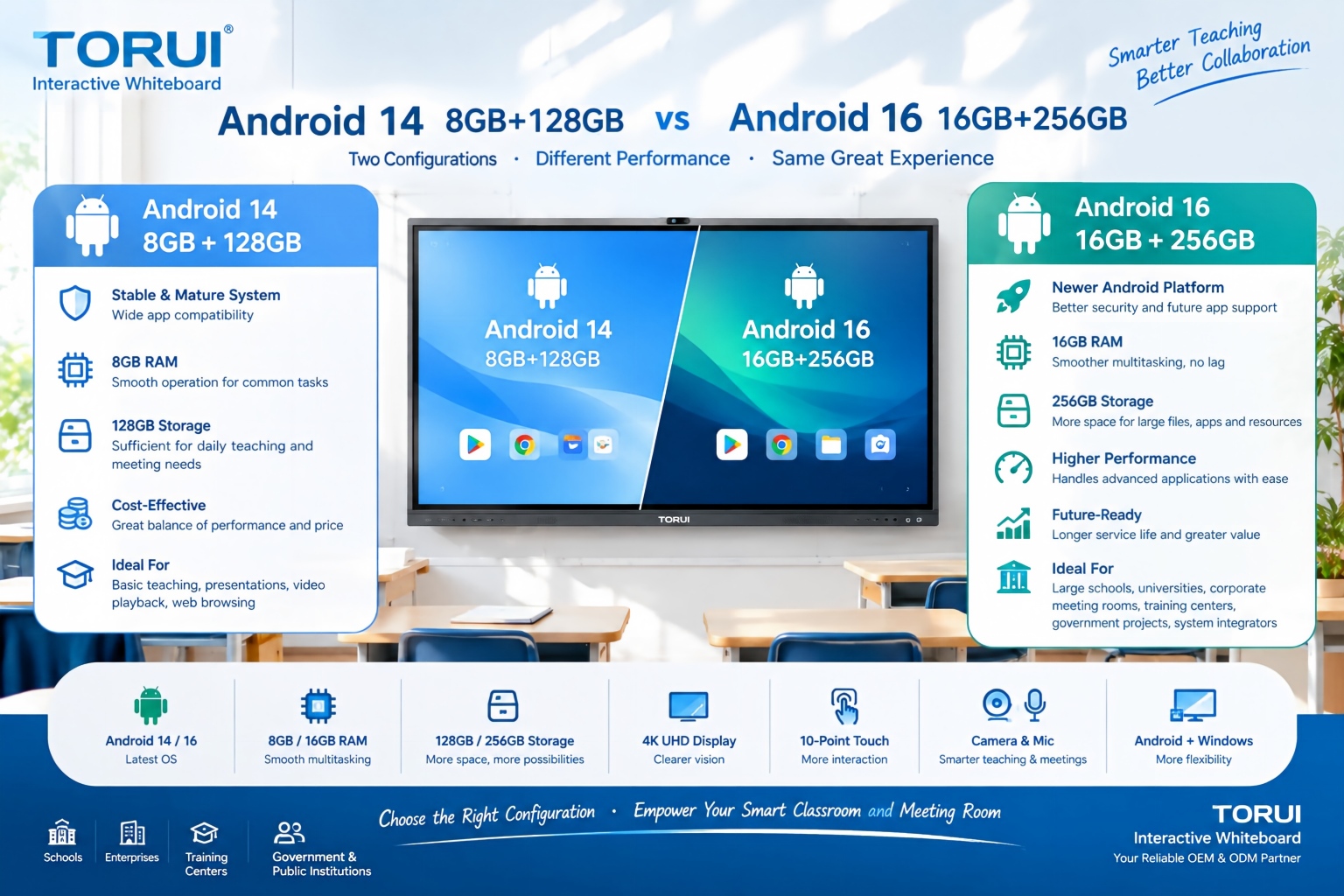
When choosing an interactive whiteboard for a school, training center, meeting room, or commercial project, the Android version and hardware configuration can significantly affect user experience. Two common configurations are Android 14 with 8GB RAM and 128GB storage and Android 16 with 16GB RAM and 256GB storage.
Android 14 8GB+128GB vs Android 16 16GB+256GB: Which Interactive Whiteboard Is Better?

Buying an interactive whiteboard is not simply about choosing the right screen size, resolution, or operating system. For B2B buyers, distributors, system integrators, schools, and corporate procurement teams, quality control is one of the most important factors affecting long-term reliability, user experience, warranty costs, and customer satisfaction.
Interactive Whiteboard Quality Control: What Should Buyers Check?
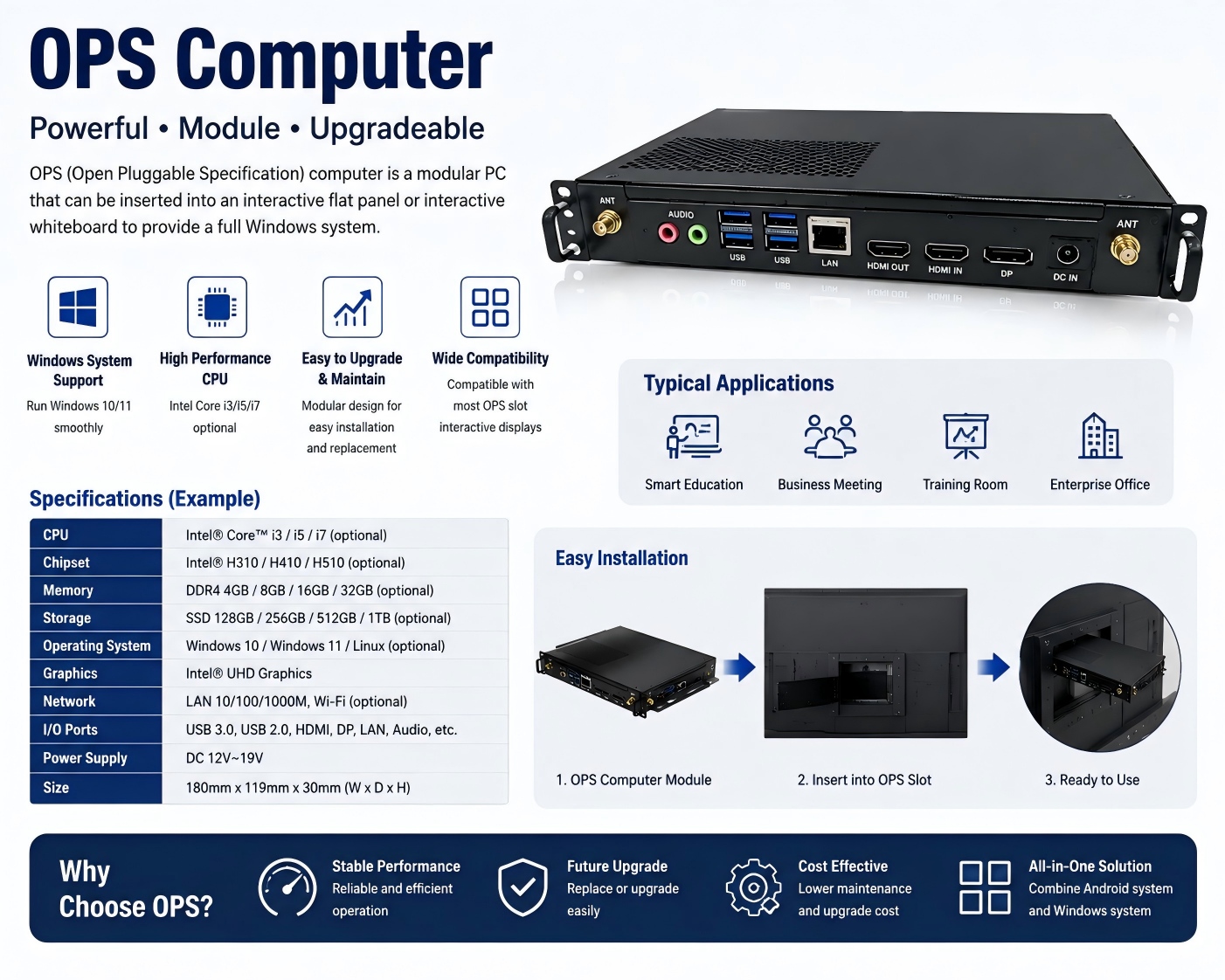
An OPS computer for an interactive whiteboard is a modular plug-in PC designed to add Windows-based computing power to an interactive display. OPS stands for Open Pluggable Specification, a standardized form factor originally developed for commercial interactive displays.
What Is an OPS Computer for Interactive Whiteboards?

Choosing the right chipset is an important decision when sourcing an interactive whiteboard for schools, conference rooms, training centers, government projects, or commercial applications. Among Rockchip platforms, RK3588 and RK3576 are two powerful options for modern Android interactive displays.
RK3588 vs RK3576: Which Chip Is Better for Interactive Whiteboards?