Interactive Whiteboard vs Touch Screen Display: Understanding the Key Differences

As digital technology becomes increasingly important in classrooms and workplaces, many organizations are investing in large interactive displays. Two commonly compared solutions are the interactive whiteboard and the touch screen display. While both allow users to interact directly with content on the screen, they differ in design, functionality, and typical use cases. Understanding these differences can help schools, training centers, and businesses choose the most suitable solution.
What Is an Interactive Whiteboard?
An interactive whiteboard is a teaching and collaboration tool that allows users to control and interact with digital content using touch, stylus pens, or other input devices. Traditional interactive whiteboards usually require a projector and a connected computer to display content onto the board surface. Users can then write, draw, annotate, or manipulate digital materials directly on the board.
Interactive whiteboards are widely used in education because they integrate well with teaching software, digital lesson plans, and classroom management tools. Teachers can display presentations, highlight key information, save notes, and share lesson content with students. Many systems also support collaboration features that allow multiple users to write on the board simultaneously.
What Is a Touch Screen Display?
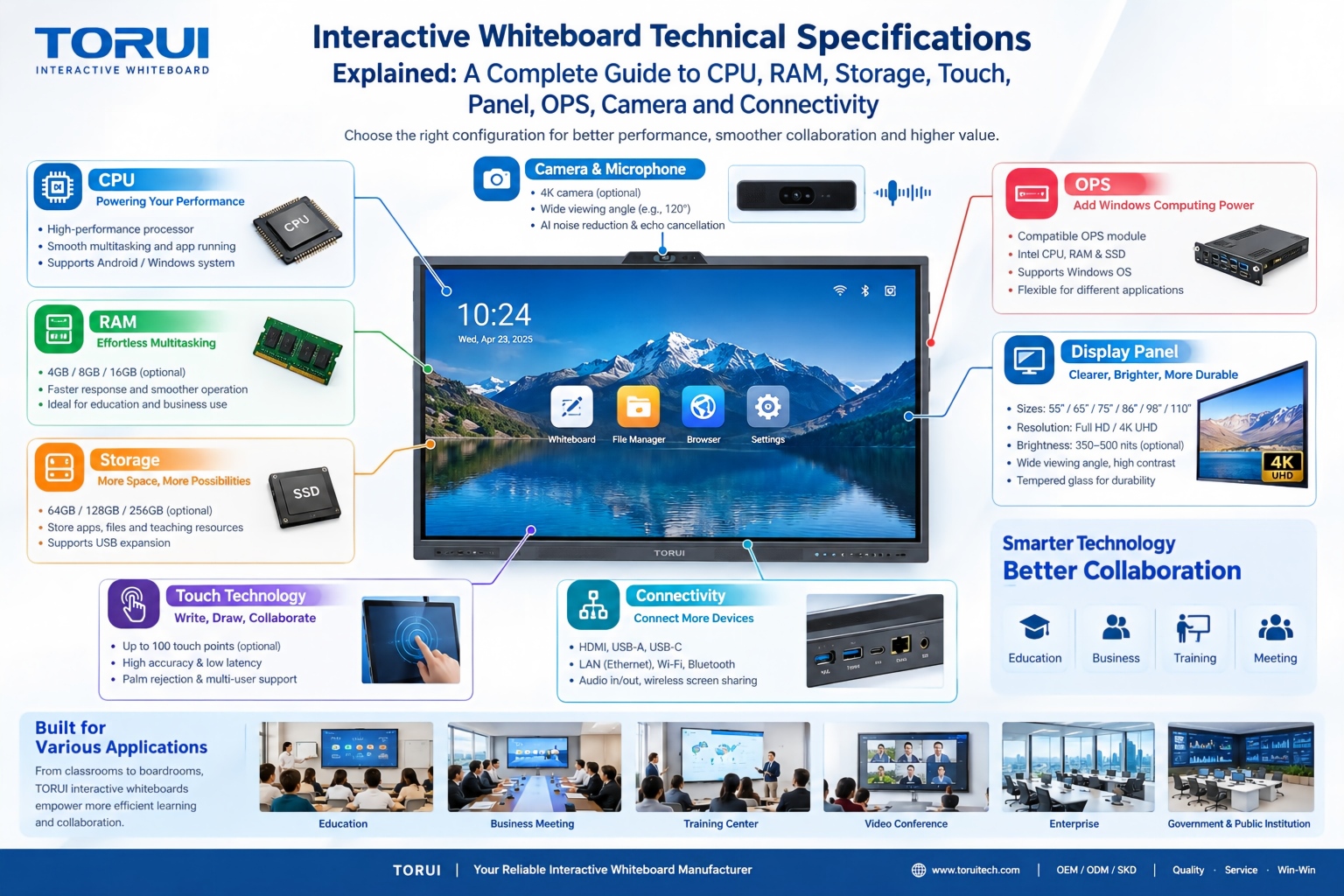
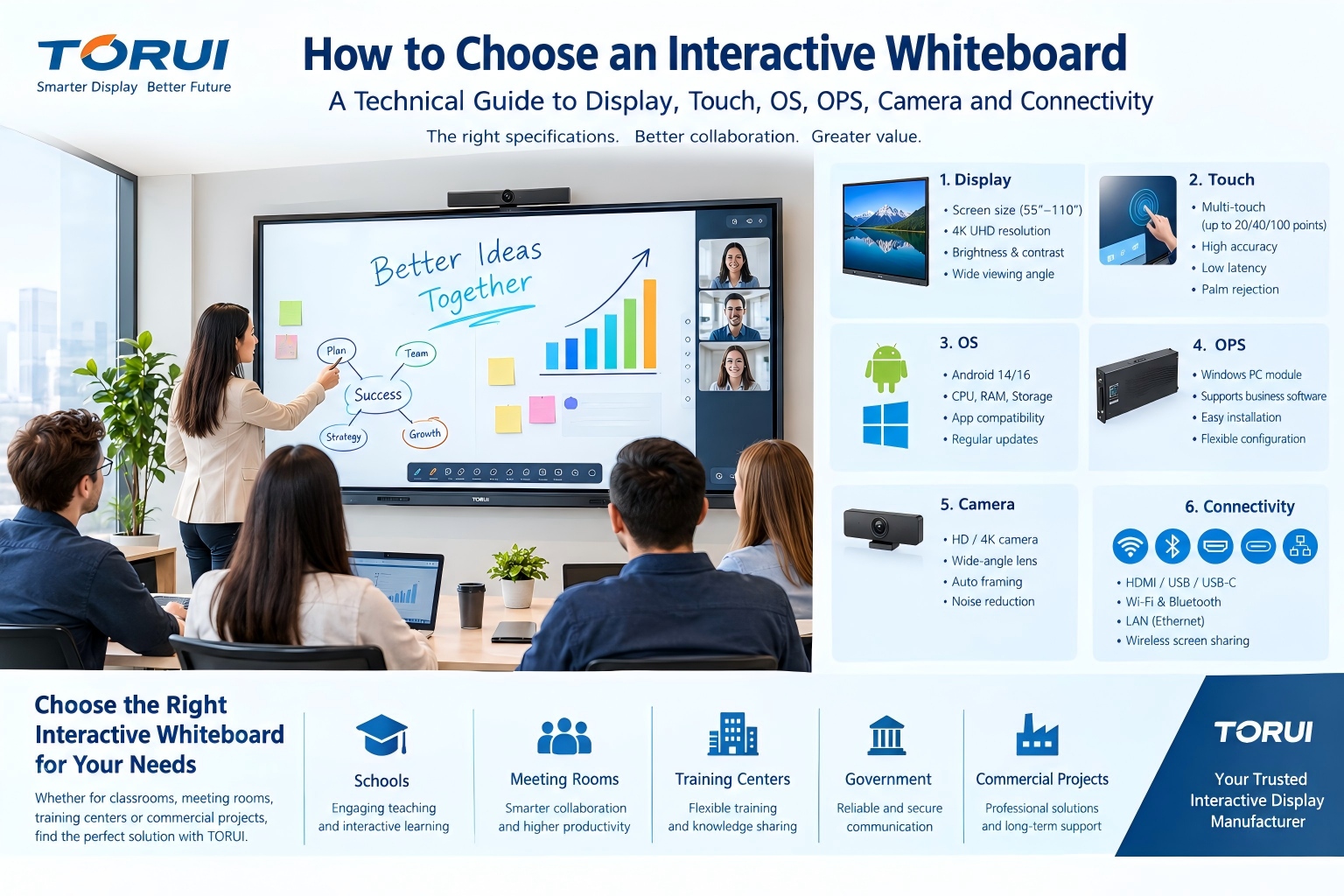
A touch screen display, often referred to as an interactive flat panel, is an all-in-one digital display that integrates a high-resolution screen, touch technology, and a built-in operating system. Unlike traditional interactive whiteboards, touch screen displays do not require an external projector. The display itself produces the image, usually with LED-backlit LCD panels and 4K resolution.
Touch screen displays are commonly used in meeting rooms, training centers, and modern classrooms. They support smooth touch interaction, wireless screen sharing, and built-in collaboration software. Many models also support an OPS computer module, allowing users to run Windows or other operating systems directly on the display.
Key Differences Between Interactive Whiteboards and Touch Screen Displays
1. Display Technology
Traditional interactive whiteboards rely on projectors to display images on the board surface. This can sometimes result in shadows or reduced brightness depending on the classroom lighting.
Touch screen displays use integrated digital panels with high brightness and resolution, providing clearer images and more consistent viewing quality.
2. Installation and Setup
Interactive whiteboards typically require a projector, mounting equipment, and a connected computer. This setup can involve more installation steps and maintenance.
Touch screen displays are usually plug-and-play devices that combine the screen, computing system, and touch functionality in one unit, making installation simpler.
3. Image Quality
Because projector-based systems depend on projection technology, the image quality may vary depending on the projector and environment.
Touch screen displays generally provide sharper visuals, often with 4K resolution, making them ideal for displaying detailed presentations, videos, and graphics.
4. Maintenance Requirements
Interactive whiteboards may require periodic projector maintenance, such as lamp replacement or calibration.
Touch screen displays typically require less maintenance because they do not rely on projection hardware.
5. Cost Considerations
Traditional interactive whiteboards can sometimes be more affordable initially, especially for smaller educational institutions. However, projector maintenance costs may add up over time.
Touch screen displays usually have a higher upfront cost but offer better long-term durability and lower maintenance requirements.
Which Option Is Better?
The best choice depends on the user’s needs and budget. For schools that already use projector-based systems, upgrading to an interactive whiteboard may be a practical option. However, many modern classrooms and corporate meeting rooms are shifting toward touch screen displays because of their higher image quality, integrated design, and easier maintenance.
Conclusion
Both interactive whiteboards and touch screen displays offer valuable interactive capabilities for education and business environments. Interactive whiteboards remain a reliable solution for many traditional classrooms, while touch screen displays represent a more modern, all-in-one approach to digital collaboration.
For organizations seeking better visual quality, simplified installation, and advanced collaboration features, touch screen displays are often the preferred solution. However, selecting the right technology ultimately depends on the specific requirements of the learning or meeting environment.
Impact of Rising Memory Chip Prices on the Interactive Whiteboard Industry
Benefits of Interactive Whiteboards for Education
Related Article