
How do interactive whiteboards help teachers and students improve teaching efficiency?
author: toruitech
2025-08-05

With the continuous advancement of educational informatization, interactive whiteboards (IWBs) have become a vital feature of modern classrooms. They integrate the functions of computers, projectors, and traditional blackboards, bringing a completely new teaching experience to teachers and students. Interactive whiteboards not only enrich teaching methods but also significantly enhance teaching efficiency. This article will elaborate on how interactive whiteboards can help teachers and students improve teaching efficiency from multiple perspectives.
1. Stimulating Learning Interest and Mobilizing Classroom Enthusiasm
Interactive whiteboards offer a wealth of multimedia capabilities, capable of displaying a variety of content formats, including images, animations, audio, and video. Compared to the simple text and images of traditional blackboards, whiteboards' vibrant, dynamic, and vivid content greatly capture students' attention. For example, when teaching geography, teachers can use the whiteboard to display animations of the Earth's rotation and revolution, helping students intuitively grasp abstract concepts. In conjunction with internet search results, interactive whiteboards' features, such as spotlights, screens, and playback, can also be used to design diverse teaching activities, such as using spotlights to review vocabulary and playback to simulate physical phenomena. These interactive experiences not only liven up the classroom atmosphere but also encourage students to actively participate in learning.
2. Promote teacher-student interaction and enhance classroom communication
The interactivity of interactive whiteboards is one of their greatest advantages. Teachers can write, draw, and annotate directly on the whiteboard, even accessing virtual teaching aids such as physics, chemistry, and biology lab equipment and math tools, making demonstrations and explanations easy. Students can then approach the whiteboard to present, practice, and collaborate, truly achieving "teacher-student interaction" and "student-student interaction." This interactive approach breaks the traditional teacher-led, student-passive classroom structure and fully leverages students' dominant role. By leveraging internet search results and the specialized features and application techniques of electronic whiteboards, diverse teaching activities can be designed to enhance student attention and engagement, fostering a collaborative learning atmosphere.
3. Integrate and expand teaching resources and improve resource utilization
Interactive whiteboards offer powerful resource integration capabilities. Teachers can pre-load a variety of teaching resources, including courseware, images, audio, and video, into the whiteboard's resource library, allowing them to access and combine them as needed during class. For example, in a Chinese language class, teachers can explain the text while displaying relevant images, playing music, and even introducing short videos to create context. In subjects like mathematics and physics, teachers can use the whiteboard to draw geometric shapes and demonstrate experimental procedures, greatly enriching teaching resources and methods. This resource integration capability effectively expands classroom capacity and enhances the relevance and effectiveness of teaching.
IV. Convenient Operation and Efficient Classroom Management
Interactive whiteboards support direct touch, writing, and erasing operations, eliminating the need for teachers to frequently switch between the computer and the blackboard, significantly saving class time. Teachers can annotate, modify, and save teaching content directly on the whiteboard, even storing their notes with a single click for easy post-class review and archiving. For knowledge points that require repeated review, whiteboards support cross-screen playback, breaking through the limitations of traditional blackboard space and content and eliminating the inefficient labor of repetitive writing. According to internet searches, interactive whiteboards can also communicate with computer applications via the network, allowing teachers to quickly access and display various resources, significantly improving classroom management efficiency. 5. Promoting Personalized Learning and Cultivating Innovation
Interactive whiteboards provide strong support for personalized teaching. Teachers can flexibly adjust teaching content and pace based on student learning progress, achieving tailored instruction. For example, in English instruction, teachers can set different exercises for students at different levels and use whiteboards for group interaction to meet students' individual learning needs. Whiteboards also provide students with more opportunities for expression and creativity. Students can draw, write, and showcase their thoughts and works on the whiteboard, cultivating their innovative and practical abilities. Internet research also indicates that interactive whiteboards can promote students' individual development and enhance their innovative abilities.
6. Improving Teaching Quality and Classroom Effectiveness
Interactive whiteboards not only improve teaching efficiency but also fundamentally optimize teaching quality. Rich multimedia resources, flexible interactive methods, and efficient classroom management make teaching content more intuitive, systematic, and effective. Teachers can focus more on lesson design and student guidance, reducing repetitive tasks. Students, in turn, can actively explore, actively think, and collaborate in a lively and engaging classroom atmosphere, comprehensively improving their overall quality. According to internet searches, interactive whiteboards can effectively stimulate students' interest in learning, overcome teaching difficulties, and create an efficient communication platform, becoming a powerful tool for improving classroom teaching effectiveness.
VII. Future-oriented Teaching Innovation Platform
With the development of technologies such as artificial intelligence, big data, and cloud computing, interactive whiteboards are constantly upgrading to support new features such as remote learning, intelligent grading, and data analysis. In the future, interactive whiteboards will become a key infrastructure for smart education, driving the development of digital, intelligent, and personalized classroom teaching.
Conclusion
In summary, interactive whiteboards, with their powerful multimedia integration capabilities, convenient operation, rich interactive functions, and efficient classroom management, provide teachers and students with a highly effective teaching platform. They not only improve classroom efficiency but also promote students' active learning and personal development, making them an indispensable tool for modern education. Teachers should fully explore and utilize the advantages of interactive whiteboards, continuously innovate teaching methods, and truly enable information technology to serve education, thereby contributing to the overall improvement of teaching quality and efficiency.
Interactive Whiteboard Applications in Meetings
Smart Boards: Opening a New Chapter in Smart Education and Efficient Collaboration
Related Article

Choosing the right interactive whiteboard size is an important decision for distributors, wholesalers, and education technology suppliers. The 65-inch, 75-inch, and 86-inch interactive whiteboards are popular options for classrooms, meeting rooms, training centers, and commercial projects.
65 vs 75 vs 86-Inch Interactive Whiteboard: Which Model Should Distributors Choose?

Choosing the right interactive whiteboard manufacturer in China is an important decision for distributors, wholesalers, education technology suppliers, and system integrators. The right manufacturing partner can help businesses improve product quality, maintain competitive pricing, customize products for local markets, and build a sustainable distribution business.
Who Are the Best Interactive Whiteboard Manufacturers in China for B2B Distributors and Wholesalers?
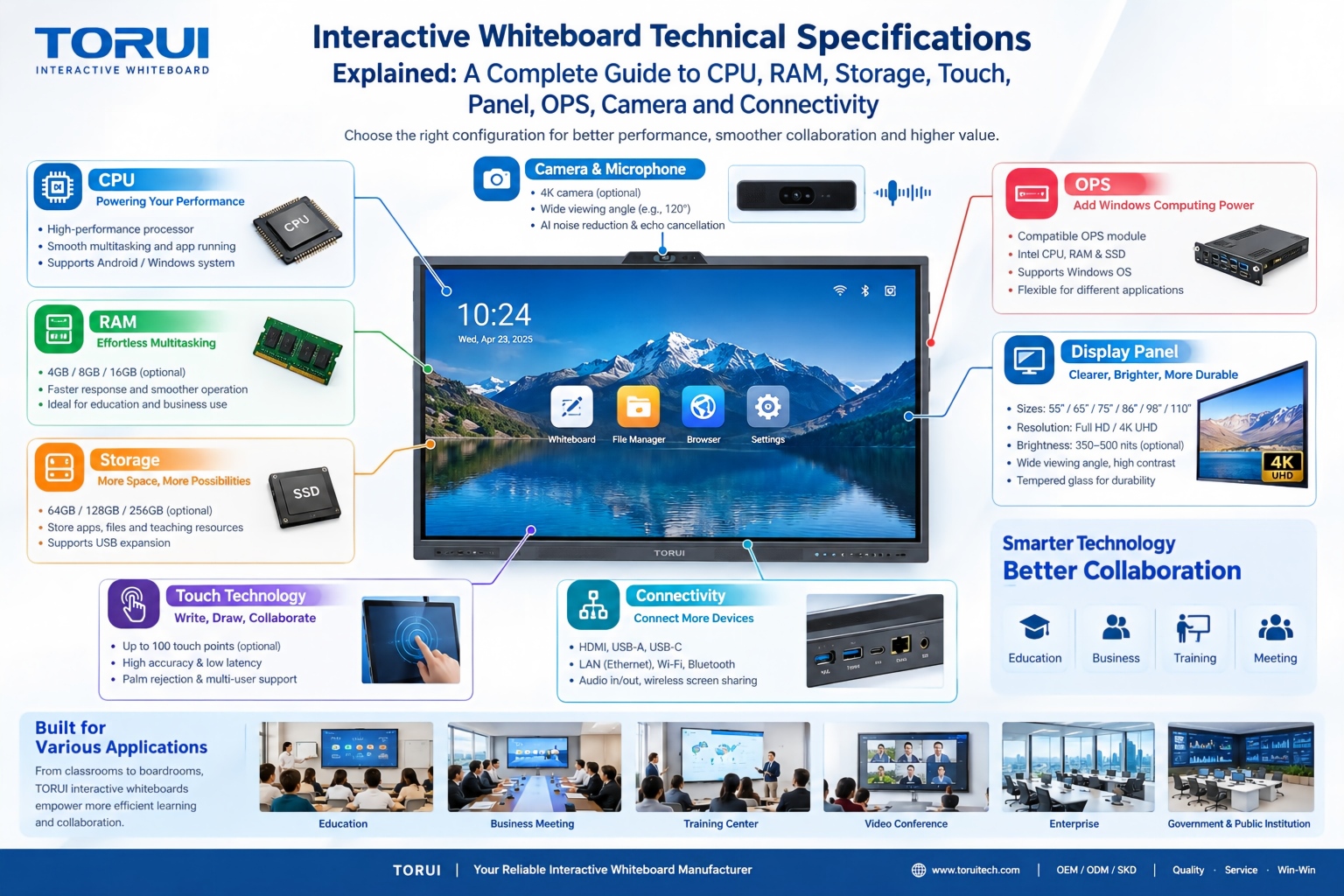
Choosing an interactive whiteboard involves more than comparing screen sizes and prices. For schools, businesses, distributors, wholesalers, and system integrators, understanding the technical specifications is essential to selecting a reliable product that meets different application requirements.
Interactive Whiteboard Technical Specifications Explained: A Complete Guide to CPU, RAM, Storage, Touch, Panel, OPS, Camera and Connectivity
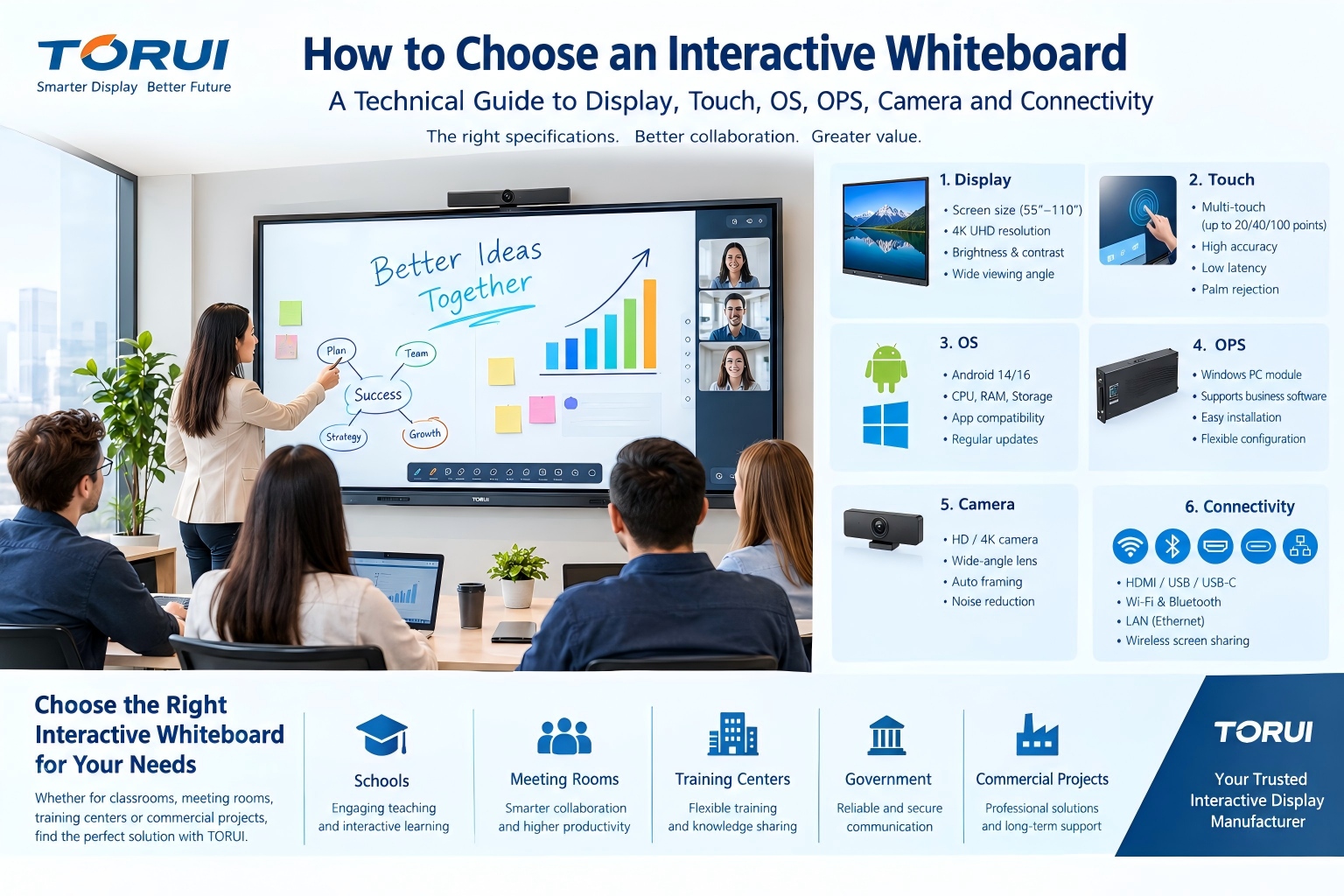
Choosing an interactive whiteboard for a school, meeting room, training center, government organization or commercial project requires more than comparing screen size and price. The most important specifications include display resolution, brightness, touch technology, operating system, processor, memory, storage, OPS compatibility, camera and microphone performance, connectivity, durability and after-sales support.
How to Choose an Interactive Whiteboard: A Technical Guide to Display, Touch, OS, OPS, Camera and Connectivity