
Primary and Secondary Schools Welcome the Fall Start of School—Interactive Whiteboards Empower Smart Classrooms
author: toruitech
2025-08-27

With the accelerating pace of global educational informatization, the fall semester will begin for primary and secondary schools around the world in 2025. This is not only a crucial moment for students to return to campus and embark on a new journey of knowledge, but also an opportunity for education systems around the world to showcase innovation and promote pedagogical change. In recent years, interactive whiteboards, as a key component of smart classrooms, have been widely adopted in primary and secondary schools around the world, contributing to efficient, intelligent, and interactive teaching environments.
I. Analysis of Fall School Start Dates in Primary and Secondary Schools Around the World
The fall start dates for primary and secondary schools vary across countries, primarily influenced by factors such as climate, culture, and educational systems. For example, in most US states, primary and secondary schools typically begin in late August or early September, while in the UK, the start date is early September. European countries like France and Germany also generally begin their new semester in September. Asian countries like China, Japan, and South Korea generally begin their new semester around September 1st. In southern hemisphere countries like Australia and New Zealand, due to opposite seasons, the fall semester typically begins early in the year (February or March), though some schools also follow the same academic system as the northern hemisphere.
The first day of school not only marks the start of a new semester but also signals the implementation of a new round of educational reforms and technological innovations by education authorities around the world. With the arrival of the new semester, schools across the country are investing resources in upgrading teaching equipment and promoting the deep integration of information technology into classroom instruction. The widespread use of interactive whiteboards is a prime example of this.
II. Interactive Whiteboards Empower Smart Classrooms
Interactive whiteboards are intelligent devices that integrate electronic writing, touch-screen operation, and multimedia presentations. They not only offer the writing functions of traditional blackboards but also integrate a variety of teaching resources, including images, audio, video, and animation, greatly enriching classroom expression. Teachers can flexibly display courseware, highlight key points, and conduct real-time interactive Q&A sessions. Students can actively participate in class discussions and take the stage for demonstrations, fostering deep interaction between teacher and student.
Related research and practical application feedback indicate that interactive whiteboards offer significant advantages in improving classroom efficiency and teaching quality. First, it optimizes classroom structure, making the teaching process more flexible and enabling teachers to adjust teaching content in real time based on student feedback. Second, powerful annotation, editing, and saving features make knowledge presentation clearer, facilitating post-class review and independent learning. Furthermore, teachers can access a wealth of teaching resources at any time through a network connection, enabling resource sharing and remote learning.
III. Interactive Whiteboards Promote Innovation in Classroom Models
The use of interactive electronic whiteboards has not only improved classroom technology but also profoundly transformed teaching models. Traditional classrooms, where teachers led the class and students passively accepted, are shifting to interactive, student-centered classrooms where both teachers and students participate. The diverse functions of electronic whiteboards provide more opportunities for communication and collaboration between teachers and students, stimulating their interest in learning and their innovative abilities. This is particularly beneficial for the transformation and all-round development of students with learning difficulties.
In practical teaching, teachers can design a variety of interactive activities, such as group discussions, on-site quizzes, and quizzes, to fully mobilize student enthusiasm. Students can use the whiteboard to independently present their learning achievements, participate in research projects, and cultivate independent thinking and teamwork skills. The development of smart classrooms makes the teaching process more open, inclusive, and efficient, facilitating individualized teaching and personalized development.
IV. Looking Ahead: Smart Classrooms Continue to Upgrade
As cutting-edge technologies such as artificial intelligence and big data continue to be integrated into the education sector, interactive whiteboards will be deeply integrated with more intelligent devices and teaching platforms, driving smart classrooms to a higher level. In the future, classrooms will become more intelligent, personalized, and collaborative, with more timely and effective interactions between teachers and students, and richer and more shared teaching resources.
In short, as schools reopen in the fall semester around the world, interactive whiteboards, as a key technological support for smart classrooms, are helping primary and secondary schools across the globe innovate their teaching models and improve educational quality. They not only enrich classroom content and optimize teaching processes, but also lay a solid foundation for students' all-round development and the cultivation of talent for future generations.
Specific Applications of Interactive Whiteboards in Meetings
Specific Applications of Interactive Whiteboards in Education
Related Article

Choosing the right interactive whiteboard size is an important decision for distributors, wholesalers, and education technology suppliers. The 65-inch, 75-inch, and 86-inch interactive whiteboards are popular options for classrooms, meeting rooms, training centers, and commercial projects.
65 vs 75 vs 86-Inch Interactive Whiteboard: Which Model Should Distributors Choose?

Choosing the right interactive whiteboard manufacturer in China is an important decision for distributors, wholesalers, education technology suppliers, and system integrators. The right manufacturing partner can help businesses improve product quality, maintain competitive pricing, customize products for local markets, and build a sustainable distribution business.
Who Are the Best Interactive Whiteboard Manufacturers in China for B2B Distributors and Wholesalers?
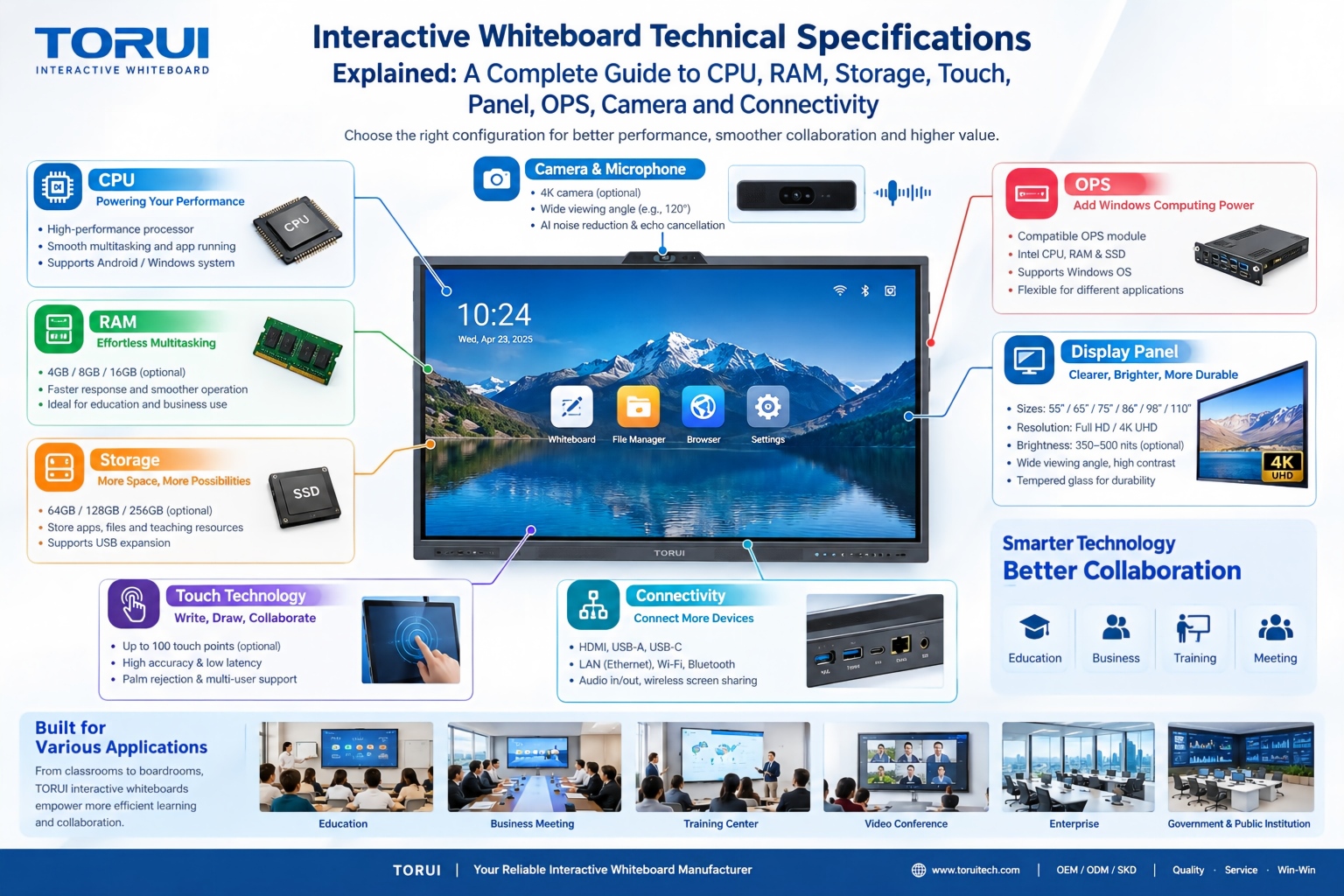
Choosing an interactive whiteboard involves more than comparing screen sizes and prices. For schools, businesses, distributors, wholesalers, and system integrators, understanding the technical specifications is essential to selecting a reliable product that meets different application requirements.
Interactive Whiteboard Technical Specifications Explained: A Complete Guide to CPU, RAM, Storage, Touch, Panel, OPS, Camera and Connectivity
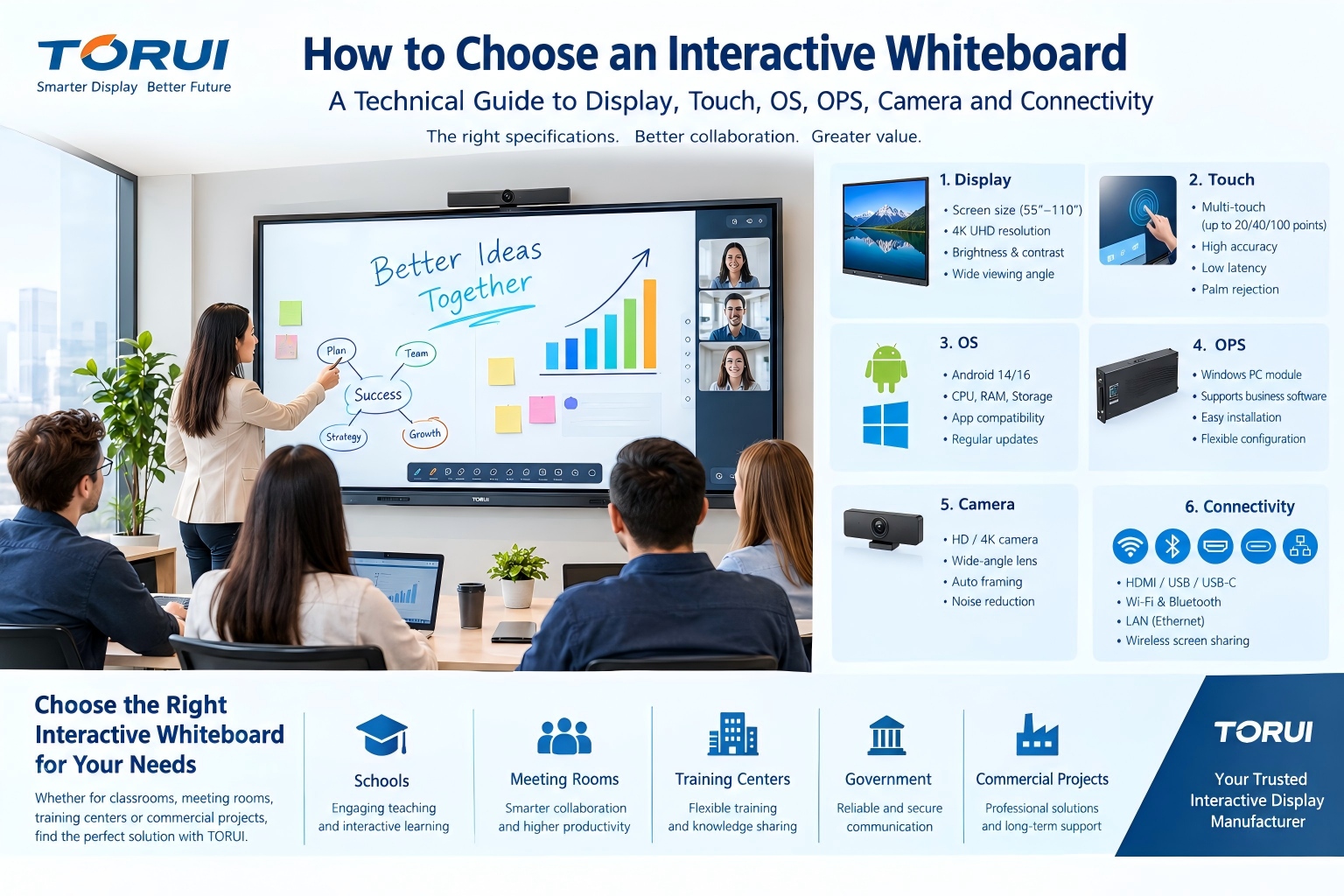
Choosing an interactive whiteboard for a school, meeting room, training center, government organization or commercial project requires more than comparing screen size and price. The most important specifications include display resolution, brightness, touch technology, operating system, processor, memory, storage, OPS compatibility, camera and microphone performance, connectivity, durability and after-sales support.
How to Choose an Interactive Whiteboard: A Technical Guide to Display, Touch, OS, OPS, Camera and Connectivity