
Key concerns of buyers purchasing smart interactive whiteboards
author: toruitech
2025-07-13

With the advancement of technology and the innovation of education and training methods, smart interactive whiteboards are gaining more and more attention in the education field and business environment. When purchasing smart interactive whiteboards, buyers usually focus on several key points to ensure that the product can meet their needs and provide the best user experience and return on investment. This article will elaborate on several aspects that buyers should focus on when purchasing smart interactive whiteboards.
1. Function and performance
First of all, buyers are most concerned about the functions and performance of smart interactive whiteboards. Different products may vary in functions, such as touch sensitivity, response speed, multi-touch capability, handwriting recognition, screen resolution and display effects. High resolution and excellent display effects can provide clearer and more delicate images, especially suitable for occasions that require high image quality, such as teaching, design and demonstration.
Multi-touch function is a highlight of smart whiteboards. It supports multiple people to operate at the same time, which is convenient for students or participants to interact and improve participation and collaboration efficiency. The handwriting recognition function makes writing more natural and smooth, and can automatically convert handwritten content into text for easy recording and subsequent use.
2. Usability
Usability is another factor that needs to be considered when purchasing a smart interactive whiteboard. The friendliness of the operating system, the simplicity of the user interface, and the ease of learning and use of software functions all directly affect the actual use effect and user experience of the product.
An intuitive and simple user interface can greatly reduce the time for training and getting started, allowing faculty and staff to quickly master and put it into use. In addition, supporting multiple input methods (such as stylus, touch finger, mouse, etc.) and being compatible with mainstream operating systems (such as Windows, MacOS, Android, etc.) will also increase the flexibility and scope of application of the device.
3. Compatibility and connectivity
In modern education and business environments, smart interactive whiteboards need to be interconnected with a variety of devices and platforms. Therefore, buyers need to consider the compatibility and connectivity of the whiteboard, including seamless connection with computers, tablets, smartphones, projectors, and network platforms.
High-quality smart interactive whiteboards are usually equipped with multiple interfaces (such as HDMI, USB, VGA, etc.) and wireless connections (such as WiFi, Bluetooth), supporting screen mirroring and real-time data transmission, making it convenient for users to switch and share content between different devices. In addition, compatibility with cloud services is becoming increasingly important, as this can enable cloud storage and sharing of data and improve collaboration efficiency.
4. Software support and scalability
Buyers should also pay attention to the software support and subsequent expansion capabilities that come with the smart whiteboard. Reliable pre-installed software and regular updates are the key to ensuring the stable operation and functional expansion of the whiteboard. Teaching software usually includes functions such as courseware production, classroom management, and student interaction; commercial software may involve meeting management, remote collaboration, data sharing, etc.
In addition, open source software support and compatibility with third-party applications should also be considered, as this can provide users with more choices and greater flexibility, allowing smart whiteboards to adapt to changing needs and scenarios.
5. Stability and durability
Stability and durability are important factors to ensure long-term use. Smart interactive whiteboards should have a sturdy structure and high-quality materials to ensure that they remain in good condition under frequent use. Features such as anti-fall, waterproof, and dustproof can also effectively extend the service life of the equipment.
In addition, the stability and reliability of the system are crucial. Excellent operating systems and firmware can avoid crashes and data loss, and provide a stable and smooth user experience. Before purchasing, you can evaluate the stability and durability of the whiteboard by checking the manufacturer's technical parameters, customer reviews, and experimental test results.
6. After-sales service and technical support
Excellent after-sales service and technical support can ensure that the equipment can be solved in time when problems occur, reducing the impact on teaching and work. Buyers should pay attention to the warranty policy, maintenance service, technical support response time, and support methods (such as telephone, email, online customer service, etc.) provided by the manufacturer.
Good after-sales service is not only a guarantee of product quality, but also a reflection of the manufacturer's commitment to customers. Some high-end brands also provide value-added services such as door-to-door service, regular inspections, and free training, which can significantly improve the overall user satisfaction.
7. Cost and cost-effectiveness
When buyers choose smart interactive whiteboards, price is also a factor that cannot be ignored. Although high-quality equipment usually has a higher price, buyers should consider the product's functions, performance, after-sales service, and service life, and pursue the most cost-effective solution. Long-term use costs, including maintenance and update costs, also need to be calculated.
8. Environmental protection and energy efficiency
Finally, environmental protection and energy efficiency are also important considerations for modern procurement. Low energy consumption, environmentally friendly materials, and recyclable designs not only meet green environmental protection requirements, but also reduce use costs. Buyers can check the energy efficiency label and environmental certification of the equipment to evaluate the environmental performance of the smart whiteboard.
Conclusion
In summary, purchasing a smart interactive whiteboard is a decision that requires multi-faceted considerations. Functions and performance, ease of use, compatibility and connectivity, software support and scalability, stability and durability, after-sales service and technical support, cost and cost-effectiveness, and environmental protection and energy efficiency are all factors that buyers need to focus on. Through comprehensive evaluation and comparison, buyers can choose the smart interactive whiteboard that best suits them and maximize educational and commercial value.
How is the market for interactive whiteboards in Europe and the United States?
The Digital Board for Classroom: Revolutionizing Modern Education
Related Article

Choosing the right interactive whiteboard size is an important decision for distributors, wholesalers, and education technology suppliers. The 65-inch, 75-inch, and 86-inch interactive whiteboards are popular options for classrooms, meeting rooms, training centers, and commercial projects.
65 vs 75 vs 86-Inch Interactive Whiteboard: Which Model Should Distributors Choose?

Choosing the right interactive whiteboard manufacturer in China is an important decision for distributors, wholesalers, education technology suppliers, and system integrators. The right manufacturing partner can help businesses improve product quality, maintain competitive pricing, customize products for local markets, and build a sustainable distribution business.
Who Are the Best Interactive Whiteboard Manufacturers in China for B2B Distributors and Wholesalers?
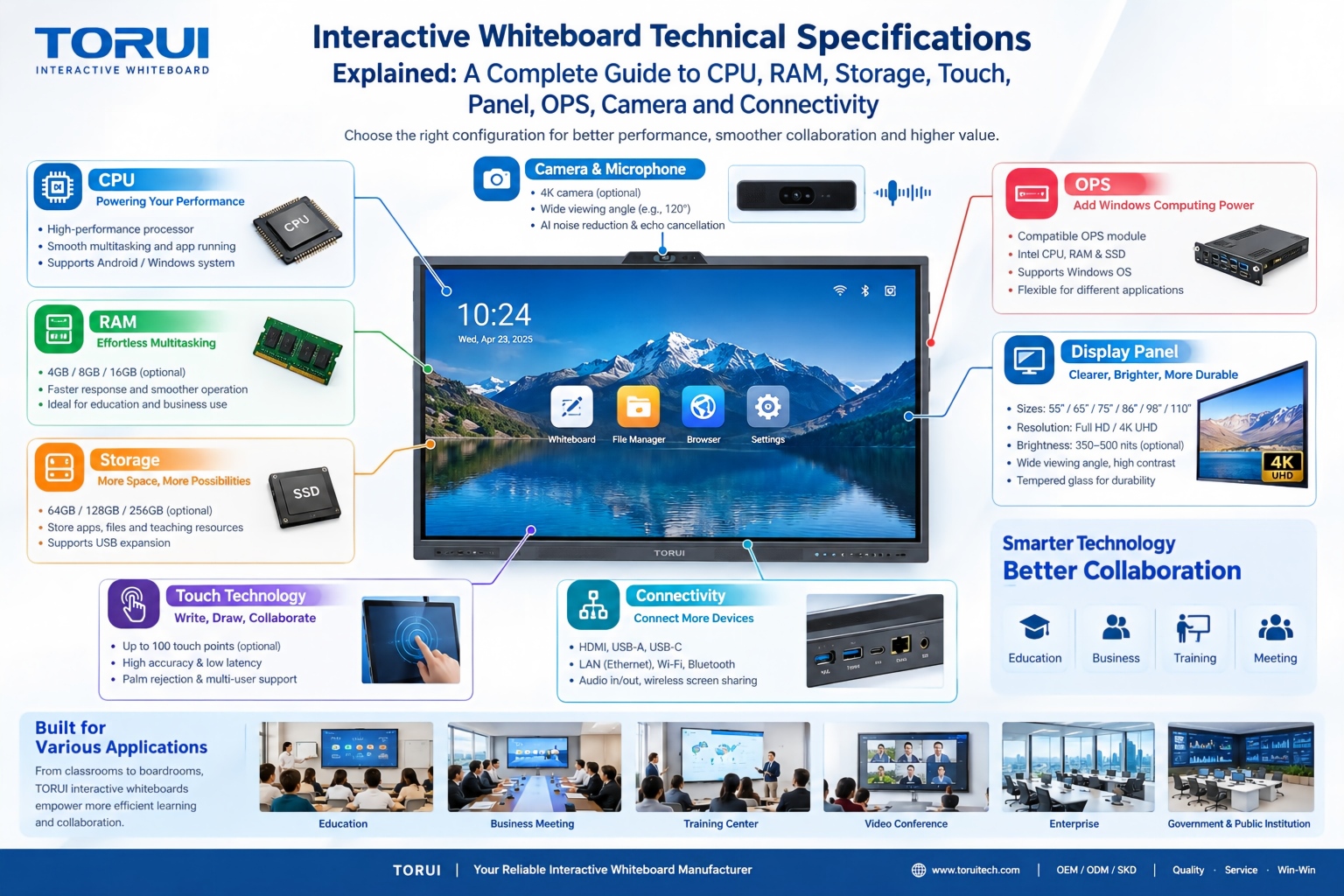
Choosing an interactive whiteboard involves more than comparing screen sizes and prices. For schools, businesses, distributors, wholesalers, and system integrators, understanding the technical specifications is essential to selecting a reliable product that meets different application requirements.
Interactive Whiteboard Technical Specifications Explained: A Complete Guide to CPU, RAM, Storage, Touch, Panel, OPS, Camera and Connectivity
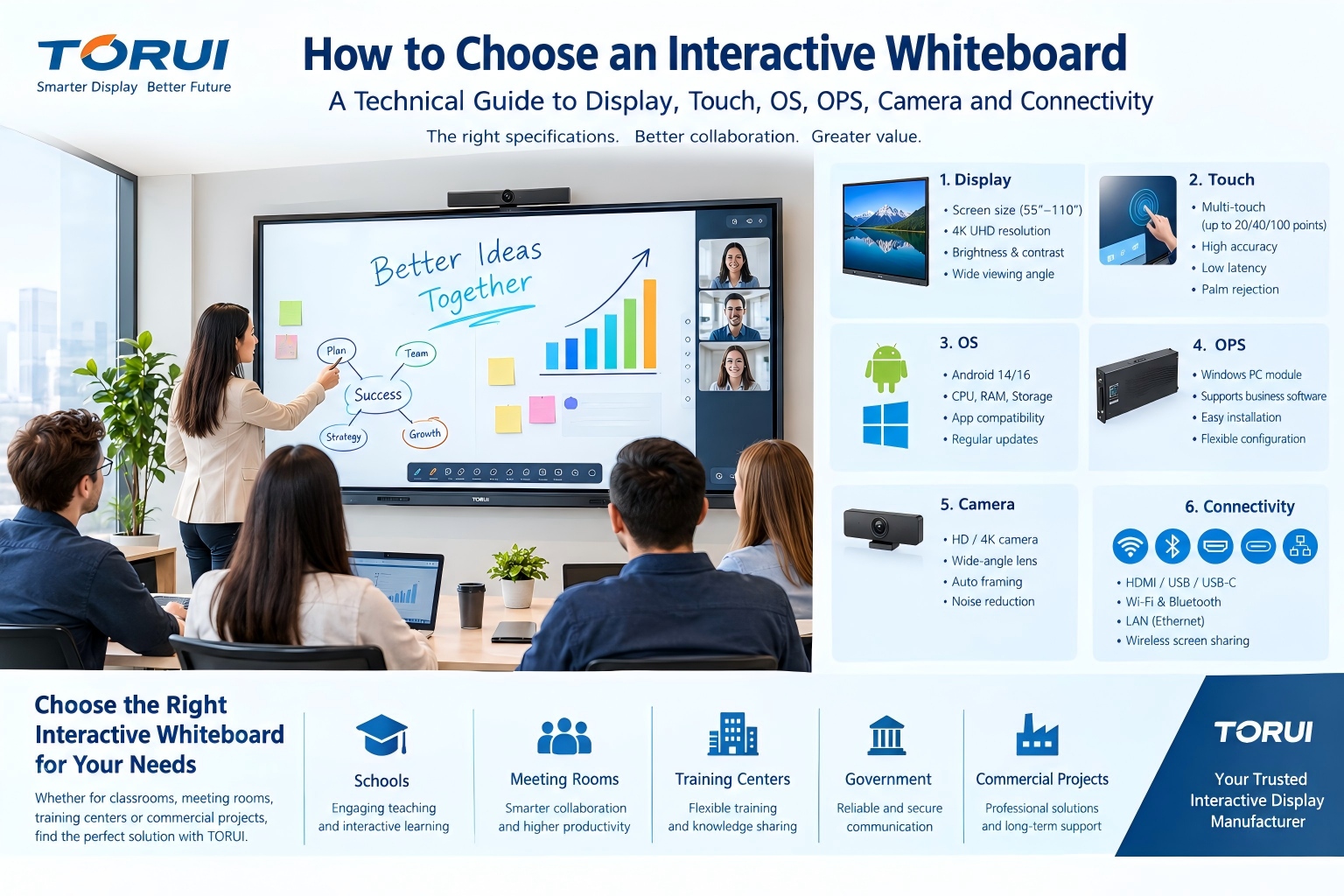
Choosing an interactive whiteboard for a school, meeting room, training center, government organization or commercial project requires more than comparing screen size and price. The most important specifications include display resolution, brightness, touch technology, operating system, processor, memory, storage, OPS compatibility, camera and microphone performance, connectivity, durability and after-sales support.
How to Choose an Interactive Whiteboard: A Technical Guide to Display, Touch, OS, OPS, Camera and Connectivity