
LED vs LCD Interactive Whiteboard: Which Is Better for Education and Business?
author: toruitech
2026-03-07

When choosing an interactive whiteboard for classrooms or meeting rooms, buyers often encounter two common display technologies: LED and LCD. While both technologies can deliver high-quality visuals and interactive functionality, they differ in their display structure, brightness, cost, and ideal application scenarios. Understanding these differences can help schools and businesses select the most suitable interactive whiteboard for their needs.
What Is an LED Interactive Whiteboard?
An LED interactive whiteboard uses light-emitting diodes as the primary light source to produce images on the display. LEDs generate their own light, allowing the screen to achieve high brightness and strong contrast.
Because LED displays are self-illuminating and energy-efficient, they often provide vivid colors and excellent visibility even in brightly lit environments.
In large display installations, LED technology also allows flexible screen sizes and modular designs, making it suitable for very large screens such as digital signage walls or conference hall displays.
What Is an LCD Interactive Whiteboard?
LCD stands for Liquid Crystal Display, a technology that uses liquid crystals to control how light passes through the screen to create images. The display requires a backlight source, which is often provided by LED lighting in modern screens.
LCD panels are widely used in interactive whiteboards for classrooms and offices because they deliver high resolution, stable image quality, and clear text rendering, which is important for reading documents, presentations, and teaching materials.
Most interactive flat panels used in education today are LCD-based displays with LED backlighting, offering a balance of performance and cost efficiency.
Key Differences Between LED and LCD Interactive Whiteboards
1. Display Brightness
LED displays generally produce higher brightness levels, making them easier to view in environments with strong ambient light.
LCD displays provide softer brightness that can be more comfortable for close viewing, which is common in classrooms and meeting rooms.
2. Image Quality and Contrast
LED technology can offer higher contrast and deeper blacks because the light output can be more precisely controlled.
LCD panels typically deliver excellent color accuracy and sharp text, which is especially beneficial when displaying detailed educational content or presentations.
3. Screen Size Flexibility
LED displays can be built in modular panels and assembled into extremely large screens.
LCD interactive whiteboards usually come in fixed sizes such as 65-inch, 75-inch, 86-inch, or 98-inch, which are ideal for classrooms and meeting spaces.
4. Cost and Practicality
In most educational environments, LCD interactive whiteboards are more affordable and easier to deploy at scale. LCD technology also integrates well with touch systems such as infrared or capacitive touch, enabling smooth writing and multi-touch interaction.
LED displays, while powerful, can be significantly more expensive for large interactive touch solutions.
Which Technology Is Better for Interactive Whiteboards?
For schools, training centers, and conference rooms, LCD interactive whiteboards are usually the most practical option. They offer clear image quality, reliable touch interaction, and cost-effective deployment for everyday teaching and collaboration.
LED technology, on the other hand, is more commonly used in large digital display walls, auditoriums, or advertising screens where brightness and scalability are more important than close-range interaction.
Conclusion
Both LED and LCD technologies play an important role in modern interactive display solutions. LED displays excel in brightness, contrast, and large-scale installations, while LCD interactive whiteboards remain the preferred choice for classrooms and meeting environments due to their affordability, readability, and stable touch performance.
For most educational institutions and corporate users, choosing a high-quality LCD interactive whiteboard with advanced touch technology and 4K resolution will provide the best balance of performance, usability, and long-term value.
Benefits of Interactive Whiteboards for Education
Best 75-Inch Interactive Whiteboard for Classrooms
Related Article

Choosing the right interactive whiteboard size is an important decision for distributors, wholesalers, and education technology suppliers. The 65-inch, 75-inch, and 86-inch interactive whiteboards are popular options for classrooms, meeting rooms, training centers, and commercial projects.
65 vs 75 vs 86-Inch Interactive Whiteboard: Which Model Should Distributors Choose?

Choosing the right interactive whiteboard manufacturer in China is an important decision for distributors, wholesalers, education technology suppliers, and system integrators. The right manufacturing partner can help businesses improve product quality, maintain competitive pricing, customize products for local markets, and build a sustainable distribution business.
Who Are the Best Interactive Whiteboard Manufacturers in China for B2B Distributors and Wholesalers?
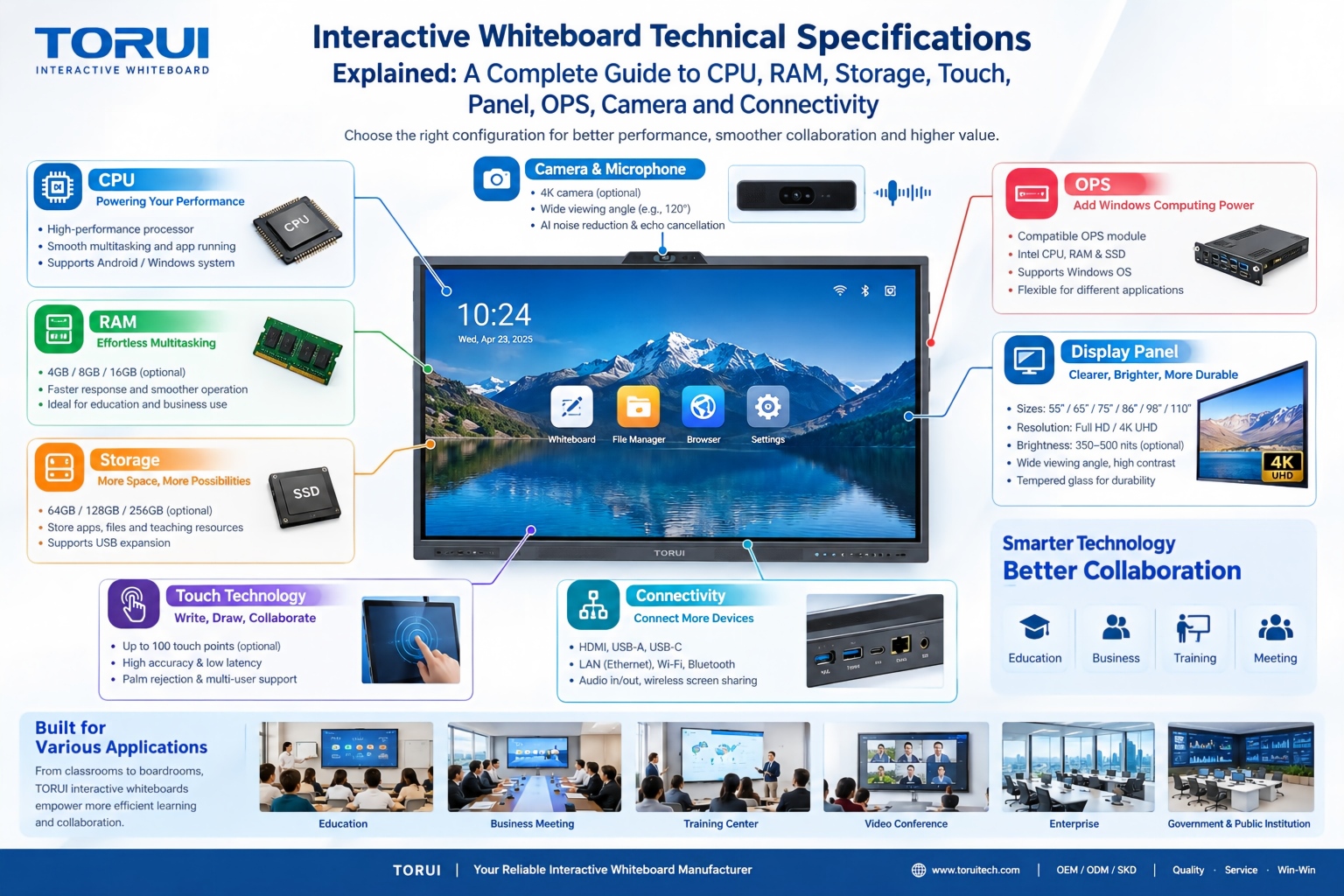
Choosing an interactive whiteboard involves more than comparing screen sizes and prices. For schools, businesses, distributors, wholesalers, and system integrators, understanding the technical specifications is essential to selecting a reliable product that meets different application requirements.
Interactive Whiteboard Technical Specifications Explained: A Complete Guide to CPU, RAM, Storage, Touch, Panel, OPS, Camera and Connectivity
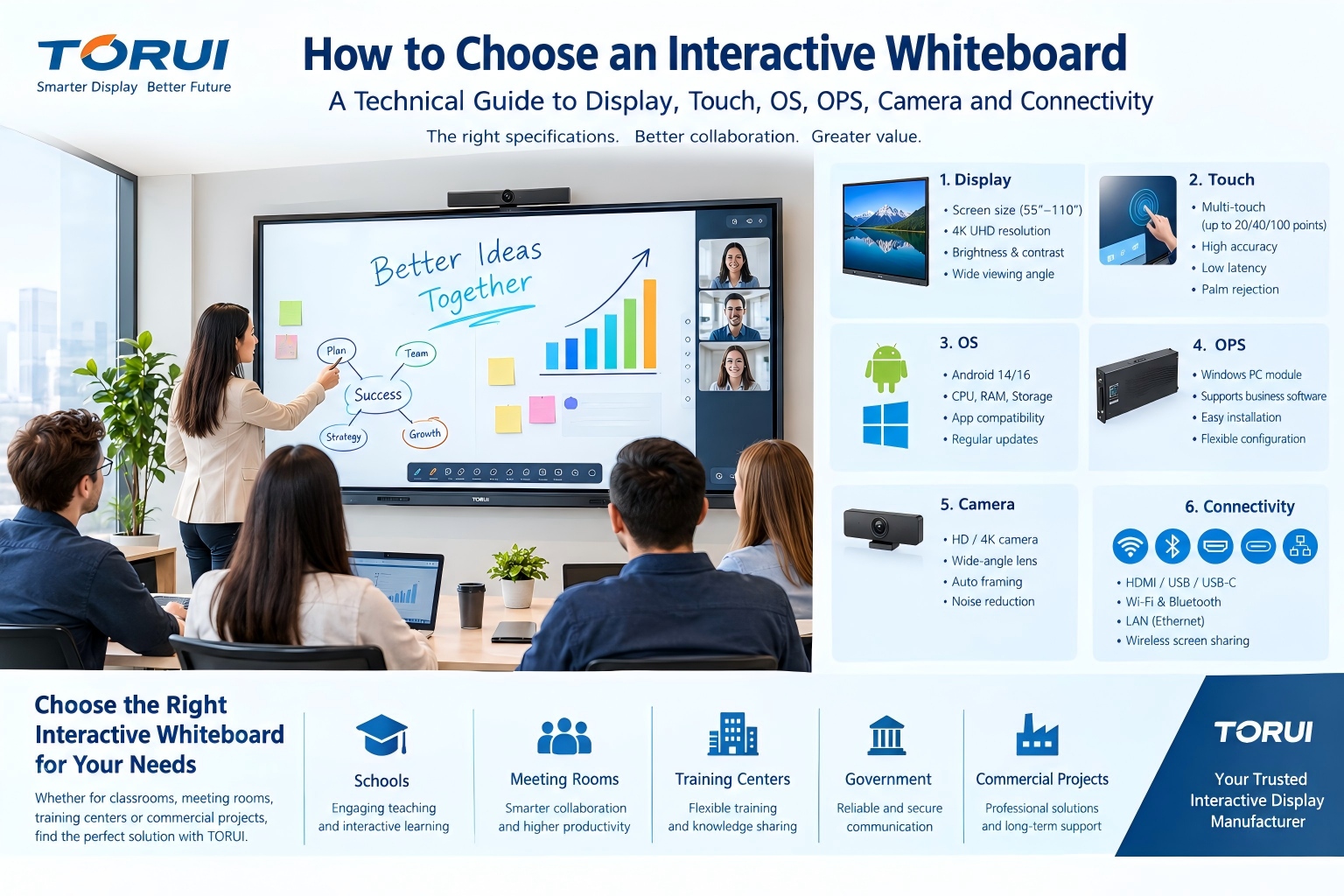
Choosing an interactive whiteboard for a school, meeting room, training center, government organization or commercial project requires more than comparing screen size and price. The most important specifications include display resolution, brightness, touch technology, operating system, processor, memory, storage, OPS compatibility, camera and microphone performance, connectivity, durability and after-sales support.
How to Choose an Interactive Whiteboard: A Technical Guide to Display, Touch, OS, OPS, Camera and Connectivity