
Interactive whiteboards are exported to the world. What are the main logistics and transportation methods?
author: toruitech
2025-07-17

Exporting interactive whiteboards to the global market requires comprehensive consideration of multiple logistics and transportation methods to ensure that they are delivered to the destination safely and on time. This not only affects the operational efficiency of the enterprise, but is also directly related to customer satisfaction and business expansion. The following is an in-depth analysis of the main logistics and transportation methods:
1. Ocean Freight
Advantages and Applicable Scenarios
Ocean freight is one of the most commonly used international logistics and transportation methods in the world. It is known for its large volume and low cost. It is particularly suitable for large and bulk exported products such as interactive whiteboards. Ocean freight is an efficient option for transportation from the country of production to countries or regions that are far away.
Limitations
The main limitation of ocean freight is that it takes a long time to ship, usually from weeks to months. In addition, ocean freight is also affected by factors such as weather and port congestion. For products that are easily damaged or require fast delivery, ocean freight may not be the best choice.
2. Air Freight
Advantages and Applicable Scenarios
Air freight is favored for its fast speed and high efficiency, and is suitable for time-sensitive interactive whiteboard orders. For urgent orders or high-value products, air freight can ensure fast delivery.
Limitations
The cost of air transport is relatively high, and there are restrictions on the size, weight and quantity of goods. Therefore, air transport is mostly used for goods that are of high importance or small quantities and need to be delivered urgently.
3. Road transport
Advantages and applicable scenarios
Road transport is highly flexible and suitable for short-distance transportation and regional distribution of goods. In cross-border transportation, it is often used to transport goods that arrive at the port by sea or air to the final destination. For transportation between neighboring countries, road is also a common mode.
Limitations
Road transport is easily affected by factors such as weather and traffic conditions, and the transportation time may not be stable enough. In addition, for ultra-long-distance cross-border transportation, its cost and efficiency disadvantages are obvious.
4. Railway transport
Advantages and applicable scenarios
Railway transport is particularly prominent in Eurasia, providing an intermediate option that is faster than sea transport and cheaper than air transport. It is suitable for large-scale interactive whiteboard transportation, especially from Asia to Europe.
Limitations
Railway line coverage is limited and needs to be used in conjunction with other modes of transportation. It is not applicable to remote areas or areas without railway connections.
5. Intermodal transport
Advantages and applicable scenarios
By combining sea, air, rail and road transport, intermodal transport achieves optimized door-to-door service. This method can effectively improve logistics efficiency and reduce the inherent risks of a single mode of transport.
Limitations
Intermodal transport is more complex in coordination and management, and requires experienced logistics suppliers to plan and implement.
6. Express service
Advantages and applicable scenarios
International express companies such as DHL, UPS, and FedEx can deliver small batches of high-value goods at extremely fast speeds. Suitable for the delivery of samples or small-scale orders.
Limitations
Express delivery costs are high and are not suitable for the transportation of bulk goods.
Comprehensive analysis
When choosing a logistics transportation method, it is necessary to comprehensively consider the physical characteristics of the interactive whiteboard, delivery time requirements, destination market, and budget and cost control strategies. Generally, sea transportation is suitable for regular large-volume orders, air transportation is used for time-sensitive situations, and intermodal transport and express delivery provide a balance between stability and speed. In order to achieve the best transportation results, companies need to carefully select reliable logistics partners and make arrangements based on the dynamics of the global market and the characteristics of their own supply chain.
A Deeper Look at the Price Factors of Smart Interactive Whiteboards
Interactive whiteboards ensure high quality and safety with ISO, CE, FCC, ROHS and CCC certifications
Related Article

Choosing the right interactive whiteboard size is an important decision for distributors, wholesalers, and education technology suppliers. The 65-inch, 75-inch, and 86-inch interactive whiteboards are popular options for classrooms, meeting rooms, training centers, and commercial projects.
65 vs 75 vs 86-Inch Interactive Whiteboard: Which Model Should Distributors Choose?

Choosing the right interactive whiteboard manufacturer in China is an important decision for distributors, wholesalers, education technology suppliers, and system integrators. The right manufacturing partner can help businesses improve product quality, maintain competitive pricing, customize products for local markets, and build a sustainable distribution business.
Who Are the Best Interactive Whiteboard Manufacturers in China for B2B Distributors and Wholesalers?
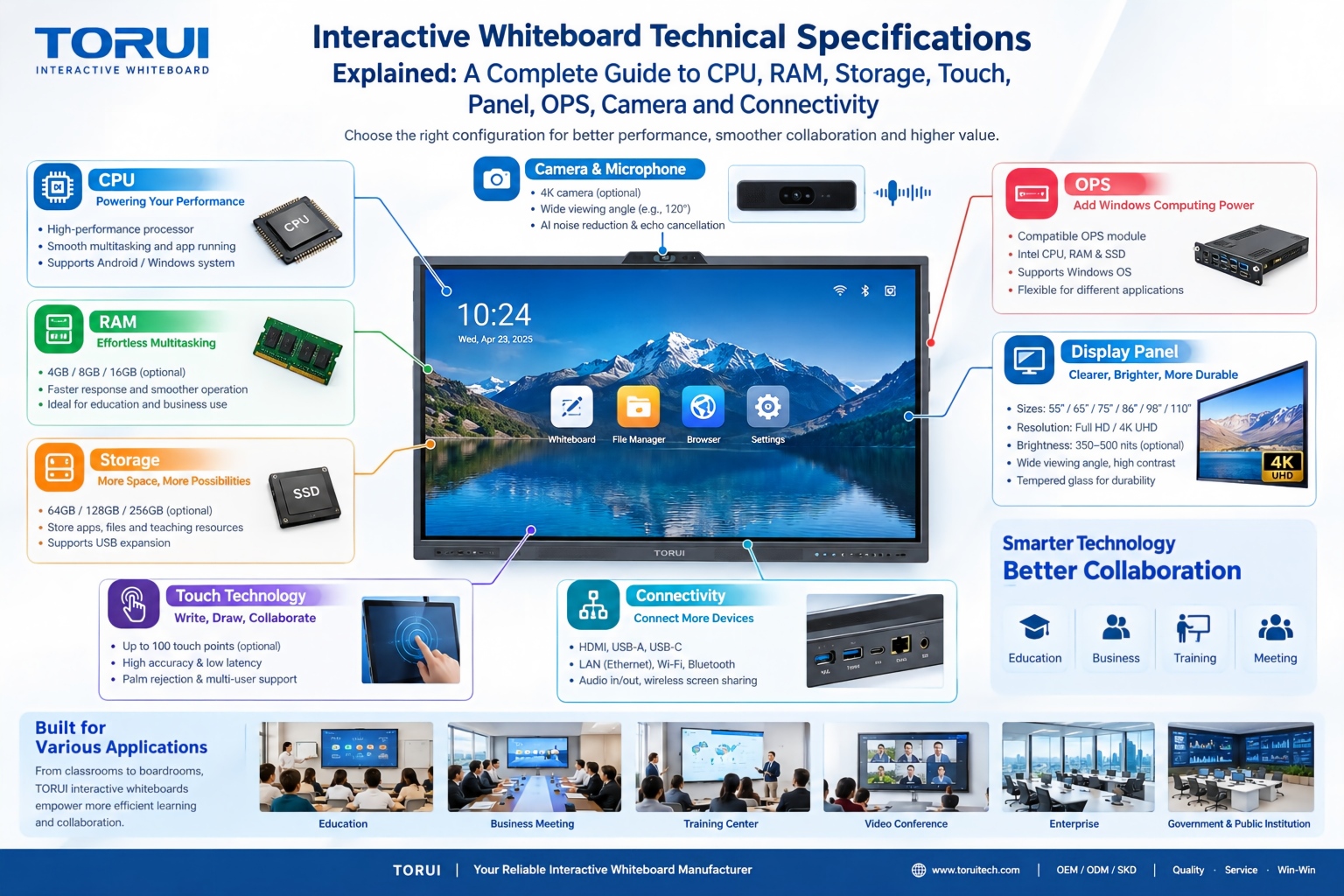
Choosing an interactive whiteboard involves more than comparing screen sizes and prices. For schools, businesses, distributors, wholesalers, and system integrators, understanding the technical specifications is essential to selecting a reliable product that meets different application requirements.
Interactive Whiteboard Technical Specifications Explained: A Complete Guide to CPU, RAM, Storage, Touch, Panel, OPS, Camera and Connectivity
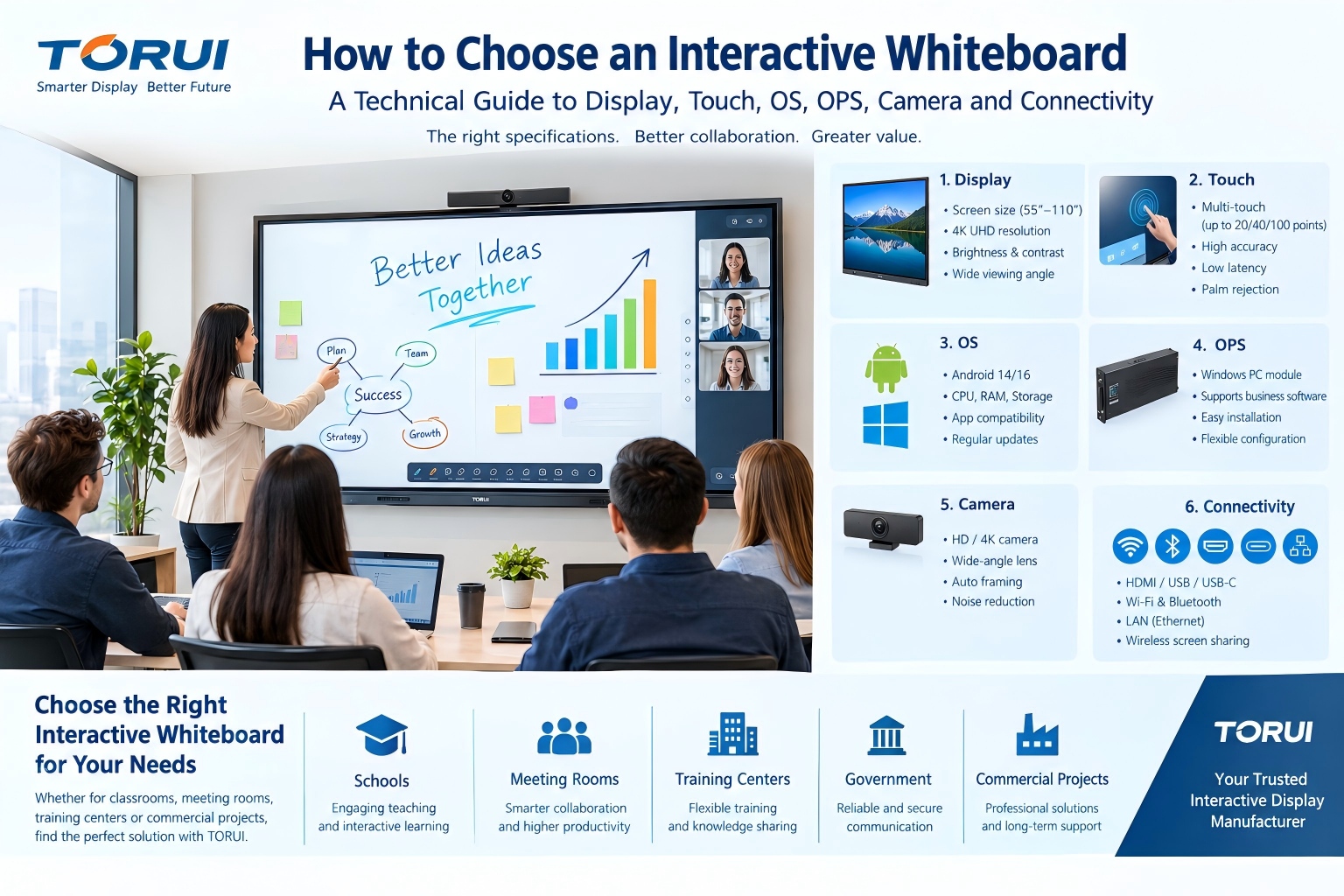
Choosing an interactive whiteboard for a school, meeting room, training center, government organization or commercial project requires more than comparing screen size and price. The most important specifications include display resolution, brightness, touch technology, operating system, processor, memory, storage, OPS compatibility, camera and microphone performance, connectivity, durability and after-sales support.
How to Choose an Interactive Whiteboard: A Technical Guide to Display, Touch, OS, OPS, Camera and Connectivity