
RK3588 vs RK3576 for Interactive Whiteboards — Which Is Better?
author: toruitech
2025-11-17

When choosing a system-on-chip (SoC) for an interactive whiteboard (IWB), the decision should be guided by the board’s target market (premium vs. cost-sensitive), intended features (4K/8K playback, video-conferencing, AI features, multi-window UI), and power/thermal constraints. Below I compare the two Rockchip chips — RK3588 and RK3576 — and give clear recommendations for typical smart-board deployments.
Core technical differences (what matters for IWBs)
-
CPU & performance:
RK3588 uses a big.LITTLE mix with Cortex-A76 high-performance cores + A55 efficiency cores, giving stronger single-thread and multi-thread performance for heavy UI, browser rendering, and multi-app workflows. RK3576 targets high efficiency with a Cortex-A72 + A53 cluster design, suitable for smooth Android UIs but generally lower raw CPU throughput than RK3588. -
GPU & graphics:
RK3588 employs an Arm Mali-G610 class GPU, which is significantly more capable for complex UI animations, hardware-accelerated 3D or multi-video layering. RK3576 typically ships with a Mali-G52 variant (less powerful). For interactive panels that run 4K multi-window environments or high-quality annotation effects, RK3588 provides a noticeably better experience. -
Video & multimedia:
RK3588 supports higher-resolution video pipelines (including strong 8K decode/encode capabilities and advanced display interfaces such as HDMI 2.1 / DP1.4), making it future-proof for ultra-high-res content and multi-input scenarios. RK3576 is very capable for 4K@60/120 workflows (and supports modern codecs) but generally targets 4K-class boards rather than 8K/advanced multi-stream setups. -
AI / NPU:
Both chips are geared toward edge AI features (onboard NPUs reported in the same ballpark for many RK variants). However, the RK3588 platform is commonly used in heavier AI+multimedia scenarios thanks to its overall higher system bandwidth. For computer-vision tasks used in smart classrooms (gesture detection, camera auto-framing), both can work, but RK3588 will handle larger ML models and multi-stream inference more comfortably.
Practical implications for interactive whiteboards
-
Premium education or boardroom panels (4K multi-window, cloud video, heavy annotation, room sensors): choose RK3588. It handles demanding UIs, multiple simultaneous video streams, hardware acceleration for codecs, and richer graphics — resulting in snappier menus, smoother touch/pen interactions, and better room-scale AI features.
-
Mid-range / cost-sensitive panels (standard 4K teaching panels, basic conferencing, single-app focus): RK3576 is a compelling choice. It offers modern codec support, good NPU capacity for common AI tasks, and lower BOM/thermal cost — a better balance for mass-market IWBs where price and power efficiency matter.
Quick decision checklist
-
Need the smoothest multi-app 4K UI, frequent 4K/8K playback, or heavy AI features → RK3588.
-
Prioritizing cost, lower power/heat, and reliable 4K performance for classrooms → RK3576.
Short spec highlights (summary)
-
RK3588: stronger CPU (A76), Mali-G610 GPU, HDMI2.1/DP1.4, 8K capable, higher system bandwidth.
-
RK3576: efficient CPU cluster (A72/A53), Mali-G52 class GPU, excellent 4K codec support, usually lower cost and power.
Conclusion
Both SoCs are modern and capable; RK3588 is best for high-end, future-proof interactive whiteboards where top UI fluidity, multi-stream video, and advanced AI are required. RK3576 is an excellent, more economical choice for mainstream 4K IWBs where cost, power efficiency, and solid multimedia support are the priority. Pick based on the product tier and user expectations: premium boards → RK3588; mainstream education/entry commercial boards → RK3576.
75 Inch vs 86 Inch Interactive Display – Which Size Should You Choose?
OPS Computer: The Essential Computing Module for Modern Interactive Displays
Related Article

Choosing the right interactive whiteboard size is an important decision for distributors, wholesalers, and education technology suppliers. The 65-inch, 75-inch, and 86-inch interactive whiteboards are popular options for classrooms, meeting rooms, training centers, and commercial projects.
65 vs 75 vs 86-Inch Interactive Whiteboard: Which Model Should Distributors Choose?

Choosing the right interactive whiteboard manufacturer in China is an important decision for distributors, wholesalers, education technology suppliers, and system integrators. The right manufacturing partner can help businesses improve product quality, maintain competitive pricing, customize products for local markets, and build a sustainable distribution business.
Who Are the Best Interactive Whiteboard Manufacturers in China for B2B Distributors and Wholesalers?
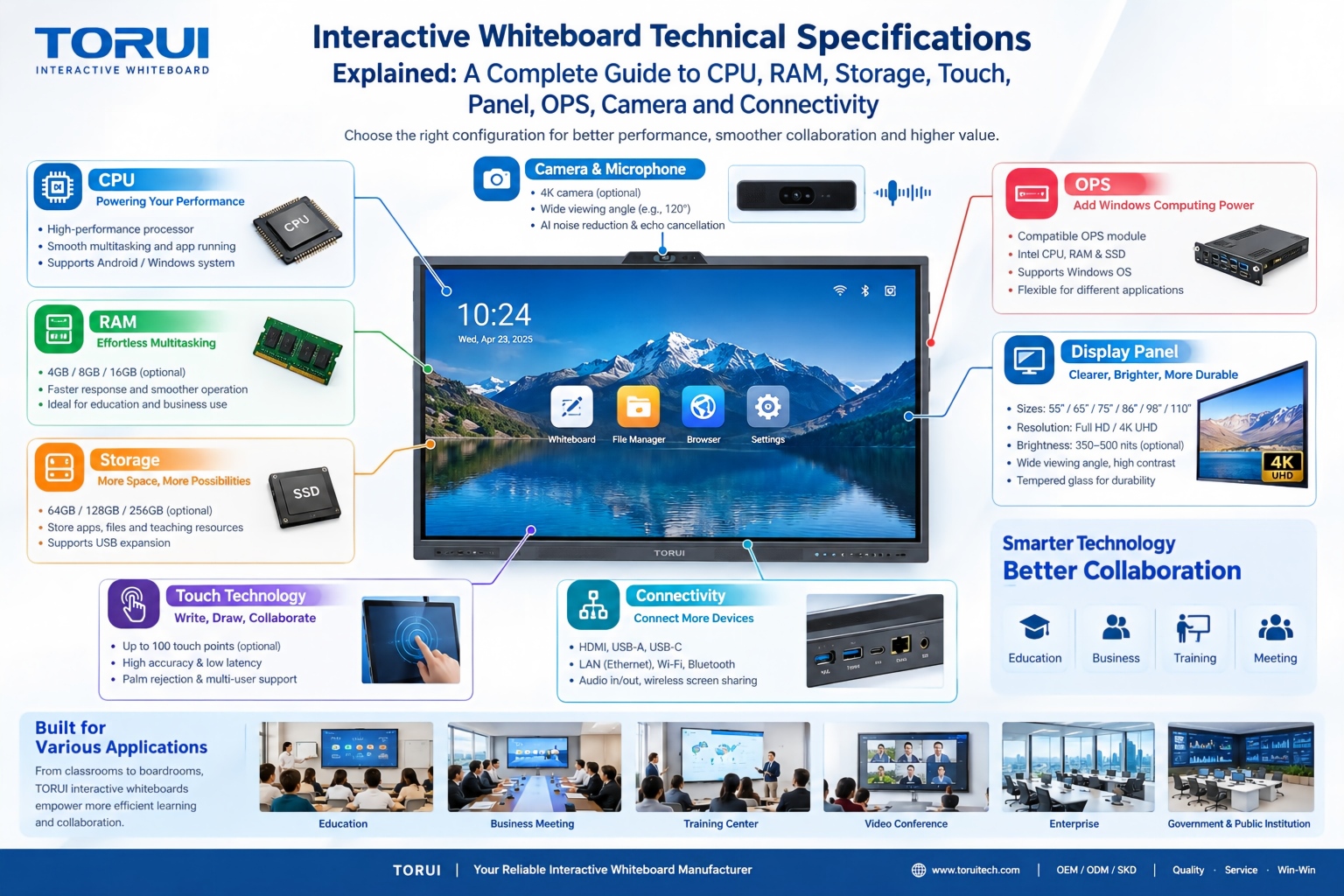
Choosing an interactive whiteboard involves more than comparing screen sizes and prices. For schools, businesses, distributors, wholesalers, and system integrators, understanding the technical specifications is essential to selecting a reliable product that meets different application requirements.
Interactive Whiteboard Technical Specifications Explained: A Complete Guide to CPU, RAM, Storage, Touch, Panel, OPS, Camera and Connectivity
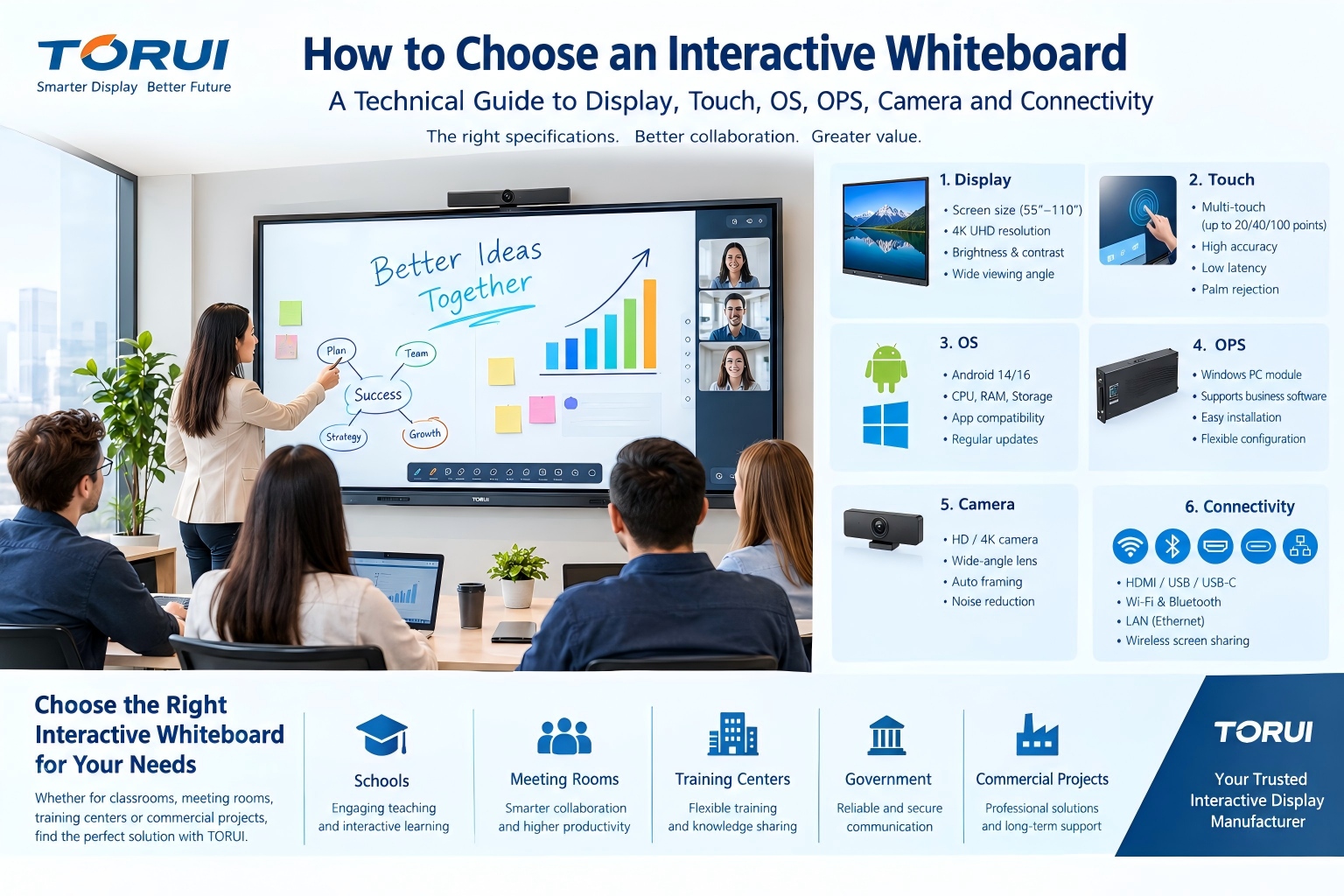
Choosing an interactive whiteboard for a school, meeting room, training center, government organization or commercial project requires more than comparing screen size and price. The most important specifications include display resolution, brightness, touch technology, operating system, processor, memory, storage, OPS compatibility, camera and microphone performance, connectivity, durability and after-sales support.
How to Choose an Interactive Whiteboard: A Technical Guide to Display, Touch, OS, OPS, Camera and Connectivity