
Smart Board for Classroom: Revolutionizing Modern Education
author: toruitech
2025-07-11

In today's rapidly advancing technological landscape, integrating digital tools into the classroom has become essential. Among these tools, the smart board for classroom settings stands out as a game-changer. This article explores the features, benefits, and applications of smart boards in educational environments.
Features of Smart Boards for Classrooms
A smart board for classroom use, also known as an interactive whiteboard, combines a large display screen with touch-sensitive input, often connected to a computer and projector. Key features include:
1. Interactive Touch Screen: Allows teachers and students to interact using a touch pen or their fingers, writing, drawing, and manipulating objects directly on the screen.
2. High-Resolution Display: Ensures that all content, including text, images, and videos, is displayed clearly, making it easy for students to view from any part of the room.
3. Multiple Connectivity Options: Compatible with various devices such as laptops, tablets, and smartphones, facilitating easy access to educational content from different sources.
4. Multimedia Integration: Supports a variety of media formats, enhancing lessons with videos, audio clips, and interactive simulations.
5. Real-Time Collaboration: Enables simultaneous input from multiple users, fostering group activities and collaborative learning.
Benefits of Using Smart Boards in Classrooms
Enhanced Student Engagement
Smart boards make lessons more interactive and engaging. The dynamic display and interactive features capture students' attention and keep them involved. Teachers can use multimedia content to explain complex concepts more effectively, catering to different learning styles.
Improved Academic Performance
Interactive smart boards encourage active participation, which has been shown to improve retention and comprehension. By transforming passive learning into an interactive experience, students are more likely to understand and remember the material.
Facilitates Diverse Teaching Methods
Smart boards support a range of teaching techniques, from traditional lecturing to modern flipped classrooms. Teachers can quickly switch between different types of content and resources, adapting their approach based on the needs of their students.
Encourages Collaboration
With features that support group work and collaboration, smart boards create opportunities for students to work together on projects, share ideas, and learn from each other. This cooperative learning model helps develop critical thinking and problem-solving skills.
Applications of Smart Boards in Classroom Settings
Interactive Lessons
Teachers can use smart boards to create interactive lessons that involve direct student participation. For example, math teachers can use visual aids to demonstrate geometric concepts, while science teachers can display interactive simulations of biological processes.
Digital Note-Taking
During lectures, notes written on the smart board can be saved and shared with students, ensuring everyone has access to accurate and complete information. This feature also helps students who may have difficulty following along in real-time.
Virtual Field Trips
Smart boards can be used to take students on virtual field trips, exploring historical sites, museums, and natural wonders without leaving the classroom. This immersive experience broadens students' horizons and deepens their understanding of the curriculum.
Remote Learning Support
In situations where remote learning is necessary, smart boards facilitate seamless integration with online teaching platforms. Teachers can conduct live sessions, share their screens, and interact with students in real-time, ensuring continuity in education delivery.
Conclusion
The adoption of smart board for classroom use is transforming the educational landscape. Their interactive features, high-quality displays, and versatile applications make them an invaluable tool for modern teaching. By enhancing student engagement, improving academic performance, and supporting diverse teaching methods, smart boards are paving the way for a more dynamic and effective educational experience. As technology continues to evolve, smart boards will undoubtedly play a crucial role in shaping the future of education.
Choosing the best Smart Board Distributors: The key to improving teaching and office efficiency
Smart whiteboard: a powerful tool to improve modern teaching and office efficiency
Related Article

Choosing the right interactive whiteboard size is an important decision for distributors, wholesalers, and education technology suppliers. The 65-inch, 75-inch, and 86-inch interactive whiteboards are popular options for classrooms, meeting rooms, training centers, and commercial projects.
65 vs 75 vs 86-Inch Interactive Whiteboard: Which Model Should Distributors Choose?

Choosing the right interactive whiteboard manufacturer in China is an important decision for distributors, wholesalers, education technology suppliers, and system integrators. The right manufacturing partner can help businesses improve product quality, maintain competitive pricing, customize products for local markets, and build a sustainable distribution business.
Who Are the Best Interactive Whiteboard Manufacturers in China for B2B Distributors and Wholesalers?
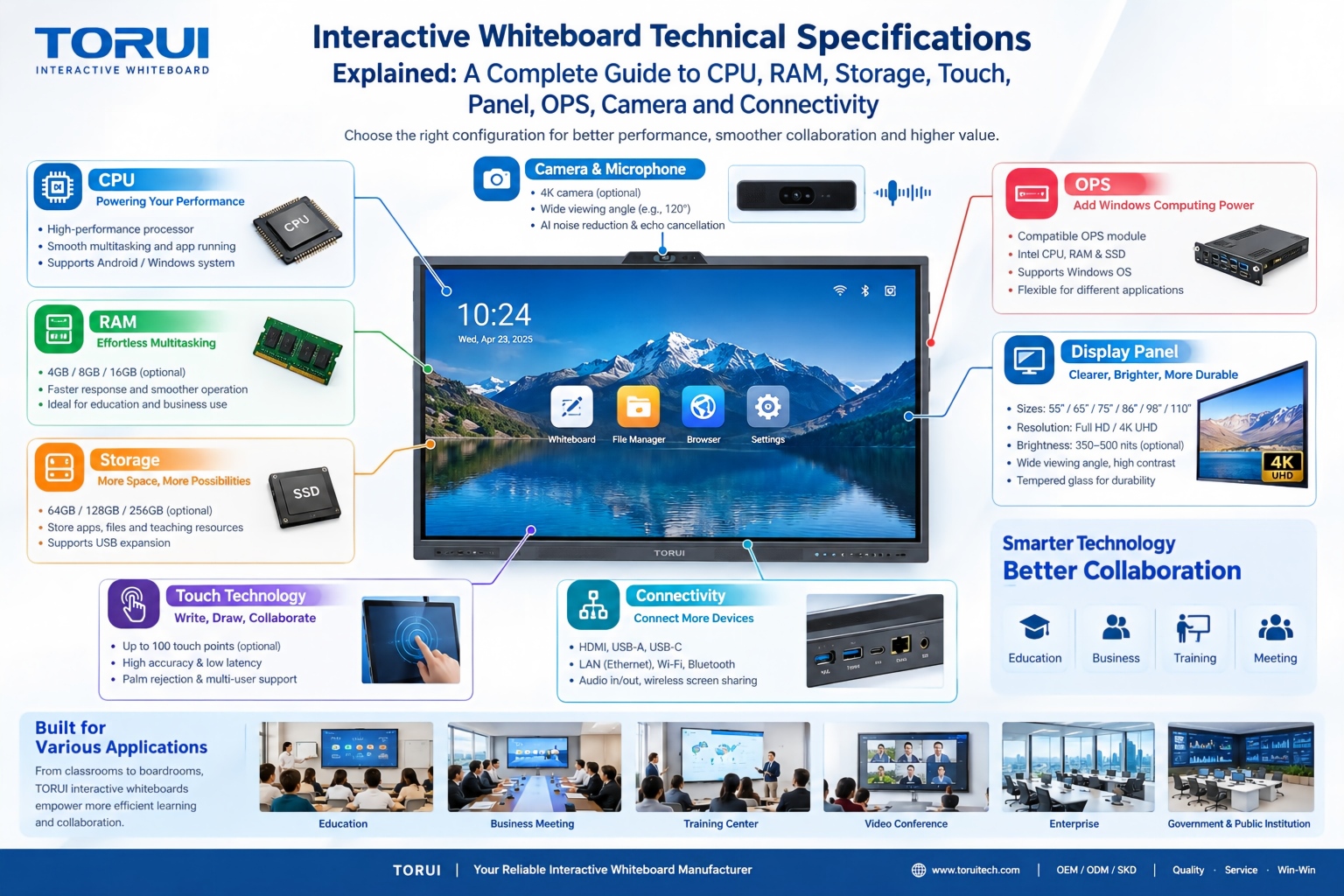
Choosing an interactive whiteboard involves more than comparing screen sizes and prices. For schools, businesses, distributors, wholesalers, and system integrators, understanding the technical specifications is essential to selecting a reliable product that meets different application requirements.
Interactive Whiteboard Technical Specifications Explained: A Complete Guide to CPU, RAM, Storage, Touch, Panel, OPS, Camera and Connectivity
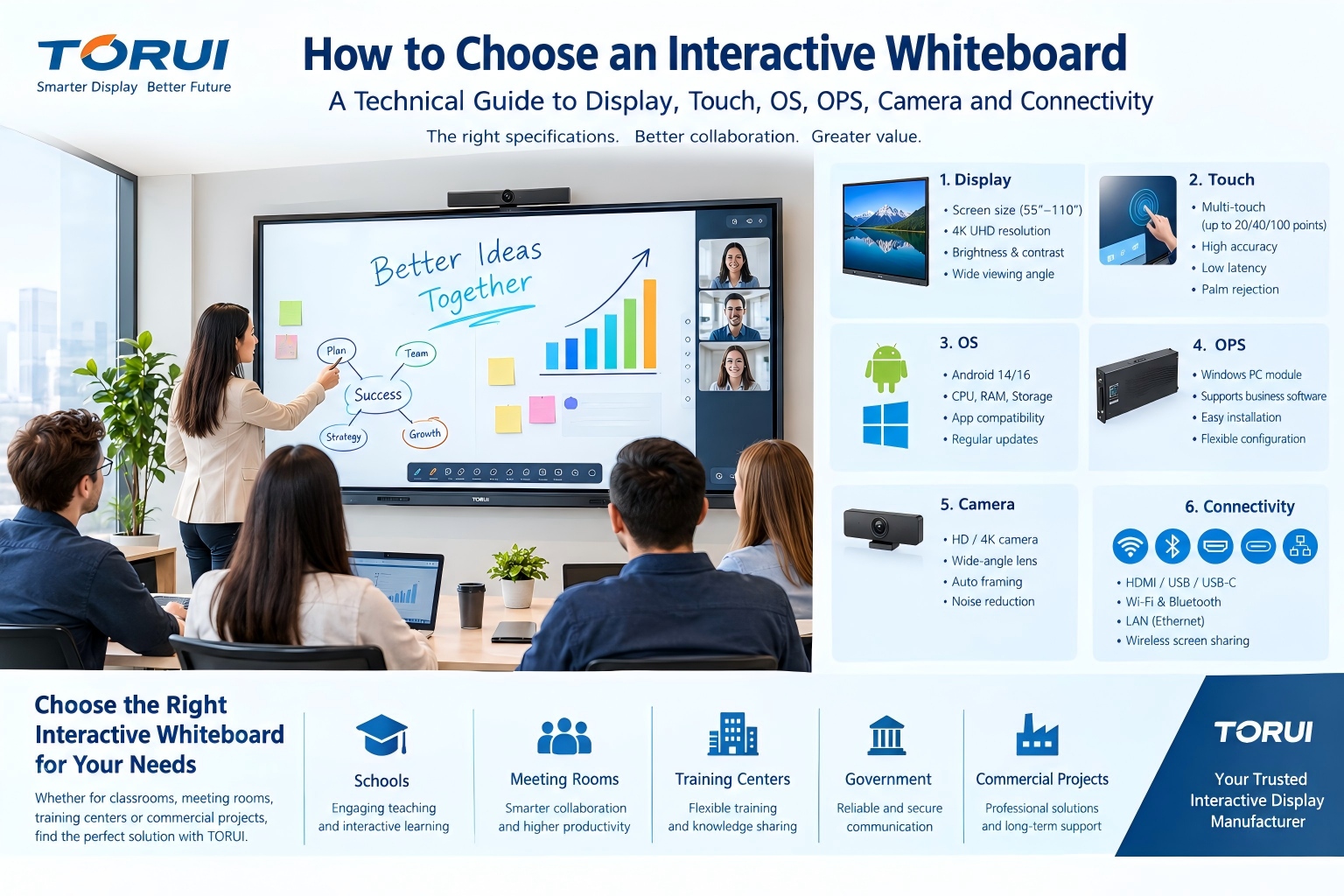
Choosing an interactive whiteboard for a school, meeting room, training center, government organization or commercial project requires more than comparing screen size and price. The most important specifications include display resolution, brightness, touch technology, operating system, processor, memory, storage, OPS compatibility, camera and microphone performance, connectivity, durability and after-sales support.
How to Choose an Interactive Whiteboard: A Technical Guide to Display, Touch, OS, OPS, Camera and Connectivity