
Smart Board: Transforming Modern Education and Business Collaboration
author: toruitech
2026-03-21

A Smart Board, also known as an interactive whiteboard, has become a vital tool in both education and corporate environments. By integrating touch technology, digital display, and interactive software, it enhances communication, engagement, and productivity. As digital transformation accelerates globally, smart boards are no longer optional—they are essential for modern learning and efficient teamwork.
What Is a Smart Board?
A smart board is a large, touch-sensitive display that connects to a computer and projector or operates as an all-in-one interactive flat panel. Users can control applications, write notes, annotate documents, and access online resources directly on the screen. It supports multiple touch points, enabling collaborative interaction among several users simultaneously.
Key Features and Benefits
1. Enhanced Interactivity
Smart boards allow users to write, draw, and manipulate content in real time. In classrooms, teachers can create dynamic lessons, while students actively participate. In business settings, teams can brainstorm and present ideas more effectively.
2. Improved Engagement
Visual and interactive elements significantly increase user engagement. Multimedia integration—such as videos, images, and animations—makes learning and presentations more compelling.
3. Seamless Collaboration
With wireless connectivity and cloud integration, smart boards enable remote collaboration. Teams across different locations can share screens, edit files, and communicate in real time.
4. User-Friendly Interface
Most smart boards feature intuitive interfaces, making them accessible even for non-technical users. This reduces training time and increases adoption rates.
5. Versatile Applications
Smart boards are widely used in education, corporate meetings, training sessions, healthcare, and even retail environments. Their adaptability makes them a valuable investment across industries.
Smart Board in Education
In educational settings, smart boards support interactive teaching methods. Teachers can integrate digital content, conduct quizzes, and save lesson notes for future use. Students benefit from a more engaging and immersive learning experience, which improves retention and understanding.
Smart Board in Business
For businesses, smart boards streamline meetings and presentations. They enable real-time annotation, data visualization, and video conferencing integration. This leads to more efficient decision-making and clearer communication among team members.
How to Choose the Right Smart Board
When selecting a smart board, consider the following factors:
-
Screen Size and Resolution: Ensure it fits your space and delivers clear visuals.
-
Touch Technology: Look for high precision and multi-touch capabilities.
-
Software Compatibility: Choose a system compatible with your existing tools.
-
Connectivity Options: Wireless casting, USB, HDMI, and cloud support are essential.
-
Durability and Support: Reliable hardware and after-sales service are crucial for long-term use.
Future Trends
The future of smart boards lies in AI integration, enhanced collaboration tools, and deeper cloud connectivity. Features such as handwriting recognition, voice control, and real-time translation are becoming increasingly common, further improving user experience.
Conclusion
Smart boards are reshaping how we teach, learn, and collaborate. By combining technology with interactivity, they provide a powerful platform for communication and innovation. Whether in classrooms or boardrooms, investing in a smart board is a strategic step toward a more connected and efficient future.
Interactive Flat Panel Display: Transforming Modern Education and Business Collaboration
Interactive Teaching Program: Transforming Modern Education
Related Article

Choosing the right interactive whiteboard size is an important decision for distributors, wholesalers, and education technology suppliers. The 65-inch, 75-inch, and 86-inch interactive whiteboards are popular options for classrooms, meeting rooms, training centers, and commercial projects.
65 vs 75 vs 86-Inch Interactive Whiteboard: Which Model Should Distributors Choose?

Choosing the right interactive whiteboard manufacturer in China is an important decision for distributors, wholesalers, education technology suppliers, and system integrators. The right manufacturing partner can help businesses improve product quality, maintain competitive pricing, customize products for local markets, and build a sustainable distribution business.
Who Are the Best Interactive Whiteboard Manufacturers in China for B2B Distributors and Wholesalers?
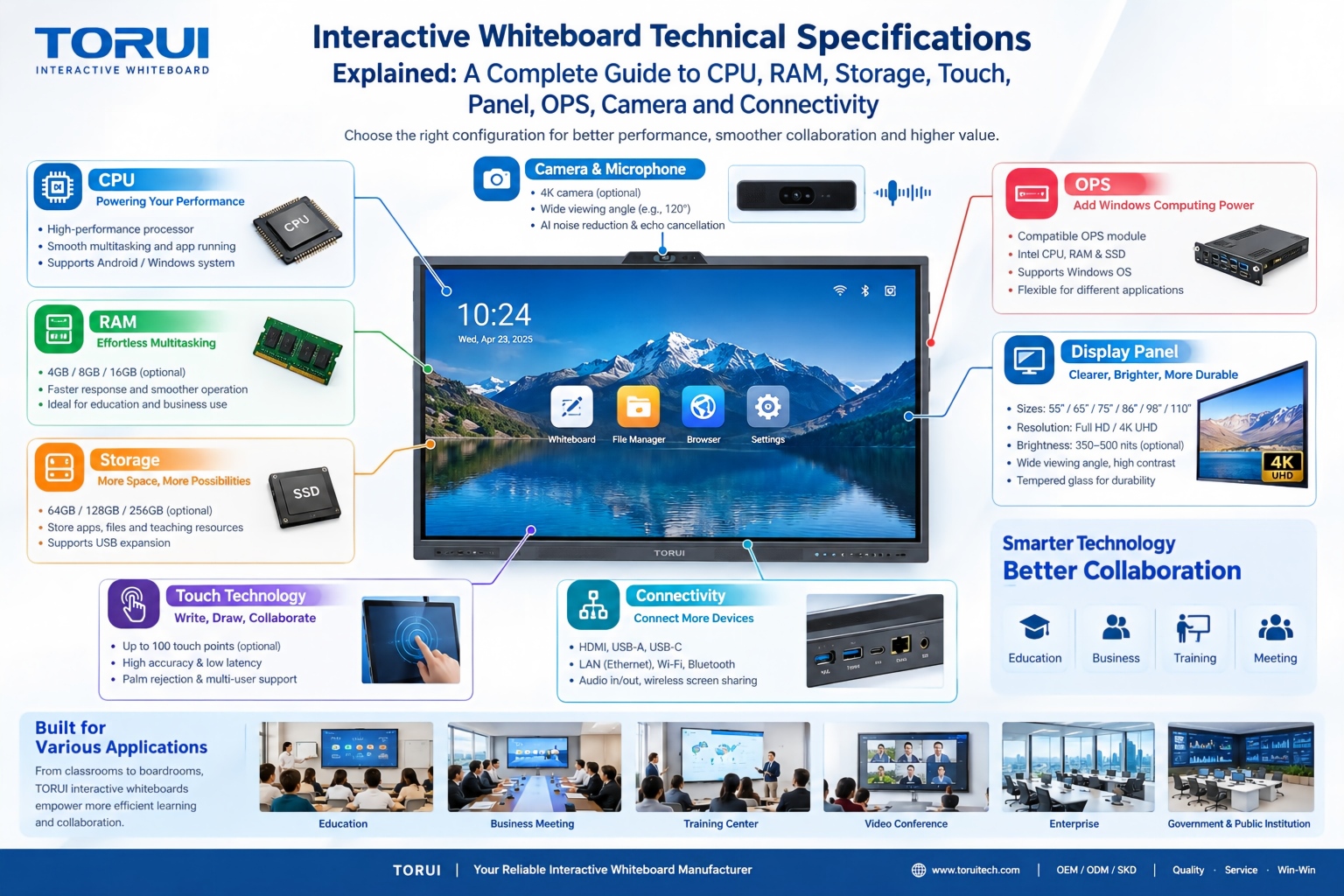
Choosing an interactive whiteboard involves more than comparing screen sizes and prices. For schools, businesses, distributors, wholesalers, and system integrators, understanding the technical specifications is essential to selecting a reliable product that meets different application requirements.
Interactive Whiteboard Technical Specifications Explained: A Complete Guide to CPU, RAM, Storage, Touch, Panel, OPS, Camera and Connectivity
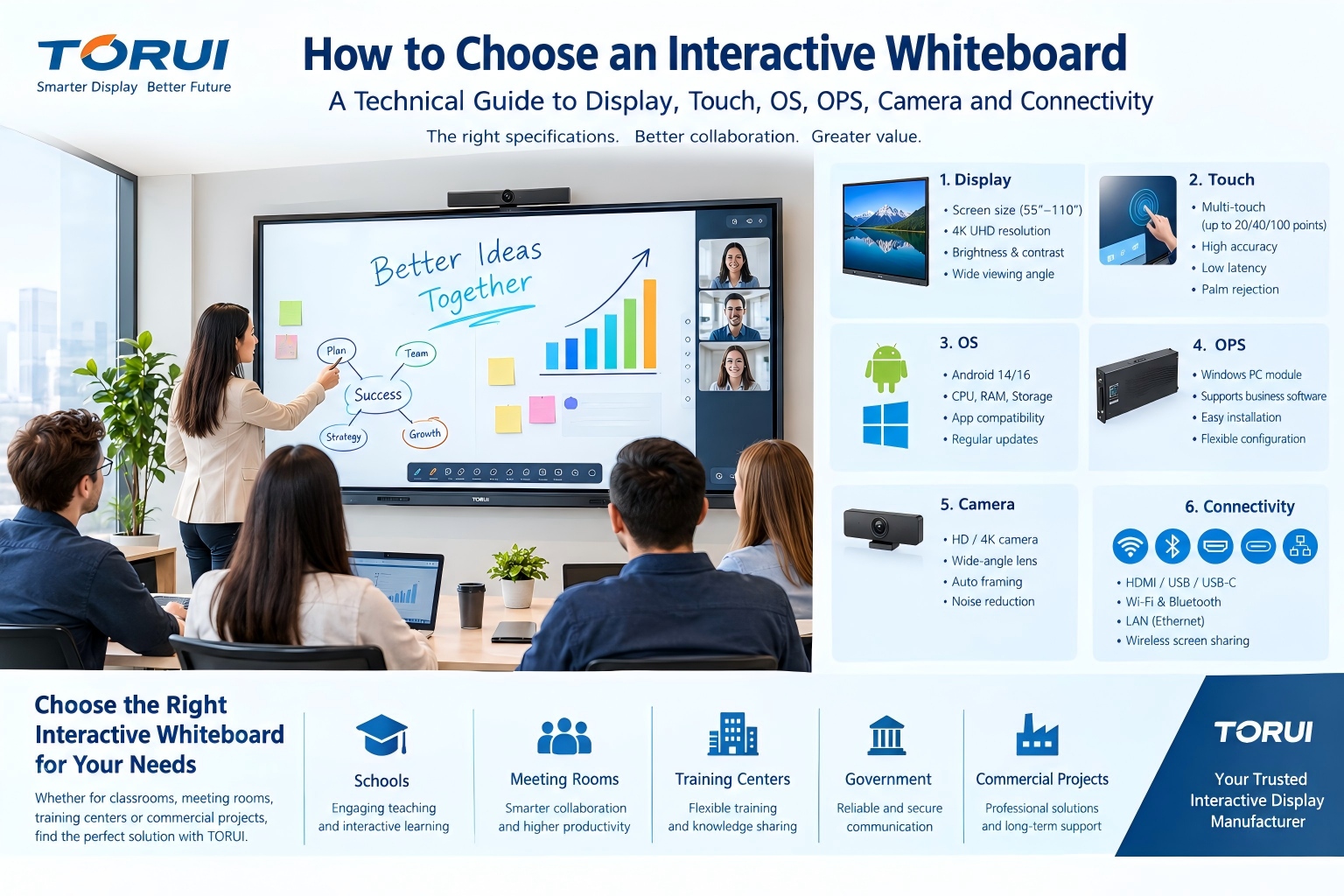
Choosing an interactive whiteboard for a school, meeting room, training center, government organization or commercial project requires more than comparing screen size and price. The most important specifications include display resolution, brightness, touch technology, operating system, processor, memory, storage, OPS compatibility, camera and microphone performance, connectivity, durability and after-sales support.
How to Choose an Interactive Whiteboard: A Technical Guide to Display, Touch, OS, OPS, Camera and Connectivity