
Smart Board — Transforming Modern Learning and Collaboration
author: toruitech
2025-10-12

What Is a Smart Board and Why It Matters
A smart board, also known as an interactive whiteboard, is a digital tool that combines touch-sensitive technology with a large display screen. It allows users to write, draw, and interact directly with multimedia content. From schools to corporations, smart boards are revolutionizing how people learn, communicate, and collaborate.
Smart Boards in Education — Making Learning Interactive
In modern classrooms, smart boards have replaced traditional blackboards. Teachers can display videos, slides, and online resources to make lessons more engaging. Students can solve problems, annotate materials, and participate directly on the board.
This level of interactivity enhances attention, supports visual and kinesthetic learning, and promotes teamwork. Teachers can also save, share, or review lessons later, improving efficiency and learning outcomes.
Smart Boards in Business — Enhancing Communication and Productivity
In corporate environments, smart boards are powerful presentation and collaboration tools. Teams can brainstorm, annotate data, and connect with remote participants via video conferencing. Wireless screen mirroring enables seamless sharing from laptops or mobile devices. This boosts efficiency, reduces paper waste, and encourages idea sharing in real time.

Key Features of Modern Smart Boards
-
4K UHD Resolution for crystal-clear visuals
-
Multi-touch Technology supporting multiple users
-
Wireless Connectivity for screen sharing
-
Integrated Android or Windows OS
-
Cloud Storage and Collaboration Tools
These features make smart boards ideal for both educational and professional use.
How to Choose the Right Smart Board
When selecting a smart board, consider:
-
Screen size and classroom or meeting room dimensions
-
Touch accuracy and writing smoothness
-
Software compatibility and OS options
-
After-sales support and warranty
A reliable manufacturer provides continuous software updates, training, and maintenance services.
The Future of Smart Boards
As digital learning and hybrid work grow, smart boards are becoming essential in creating interactive, efficient, and connected environments. They bridge physical and digital spaces, making collaboration smarter and more engaging than ever.
How to Install and Calibrate an Interactive Whiteboard
Smartboards for Classrooms: Enhancing Interactive Learning in the Digital Age
Related Article

Choosing the right interactive whiteboard size is an important decision for distributors, wholesalers, and education technology suppliers. The 65-inch, 75-inch, and 86-inch interactive whiteboards are popular options for classrooms, meeting rooms, training centers, and commercial projects.
65 vs 75 vs 86-Inch Interactive Whiteboard: Which Model Should Distributors Choose?

Choosing the right interactive whiteboard manufacturer in China is an important decision for distributors, wholesalers, education technology suppliers, and system integrators. The right manufacturing partner can help businesses improve product quality, maintain competitive pricing, customize products for local markets, and build a sustainable distribution business.
Who Are the Best Interactive Whiteboard Manufacturers in China for B2B Distributors and Wholesalers?
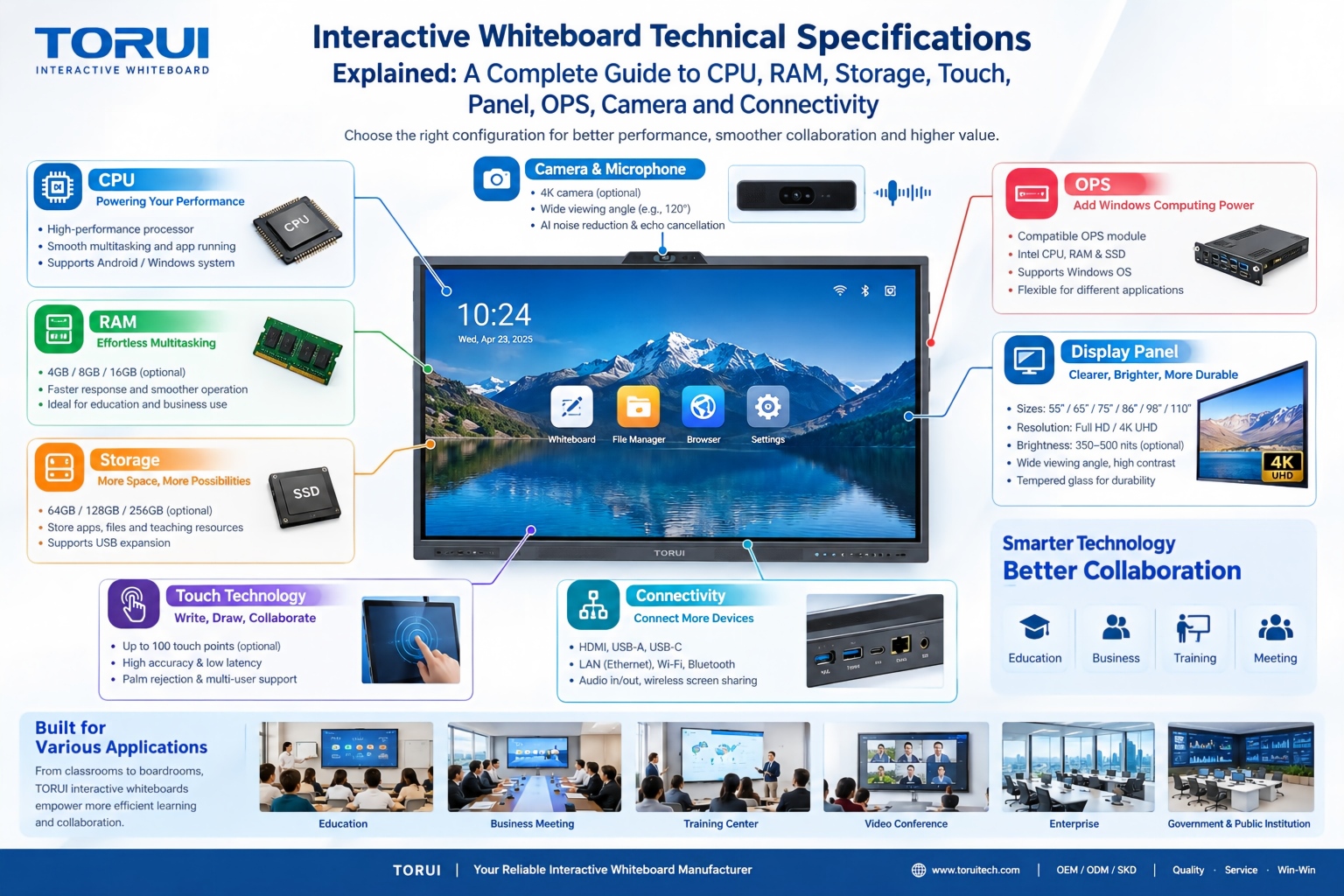
Choosing an interactive whiteboard involves more than comparing screen sizes and prices. For schools, businesses, distributors, wholesalers, and system integrators, understanding the technical specifications is essential to selecting a reliable product that meets different application requirements.
Interactive Whiteboard Technical Specifications Explained: A Complete Guide to CPU, RAM, Storage, Touch, Panel, OPS, Camera and Connectivity
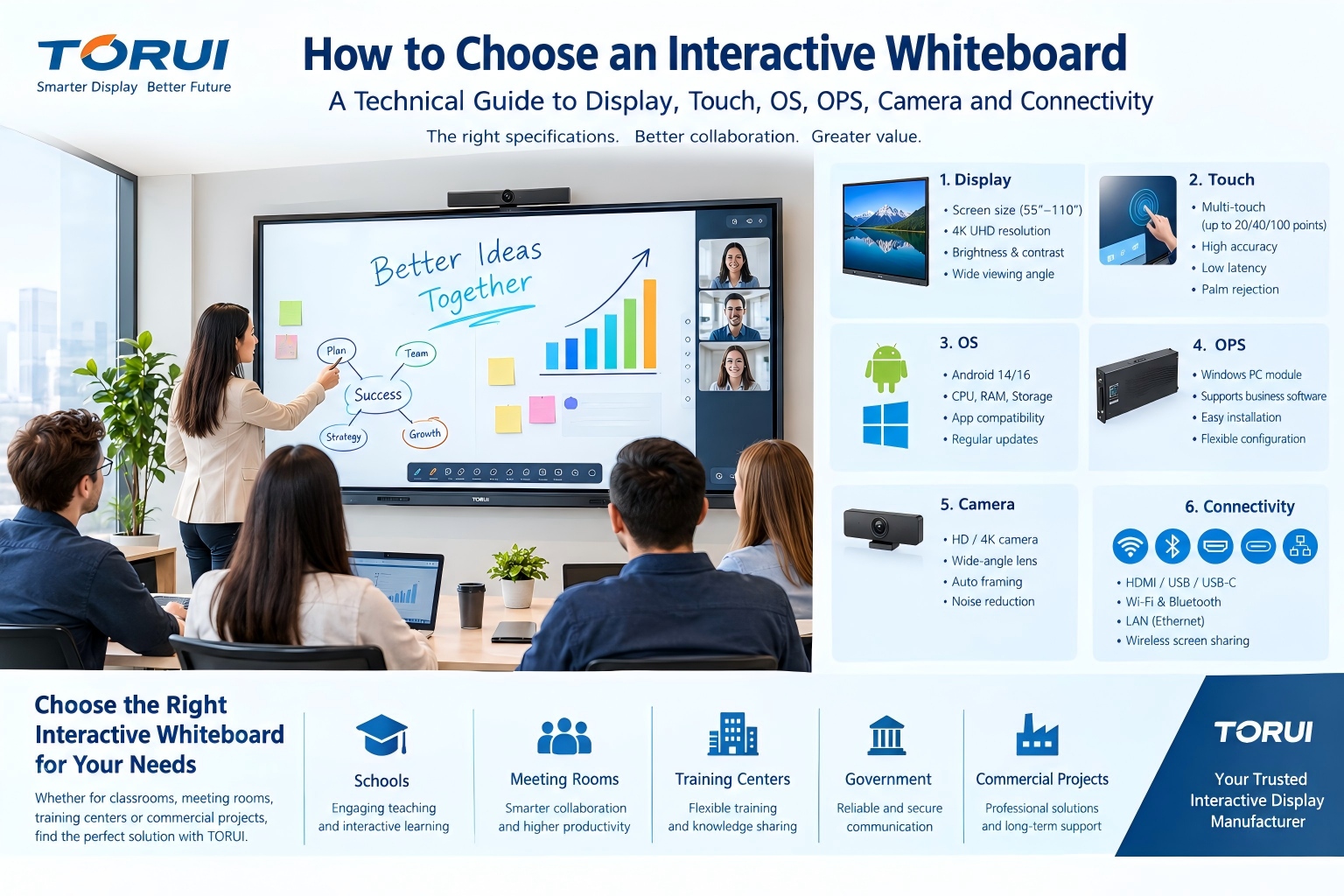
Choosing an interactive whiteboard for a school, meeting room, training center, government organization or commercial project requires more than comparing screen size and price. The most important specifications include display resolution, brightness, touch technology, operating system, processor, memory, storage, OPS compatibility, camera and microphone performance, connectivity, durability and after-sales support.
How to Choose an Interactive Whiteboard: A Technical Guide to Display, Touch, OS, OPS, Camera and Connectivity