
Specific Applications of Interactive Whiteboards in Education
author: toruitech
2025-08-27

With the rapid development of information technology, interactive whiteboards (IWBs), as advanced teaching aids, have become widely used in various educational settings worldwide. They integrate computer, multimedia, and internet technologies to create an interactive, intuitive, and efficient teaching environment for teachers and students. This article will detail the specific applications of interactive whiteboards in education, including their functional advantages, teaching innovations, enhanced interactivity, student initiative development, and practical application cases.
I. Functional Advantages of Interactive Whiteboards
Interactive whiteboards combine the intuitive writing capabilities of traditional blackboards with the rich expressiveness of modern multimedia technology. Teachers can write, draw, and erase directly on the whiteboard, and can also access a variety of resources such as images, videos, animations, and audio for presentations. Using a dedicated electronic pen or touchscreen, teachers and students can perform a variety of interactive operations on the whiteboard, including annotation, circling, dragging, zooming, spotlighting, opening the screen, taking snapshots, and recording the screen, greatly enriching classroom presentations.
Interactive whiteboards also offer handwriting recognition, content saving and exporting, courseware creation, and remote learning capabilities. For example, teachers can save classroom lectures in real time as PowerPoint or HTML files for easy after-class review. Remote learning and collaborative meetings can also be conducted over the internet, breaking down physical limitations and promoting resource sharing.
II. Innovation and Diversification of Instructional Design
Interactive whiteboards provide teachers with a rich range of instructional design options. Teachers can flexibly design teaching activities tailored to the specific characteristics of different subjects and student needs. For example, in elementary school math classes, teachers can use animations and engaging images to create vivid learning scenarios and spark student interest. In subjects like biology and physics, teachers can use whiteboards to demonstrate experimental procedures and dynamic models to help students intuitively understand abstract concepts.
Interactive whiteboards allow teachers to integrate a variety of teaching resources and access them flexibly during class, enhancing flexibility and targeted instruction. During instruction, teachers can adjust content based on student feedback, ensuring personalized instruction. Furthermore, the whiteboard's multimedia features help build knowledge structures, identify key points and difficulties, and promote systematic learning.
III. Promoting Teacher-Student Interaction and Classroom Engagement
One of the greatest advantages of interactive whiteboards is their powerful interactivity. Teachers and students can participate in the development and discussion of classroom content. Teachers can not only display courseware but also allow students to participate in activities such as problem solving, demonstrations, and annotation. Whiteboard features such as voting, Q&A, and group discussions effectively stimulate student thinking and expression, enhancing classroom engagement.
In practical teaching, interactive whiteboards support diverse interactions between teachers and students, as well as between students themselves. For example, teachers can use voting to gather student opinions, organize groups to solve problems, or allow students to independently design courseware and present their learning outcomes. This interactive model helps cultivate students' collaborative skills, innovation, and critical thinking.
IV. Cultivating Student Subjectivity and Autonomous Learning
Interactive whiteboards are not only teaching tools for teachers but also platforms for student self-directed learning. In class, students can use the multimedia resources on the whiteboard to independently explore knowledge, conduct research projects, and conduct experiments. Teachers act as guides and facilitators, encouraging students to think independently and innovate.
Through interactive whiteboards, students can independently collect and organize information, create learning materials, and present their own perspectives. This learning approach helps stimulate students' interest and initiative, cultivating independent thinking and problem-solving skills. Outside of class, students can access more resources online for expanded learning, achieving a seamless integration of in-class and out-of-class knowledge.
V. Practical Application Case Analysis
Elementary School Math Classroom: Teachers use interactive whiteboards to incorporate animations and engaging images into the introduction to stimulate student interest. Dynamic demonstrations of geometric figure transformations help students understand abstract concepts such as area calculation. Students can participate in the class and personally experience geometric transformations, enhancing their understanding and retention.
Biology Experiment Teaching: Teachers use whiteboards to demonstrate experimental steps and animate cell division. Students can annotate experimental phenomena and propose hypotheses on the whiteboards, and collaboratively analyze experimental results through group discussions. After class, students can save the lesson content for review and independent research.
Remote Collaborative Conferencing: Interactive whiteboards support remote teaching and conferencing. Teachers and students can share screens in real time, collaborate on courseware, and engage in interactive discussions from different locations, effectively promoting resource sharing and cross-school communication.
VI. Challenges and Outlook
Although interactive whiteboards have brought many conveniences and innovations, they still face some challenges in practical application, such as uneven teacher information technology literacy, a need to improve resource development and instructional design capabilities, and high equipment maintenance and upgrade costs. In the future, with technological advancements and evolving educational concepts, interactive whiteboards will play a greater role in teaching, promoting the development of informatization and personalized education.
Conclusion
As a key carrier of modern educational technology, interactive whiteboards have greatly enriched teaching methods and classroom interaction models. They not only improve teaching efficiency and quality, but also provide ample space for students to develop independent learning and innovative abilities. With the continuous advancement of educational informatization, interactive whiteboards will demonstrate their unique value in more areas and become a crucial component of future smart classrooms.
Primary and Secondary Schools Welcome the Fall Start of School—Interactive Whiteboards Empower Smart Classrooms
Analysis of the Main Application Scenarios of Interactive Whiteboards
Related Article

Choosing the right interactive whiteboard size is an important decision for distributors, wholesalers, and education technology suppliers. The 65-inch, 75-inch, and 86-inch interactive whiteboards are popular options for classrooms, meeting rooms, training centers, and commercial projects.
65 vs 75 vs 86-Inch Interactive Whiteboard: Which Model Should Distributors Choose?

Choosing the right interactive whiteboard manufacturer in China is an important decision for distributors, wholesalers, education technology suppliers, and system integrators. The right manufacturing partner can help businesses improve product quality, maintain competitive pricing, customize products for local markets, and build a sustainable distribution business.
Who Are the Best Interactive Whiteboard Manufacturers in China for B2B Distributors and Wholesalers?
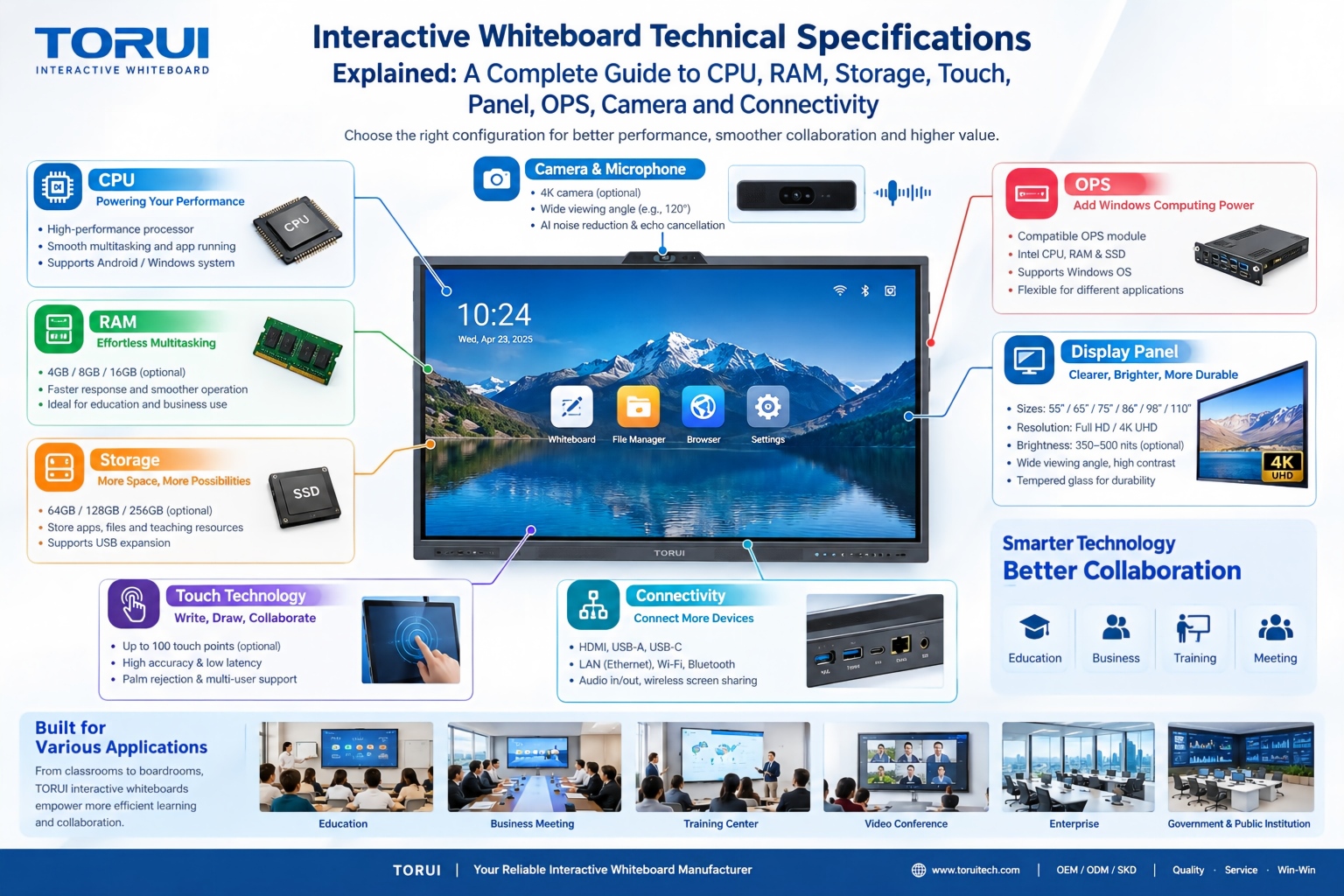
Choosing an interactive whiteboard involves more than comparing screen sizes and prices. For schools, businesses, distributors, wholesalers, and system integrators, understanding the technical specifications is essential to selecting a reliable product that meets different application requirements.
Interactive Whiteboard Technical Specifications Explained: A Complete Guide to CPU, RAM, Storage, Touch, Panel, OPS, Camera and Connectivity
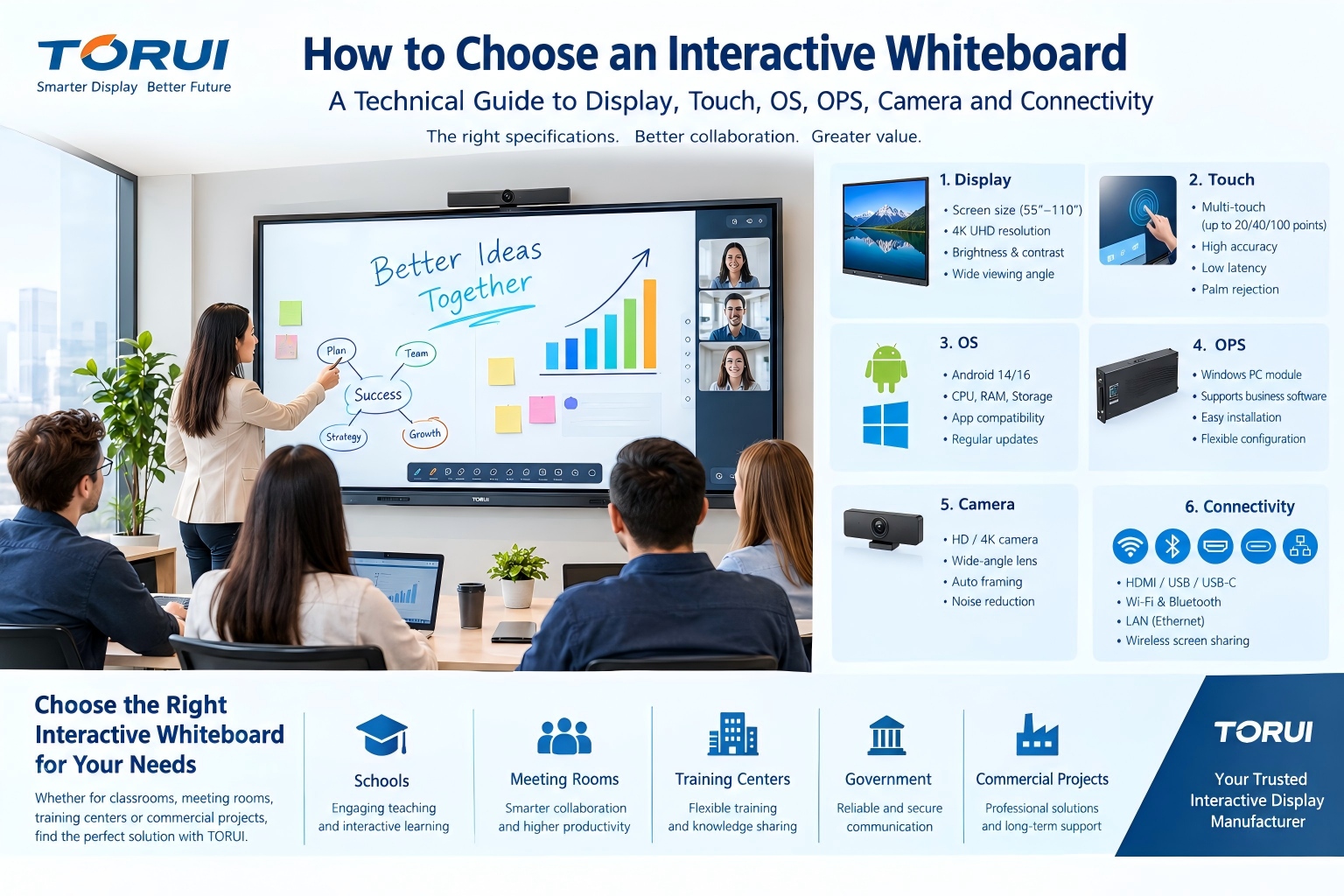
Choosing an interactive whiteboard for a school, meeting room, training center, government organization or commercial project requires more than comparing screen size and price. The most important specifications include display resolution, brightness, touch technology, operating system, processor, memory, storage, OPS compatibility, camera and microphone performance, connectivity, durability and after-sales support.
How to Choose an Interactive Whiteboard: A Technical Guide to Display, Touch, OS, OPS, Camera and Connectivity