
Specific Applications of Interactive Whiteboards in Meetings
author: toruitech
2025-08-28

With the continuous advancement of information technology, businesses are increasingly demanding more efficient meetings and more collaborative methods. Interactive whiteboards, as intelligent devices that integrate display, writing, and interaction, are becoming a vital tool in modern meeting rooms. They not only improve communication efficiency but also significantly enrich collaboration models. This article will provide an in-depth analysis of interactive whiteboards' specific applications in meetings, focusing on their features, application scenarios, practical benefits, and future developments.
I. Features of Interactive Whiteboards
Interactive whiteboards integrate large-screen display technology, precise positioning technology, electronics, and computer technology to replace traditional projection screens and blackboards, enabling information-based and intelligent meeting support. Key features include:
Intelligent Writing and Annotation
Compared to traditional whiteboards, interactive whiteboards support multiple operations, including handwriting, drawing, and erasing. Written content can be saved, edited, and shared in real time. Whether taking meeting notes, brainstorming, or annotating plans, these tasks can be completed efficiently, ensuring that information is not lost and facilitating subsequent organization and archiving.
Multimedia Presentation
The interactive whiteboard can directly import various file formats, including PPT, PDF, images, and videos, and supports multi-page switching and highlighting. Whether it's a project progress report, data analysis, or product demonstration, it allows for intuitive and rich content presentation.
Remote Conferencing and Real-Time Interaction
The interactive whiteboard is compatible with various video conferencing software and equipped with a camera and microphone, allowing remote participants to communicate in real time. Remote participants can not only clearly hear the meeting content but also participate in interactive writing and annotation, achieving "face-to-face" collaboration.
II. Interactive Whiteboard Application Scenarios in Meetings
Project Management and Progress Reporting
During regular project meetings, interactive whiteboards can display project schedules, key milestones, task assignments, and other information. Project members can write updates and highlight risk points directly on the whiteboard, facilitating timely team communication and plan adjustments.
Brainstorming and Creative Discussions
Interactive whiteboards provide an open and interactive platform for brainstorming. Participants can freely write, draw mind maps, and drag and drop images to quickly organize and summarize creative ideas, greatly stimulating team innovation.
Proposal Review and Decision-Making
During proposal reviews, various documents, images, and data can be displayed on a single screen, allowing experts or leaders to instantly annotate, highlight, and modify them, enhancing the focus and depth of discussions. This makes the decision-making process more efficient and transparent.
Training and Presentations
Interactive whiteboards support the display of multimedia courseware. Instructors can annotate while explaining, while participants can participate in interactive Q&A and group discussions. This makes the training process more engaging and immersive, significantly improving learning outcomes.
III. Practical Benefit Analysis
Improving Meeting Efficiency
Interactive whiteboards integrate multiple functions, eliminating the tedious steps of traditional meetings, such as device switching and document distribution. Meeting discussion content is visualized in real time, making the decision-making process clearer, saving time, and improving efficiency.
Enhancing Team Collaboration
Participants can jointly edit and annotate content, fully expressing their opinions and promoting team communication and collaboration. Multi-device projection and remote interaction capabilities allow remote members to participate deeply in discussions, breaking down information barriers.
Optimizing Information Management
Meeting content can be automatically saved and archived for later reference and knowledge accumulation. Easily sharing information improves information management and reduces omissions and misunderstandings.
IV. Future Development Trends
With the continuous advancement of technologies such as artificial intelligence, big data, and cloud computing, interactive whiteboards will continue to evolve in the conferencing field. In the future, features like intelligent voice recognition, automatic meeting minutes, and data analysis will be further integrated, elevating meeting intelligence and automation. At the same time, cloud-based collaboration and mobile office work will become mainstream, and interactive whiteboards will better support remote work and global team collaboration.
Conclusion
Interactive whiteboards, with their powerful functionality and flexible application options, are profoundly changing communication and collaboration in meetings. They not only improve meeting efficiency and user experience, but also drive improvements in corporate management and innovation. With continuous technological advancements, interactive whiteboards will play an even more crucial role in future meeting rooms, becoming essential tools for efficient collaboration and smart office work in modern enterprises.
September 1st marks the start of the new school year, and TORUI interactive whiteboards are empowering smart classrooms
Primary and Secondary Schools Welcome the Fall Start of School—Interactive Whiteboards Empower Smart Classrooms
Related Article

Choosing the right interactive whiteboard size is an important decision for distributors, wholesalers, and education technology suppliers. The 65-inch, 75-inch, and 86-inch interactive whiteboards are popular options for classrooms, meeting rooms, training centers, and commercial projects.
65 vs 75 vs 86-Inch Interactive Whiteboard: Which Model Should Distributors Choose?

Choosing the right interactive whiteboard manufacturer in China is an important decision for distributors, wholesalers, education technology suppliers, and system integrators. The right manufacturing partner can help businesses improve product quality, maintain competitive pricing, customize products for local markets, and build a sustainable distribution business.
Who Are the Best Interactive Whiteboard Manufacturers in China for B2B Distributors and Wholesalers?
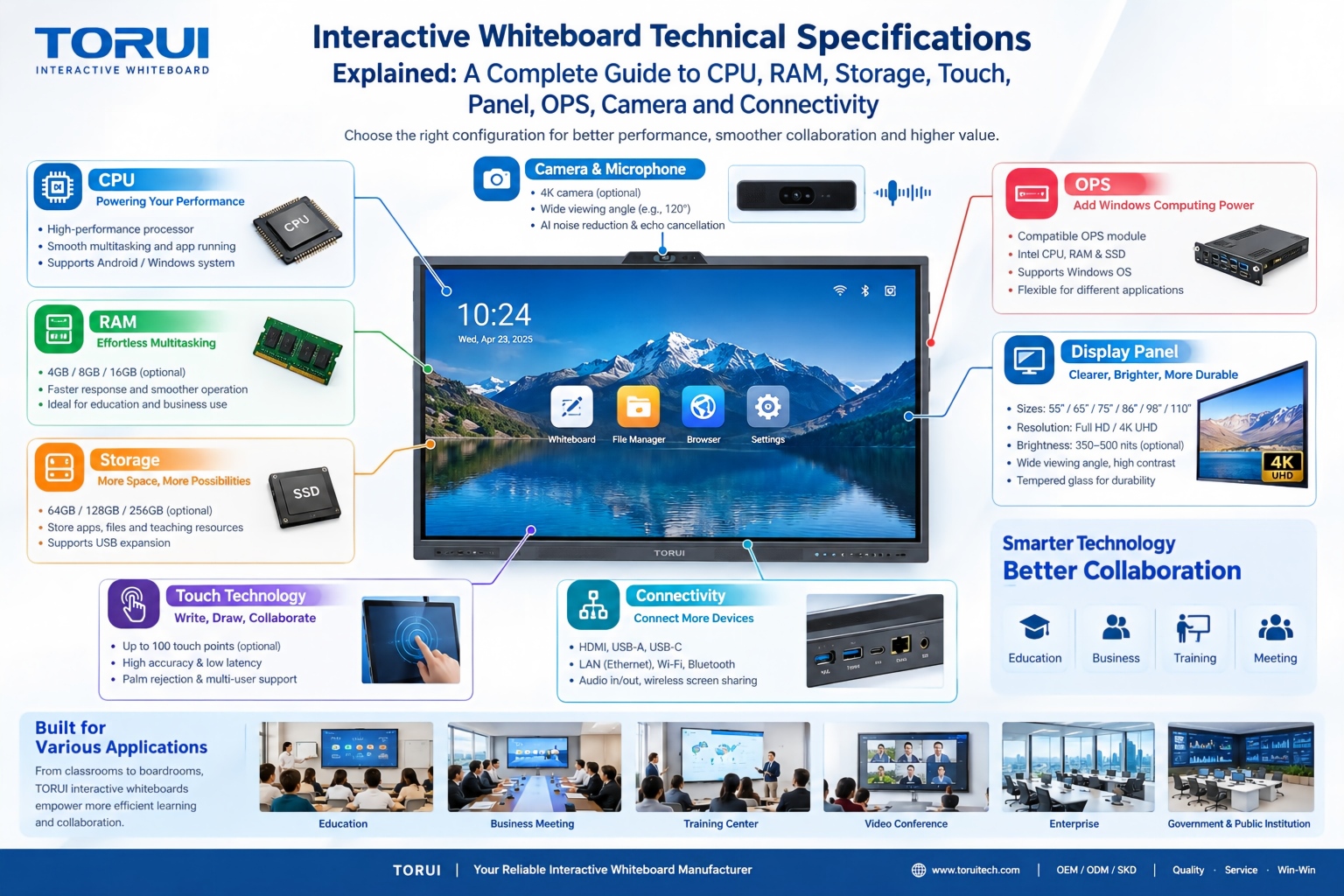
Choosing an interactive whiteboard involves more than comparing screen sizes and prices. For schools, businesses, distributors, wholesalers, and system integrators, understanding the technical specifications is essential to selecting a reliable product that meets different application requirements.
Interactive Whiteboard Technical Specifications Explained: A Complete Guide to CPU, RAM, Storage, Touch, Panel, OPS, Camera and Connectivity
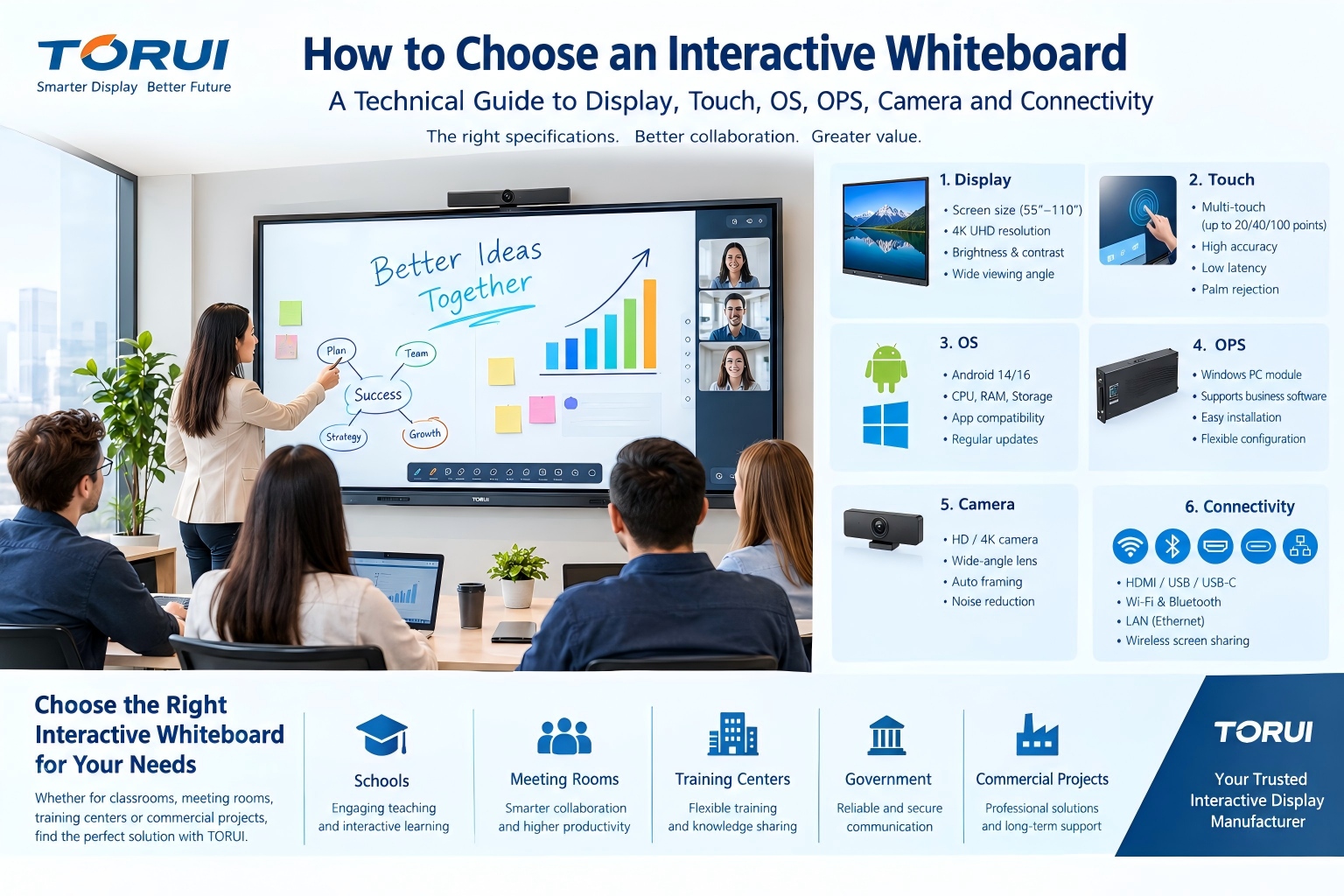
Choosing an interactive whiteboard for a school, meeting room, training center, government organization or commercial project requires more than comparing screen size and price. The most important specifications include display resolution, brightness, touch technology, operating system, processor, memory, storage, OPS compatibility, camera and microphone performance, connectivity, durability and after-sales support.
How to Choose an Interactive Whiteboard: A Technical Guide to Display, Touch, OS, OPS, Camera and Connectivity