
The Application and Value of Interactive Whiteboards
author: toruitech
2025-12-28
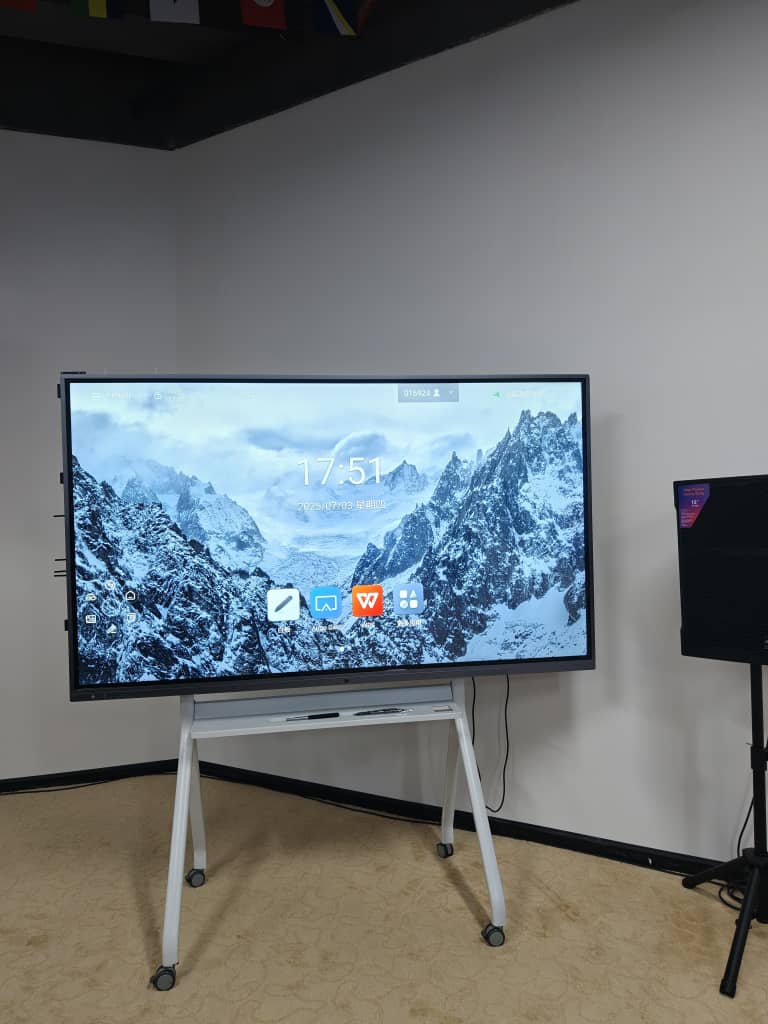
In today's digital age, interactive whiteboards (IWBs) have become a transformative tool in both educational and business environments. These devices integrate traditional whiteboard functions with modern technology, offering touch-sensitive surfaces that allow for dynamic and interactive engagement. With the increasing reliance on technology for collaboration, learning, and communication, interactive whiteboards are playing an essential role in enhancing productivity, engagement, and outcomes in various sectors.
Applications of Interactive Whiteboards
-
Education
One of the primary applications of IWBs is in educational settings. Teachers can use interactive whiteboards to engage students in a more immersive and interactive manner. These boards can display multimedia content, such as videos, interactive simulations, and virtual tours, which are not possible with traditional chalkboards. With touch capabilities, students can interact with the material directly, solving problems, drawing diagrams, or manipulating objects on the screen. This active participation helps increase engagement, motivation, and retention of knowledge.Additionally, IWBs support collaborative learning. Multiple students can simultaneously interact with the board, allowing for group activities, discussions, and problem-solving exercises. The integration with other educational tools, such as learning management systems (LMS) and online resources, further enhances the teaching and learning experience.
-
Business Collaboration
In the business world, IWBs are widely used for meetings, presentations, and brainstorming sessions. They enable participants to write, draw, and manipulate data during discussions in real-time. For example, during a business strategy meeting, an IWB can display charts, graphs, and documents, which can be annotated live by participants. The ability to integrate with video conferencing software also makes IWBs ideal for remote collaboration, allowing teams to interact seamlessly across locations.Interactive whiteboards can also be used for training purposes. Employees can participate in workshops, technical training, or onboarding sessions in an interactive environment. This makes learning more engaging and effective compared to passive methods like PowerPoint presentations.
-
Healthcare
In healthcare, IWBs can assist in training medical professionals, conducting workshops, and improving patient education. Surgeons, doctors, and healthcare educators can use IWBs to illustrate complex procedures, anatomy, or treatment plans. Interactive simulations on the whiteboard can offer real-time, hands-on practice for medical students and professionals, enhancing their learning and understanding of medical concepts. -
Government and Public Sector
Government agencies and public organizations can leverage IWBs for meetings, public communication, and educational initiatives. These boards allow for the clear presentation of data and plans, with the ability to make annotations and highlight key points during discussions. Furthermore, IWBs can be used for public outreach campaigns, enhancing the public’s understanding of policies, procedures, and new initiatives.
Value of Interactive Whiteboards
-
Enhanced Collaboration and Engagement
The primary value of IWBs lies in their ability to foster collaboration. Whether in a classroom or boardroom, interactive whiteboards enable real-time interaction, allowing participants to work together more effectively. In education, this collaboration is particularly valuable, as it helps students learn from one another and participate in group problem-solving activities. Similarly, in business environments, the ability to collaborate seamlessly, even across distances, drives efficiency and innovation. -
Improved Learning and Knowledge Retention
Interactive whiteboards support various learning styles, making them versatile tools for students of all ages. Visual learners benefit from multimedia content, while kinesthetic learners engage through hands-on interaction with the board. This multi-sensory learning experience enhances knowledge retention and helps learners grasp complex concepts more easily.Studies have shown that using IWBs in classrooms can increase student participation, motivation, and understanding of the material, leading to improved academic performance.
-
Cost-Effectiveness
While the initial cost of an interactive whiteboard can be higher than traditional whiteboards or projectors, the long-term value it provides is significant. IWBs reduce the need for paper-based resources, and they facilitate the integration of digital content, which can be reused for multiple lessons or presentations. Furthermore, the ability to record lessons, meetings, and presentations directly from the whiteboard makes it easier to share materials with others, reducing the time and cost of re-preparing content. -
Future-Proofing
As technology continues to evolve, IWBs provide a future-proof solution for businesses and educational institutions. Their integration with cloud-based services, artificial intelligence, and other emerging technologies ensures that IWBs remain relevant and adaptable in an ever-changing digital landscape. This longevity makes them a wise investment, offering value far beyond their initial cost. -
Sustainability
Interactive whiteboards contribute to sustainability efforts by reducing paper waste. Traditional chalkboards and whiteboards require significant paper usage for note-taking and educational materials. With IWBs, all of these materials can be digitalized, reducing the environmental impact of traditional paper-based resources.
Conclusion
Interactive whiteboards are invaluable tools in modern education, business, healthcare, and other sectors. They foster collaboration, enhance engagement, and improve outcomes by integrating advanced technology into everyday activities. As these devices continue to evolve, their applications will expand, offering even greater benefits in terms of productivity, sustainability, and user experience. The value of IWBs lies not only in their ability to improve efficiency but also in their role in shaping the future of digital collaboration and learning. Investing in interactive whiteboards is a step towards a more connected, efficient, and sustainable future.
How to Choose the Right Interactive Whiteboard for Schools
Interactive Whiteboard Market 2026: Global Analysis, Trends, and Forecast
Related Article

Choosing the right interactive whiteboard size is an important decision for distributors, wholesalers, and education technology suppliers. The 65-inch, 75-inch, and 86-inch interactive whiteboards are popular options for classrooms, meeting rooms, training centers, and commercial projects.
65 vs 75 vs 86-Inch Interactive Whiteboard: Which Model Should Distributors Choose?

Choosing the right interactive whiteboard manufacturer in China is an important decision for distributors, wholesalers, education technology suppliers, and system integrators. The right manufacturing partner can help businesses improve product quality, maintain competitive pricing, customize products for local markets, and build a sustainable distribution business.
Who Are the Best Interactive Whiteboard Manufacturers in China for B2B Distributors and Wholesalers?
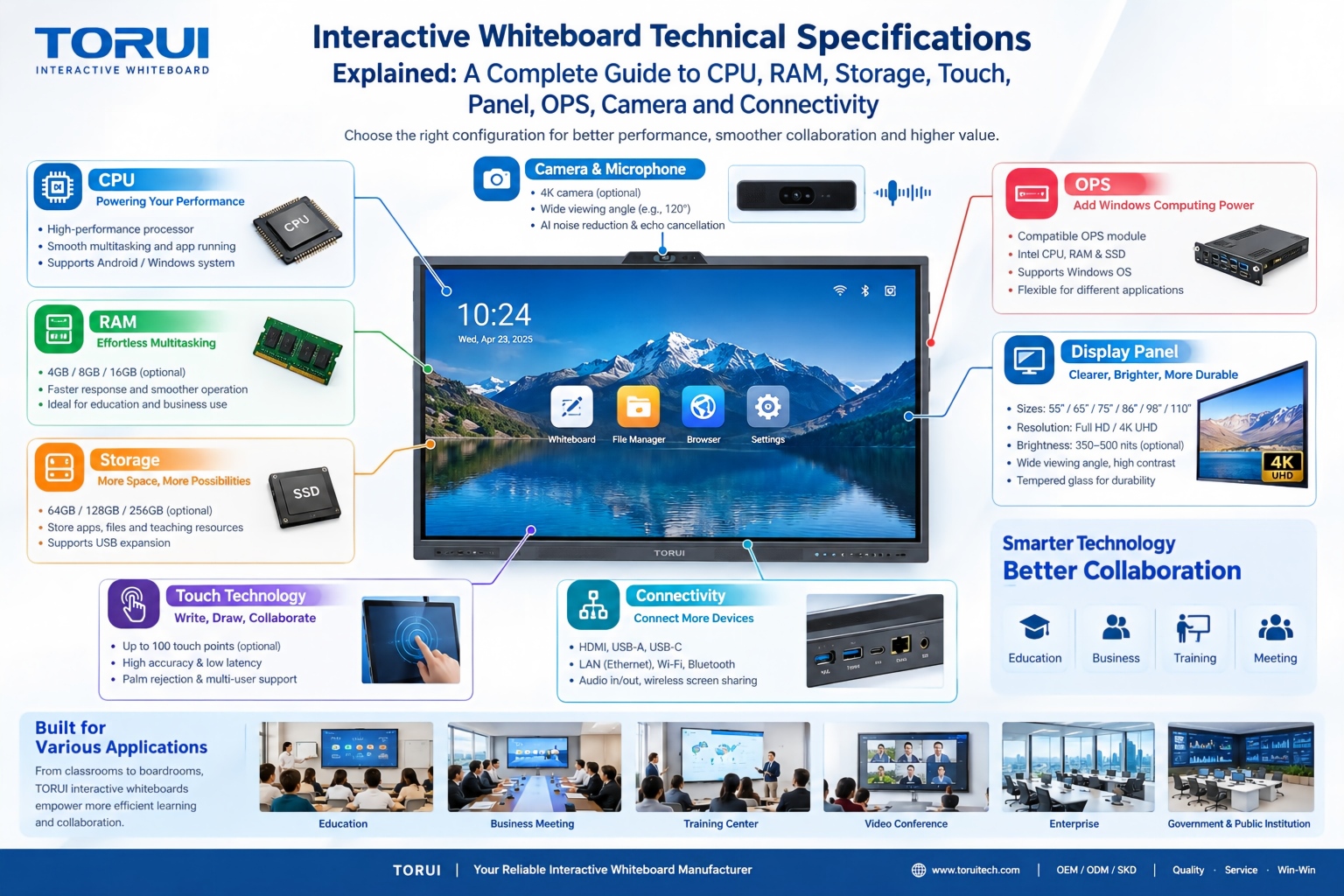
Choosing an interactive whiteboard involves more than comparing screen sizes and prices. For schools, businesses, distributors, wholesalers, and system integrators, understanding the technical specifications is essential to selecting a reliable product that meets different application requirements.
Interactive Whiteboard Technical Specifications Explained: A Complete Guide to CPU, RAM, Storage, Touch, Panel, OPS, Camera and Connectivity
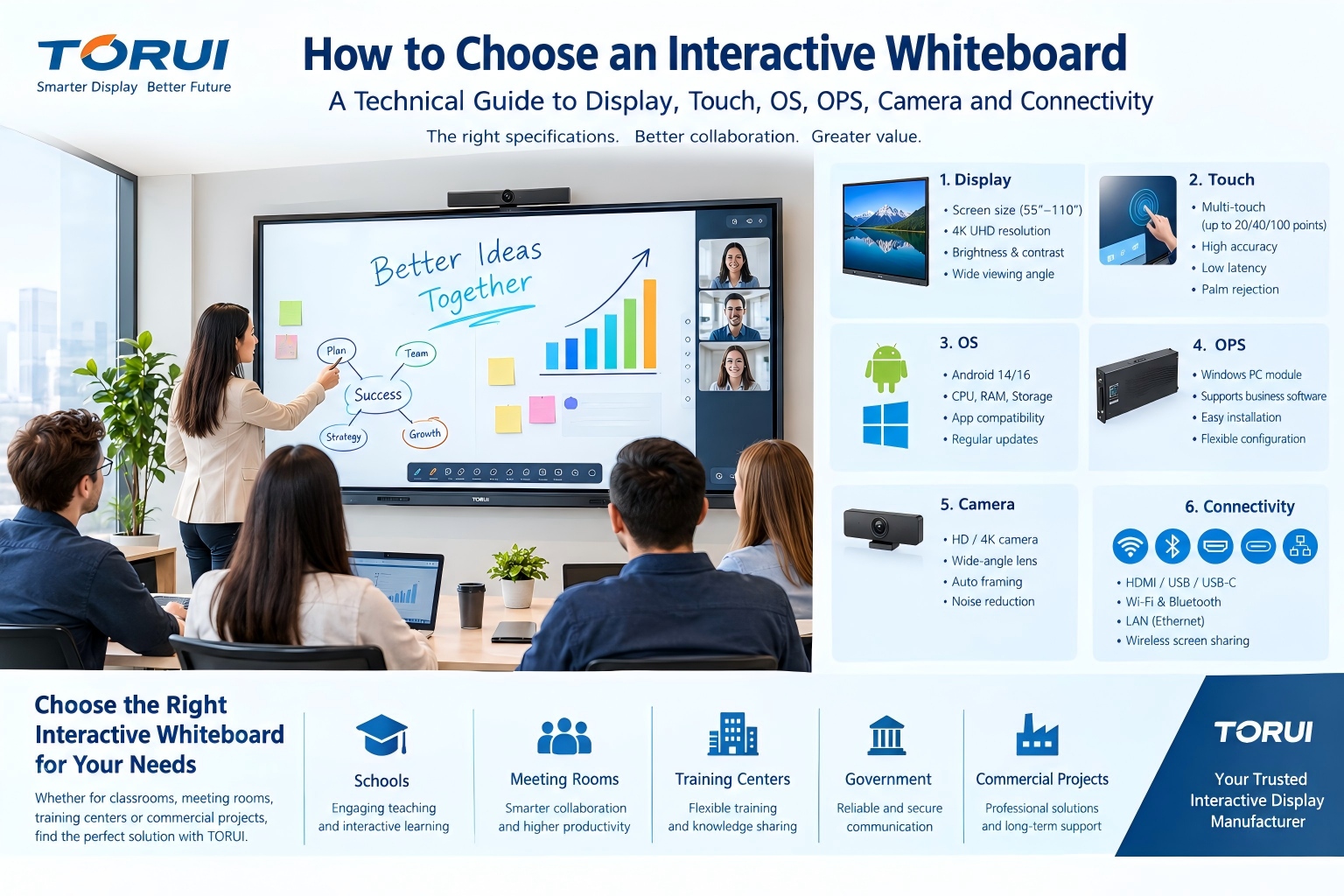
Choosing an interactive whiteboard for a school, meeting room, training center, government organization or commercial project requires more than comparing screen size and price. The most important specifications include display resolution, brightness, touch technology, operating system, processor, memory, storage, OPS compatibility, camera and microphone performance, connectivity, durability and after-sales support.
How to Choose an Interactive Whiteboard: A Technical Guide to Display, Touch, OS, OPS, Camera and Connectivity