
The Role and Benefits of Interactive Whiteboards in Modern Education and Business
author: toruitech
2025-09-24

An interactive whiteboard (IWB), also known as a smart board, is a powerful digital tool designed to enhance teaching, learning, and business collaboration. Unlike traditional chalkboards or dry-erase boards, interactive whiteboards integrate touch-screen technology with computer software, allowing users to display, write, draw, and interact with multimedia content in real time. Their ability to merge traditional teaching with digital interactivity makes them one of the most valuable investments for classrooms, training centers, and modern workplaces.
Key Features of Interactive Whiteboards
Interactive whiteboards are equipped with advanced touch-sensitive displays that respond to fingers, pens, or styluses. They connect to computers, tablets, or cloud platforms, enabling users to display presentations, videos, or online resources instantly. Many models come with multi-touch functionality, allowing several people to collaborate on the board simultaneously. Integrated annotation tools, handwriting recognition, and wireless screen sharing further expand their usability in diverse environments.
Benefits in Education
In education, interactive whiteboards have transformed traditional classrooms into dynamic and engaging learning spaces. Teachers can incorporate multimedia content such as videos, images, and animations to explain complex concepts more clearly. For example, a science teacher can display a 3D model of the human body, allowing students to explore anatomy interactively. Students can also participate directly by writing on the board, solving problems, or presenting group projects.
This level of interactivity not only increases student engagement but also supports different learning styles. Visual learners benefit from images and diagrams, while kinesthetic learners gain from hands-on interaction with the content. Furthermore, many interactive whiteboards are compatible with remote learning platforms, making hybrid or online education more effective and collaborative.
Benefits in Business
In the corporate world, interactive whiteboards play a vital role in meetings, training sessions, and project management. They allow teams to brainstorm ideas visually, annotate charts, and share digital notes instantly. For global businesses, integrated video conferencing and screen-sharing features enable seamless collaboration with colleagues across different locations. The ability to save and distribute meeting notes digitally reduces reliance on paper and improves overall efficiency.
Businesses also benefit from the whiteboard’s integration with productivity tools such as Microsoft Teams, Zoom, and Google Workspace. This ensures that presentations, data analysis, and project updates are not only interactive but also accessible to all participants, whether in the office or working remotely.
Advantages Over Traditional Whiteboards
Compared with conventional boards, interactive whiteboards offer long-term advantages:
-
Engagement: Interactive tools capture attention better than static writing.
-
Collaboration: Multiple users can contribute simultaneously.
-
Accessibility: Lessons or meetings can be saved, shared, and reviewed later.
-
Integration: Compatibility with modern software and online resources.
-
Sustainability: Reduces paper use by enabling digital note-taking.
Choosing the Right Interactive Whiteboard
When selecting an interactive whiteboard, organizations should consider factors such as screen size, resolution, touch sensitivity, connectivity options, and software compatibility. For large classrooms or meeting halls, a bigger display ensures visibility for all participants. Businesses may prioritize cloud integration, while schools may focus on ease of use and durability for daily lessons.
Conclusion
Interactive whiteboards have become essential tools in both education and business. By combining digital interactivity with traditional collaboration, they foster engagement, enhance productivity, and create smarter environments for learning and teamwork. As technology continues to evolve, interactive whiteboards will play an even greater role in shaping the future of communication and knowledge sharing.
Teaching Equipment Upgrade Solutions
Understanding Interactive Technology: Transforming Education, Business, and Daily Life
Related Article

Choosing the right interactive whiteboard size is an important decision for distributors, wholesalers, and education technology suppliers. The 65-inch, 75-inch, and 86-inch interactive whiteboards are popular options for classrooms, meeting rooms, training centers, and commercial projects.
65 vs 75 vs 86-Inch Interactive Whiteboard: Which Model Should Distributors Choose?

Choosing the right interactive whiteboard manufacturer in China is an important decision for distributors, wholesalers, education technology suppliers, and system integrators. The right manufacturing partner can help businesses improve product quality, maintain competitive pricing, customize products for local markets, and build a sustainable distribution business.
Who Are the Best Interactive Whiteboard Manufacturers in China for B2B Distributors and Wholesalers?
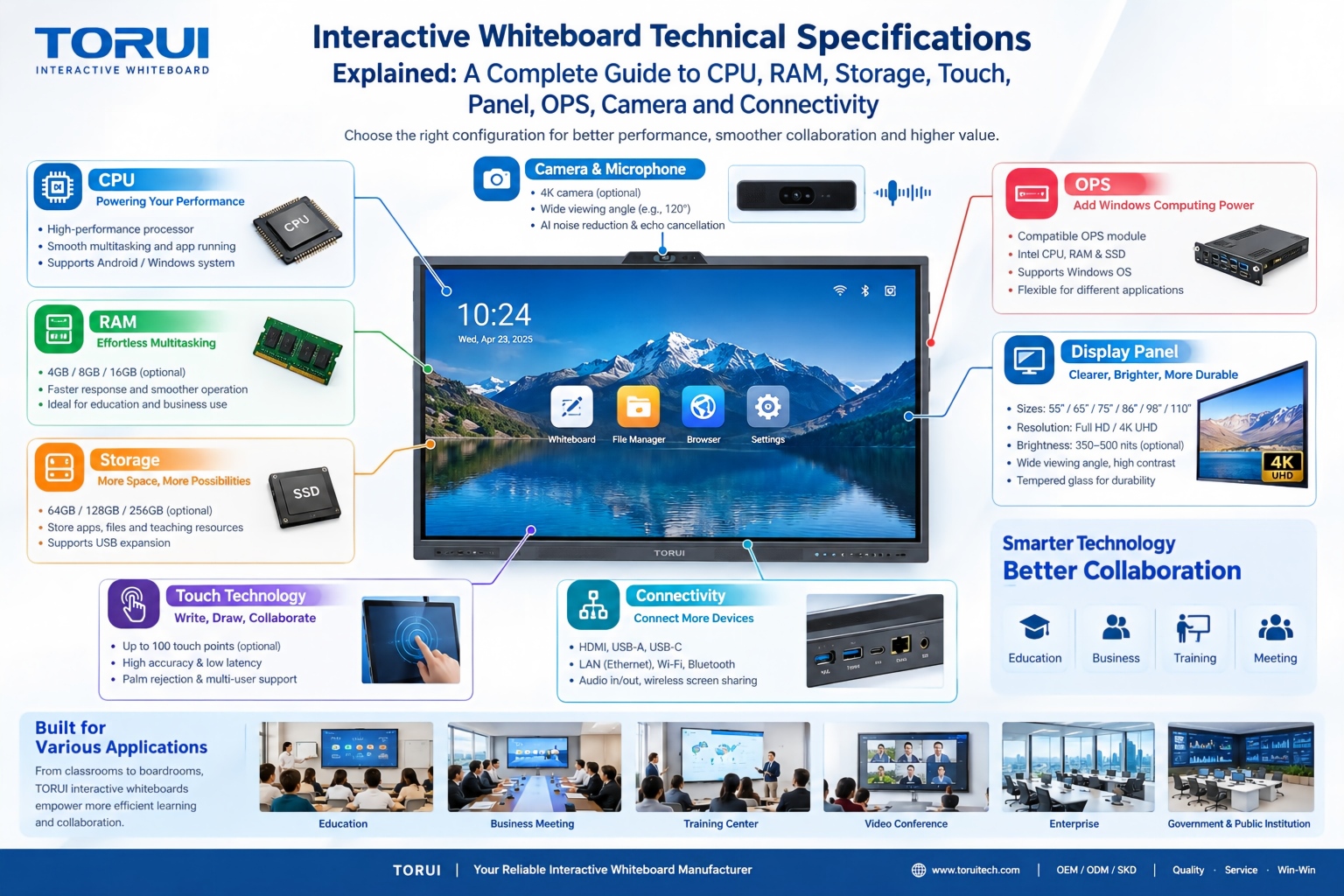
Choosing an interactive whiteboard involves more than comparing screen sizes and prices. For schools, businesses, distributors, wholesalers, and system integrators, understanding the technical specifications is essential to selecting a reliable product that meets different application requirements.
Interactive Whiteboard Technical Specifications Explained: A Complete Guide to CPU, RAM, Storage, Touch, Panel, OPS, Camera and Connectivity
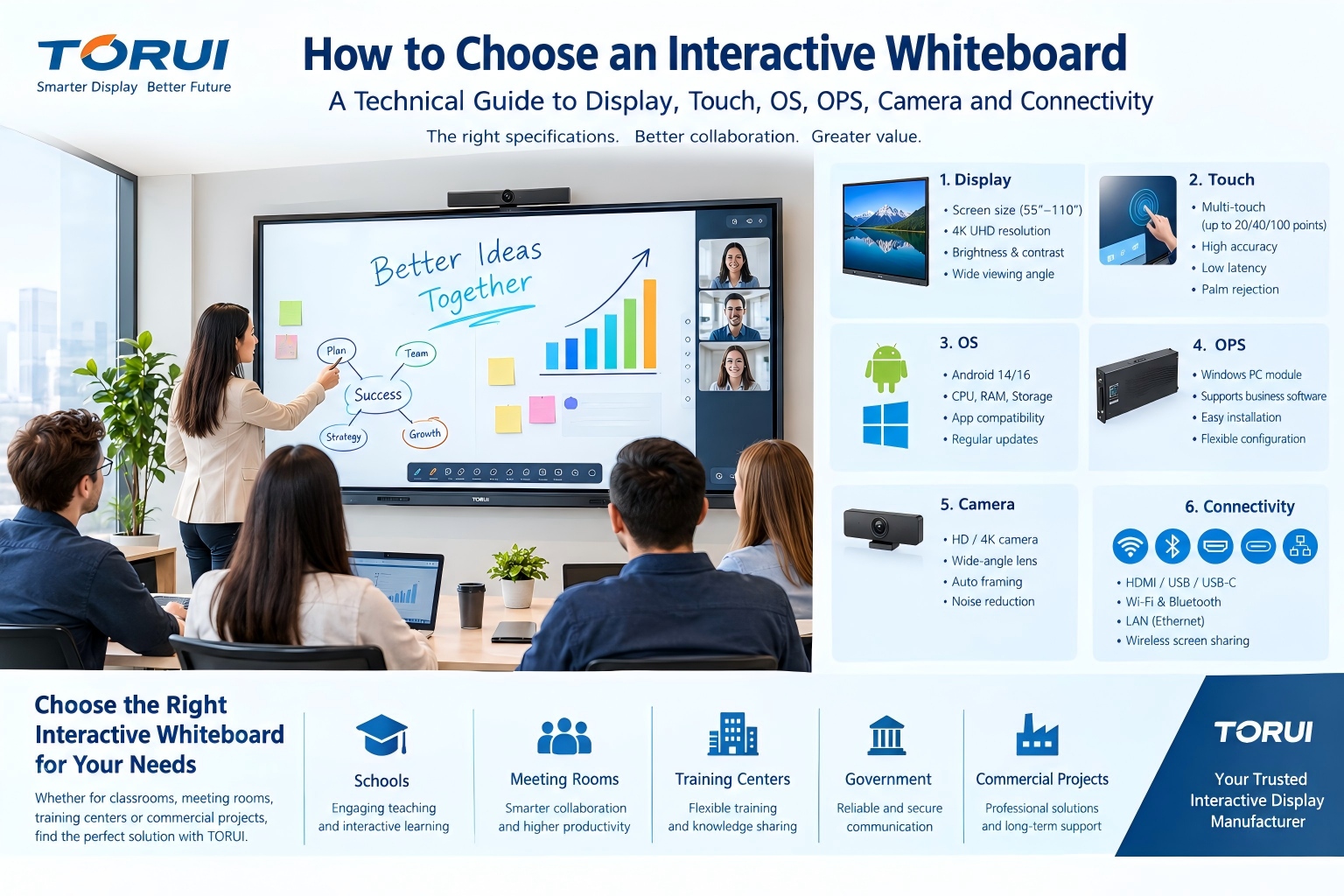
Choosing an interactive whiteboard for a school, meeting room, training center, government organization or commercial project requires more than comparing screen size and price. The most important specifications include display resolution, brightness, touch technology, operating system, processor, memory, storage, OPS compatibility, camera and microphone performance, connectivity, durability and after-sales support.
How to Choose an Interactive Whiteboard: A Technical Guide to Display, Touch, OS, OPS, Camera and Connectivity