
The Value and Significance of Upgrading Schools with Interactive Whiteboards
author: toruitech
2025-09-28

Amid the rapid development of modern education, upgrading school teaching equipment has become a crucial step in improving educational quality. As an intelligent teaching tool integrating multimedia, touch technology, and online resources, interactive whiteboards are increasingly becoming a core component of school upgrades worldwide. They have not only transformed teachers' teaching methods but also profoundly impacted students' learning experiences, providing strong support for educational modernization.
First, interactive whiteboards can effectively enhance classroom interactivity and engagement. Traditional blackboards or projectors often rely on one-way instruction, which can lead to student inattention or passive learning. Interactive whiteboards, on the other hand, utilize touch controls, real-time annotation, and image and video presentations to make classroom content more vivid and intuitive. Teachers can use whiteboards to present complex diagrams or experimental procedures, while students can participate by clicking and dragging. This multi-sensory learning approach not only stimulates students' interest but also fosters their proactive thinking and inquiry skills.
Second, interactive whiteboards offer unique advantages in resource integration. With the continuous expansion of online educational resources, teachers can use whiteboards to directly integrate a vast array of online courses, videos, and test banks into the classroom. This allows teaching to move beyond textbook content and integrate local and global resources. For schools in remote areas, interactive whiteboards can narrow the urban-rural education gap and provide students with learning conditions comparable to those in first-tier cities.
Furthermore, interactive whiteboards can improve teachers' teaching efficiency and innovation. Teachers can create multimedia courseware in advance during lesson planning and directly access them during class, integrating them with the whiteboard's functionality for flexible presentations. This not only saves time spent on writing and erasing in class but also makes teaching more systematic and coherent. Furthermore, interactive whiteboards support screen recording and playback, allowing students to review and consolidate their lessons after class, creating a complete cycle of pre-class preparation, in-class learning, and post-class review.
In the long run, the introduction of interactive whiteboards in schools is also a crucial step in promoting educational informatization. It not only aligns with the development of digital campuses but also lays the foundation for future smart classrooms. By integrating them with tablets and smart classroom systems, schools can foster an open, shared, and sustainable educational ecosystem, helping students better adapt to the digital literacy and innovation demands of a future society.
In summary, upgrading schools with interactive whiteboards is not only an update to teaching tools, but also a revolution in educational philosophy. By enhancing classroom interaction, integrating educational resources, and improving teaching efficiency, it brings a brand new teaching and learning experience to teachers and students. In the future, with the continuous advancement and popularization of technology, interactive whiteboards will become an indispensable component of school modernization, injecting new impetus into improving educational quality and achieving educational equity.
Classroom Upgrade Solutions: Interactive Whiteboards Empower Smart Classrooms
Smart Board Interactive Whiteboard: A Comprehensive Guide
Related Article

Choosing the right interactive whiteboard size is an important decision for distributors, wholesalers, and education technology suppliers. The 65-inch, 75-inch, and 86-inch interactive whiteboards are popular options for classrooms, meeting rooms, training centers, and commercial projects.
65 vs 75 vs 86-Inch Interactive Whiteboard: Which Model Should Distributors Choose?

Choosing the right interactive whiteboard manufacturer in China is an important decision for distributors, wholesalers, education technology suppliers, and system integrators. The right manufacturing partner can help businesses improve product quality, maintain competitive pricing, customize products for local markets, and build a sustainable distribution business.
Who Are the Best Interactive Whiteboard Manufacturers in China for B2B Distributors and Wholesalers?
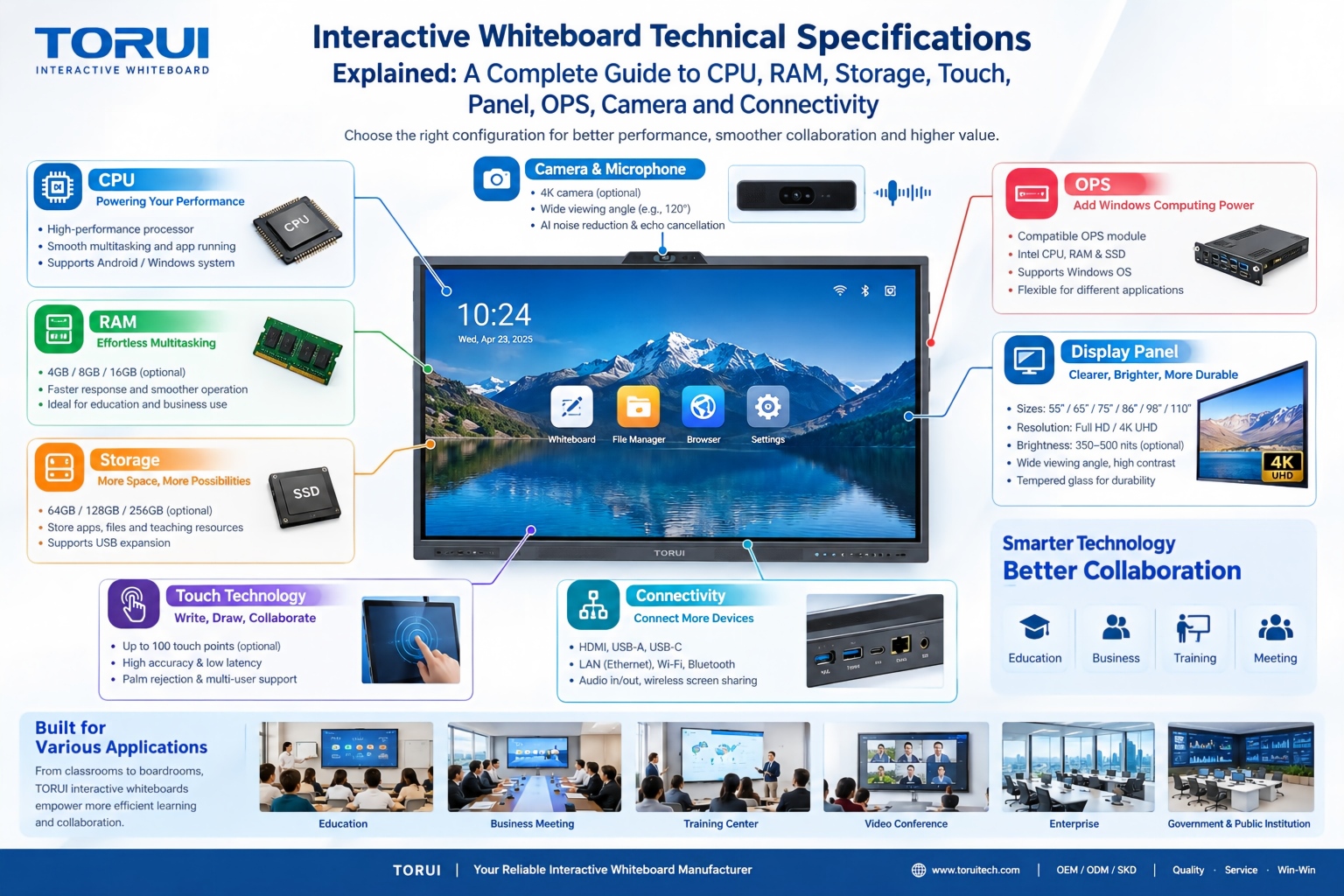
Choosing an interactive whiteboard involves more than comparing screen sizes and prices. For schools, businesses, distributors, wholesalers, and system integrators, understanding the technical specifications is essential to selecting a reliable product that meets different application requirements.
Interactive Whiteboard Technical Specifications Explained: A Complete Guide to CPU, RAM, Storage, Touch, Panel, OPS, Camera and Connectivity
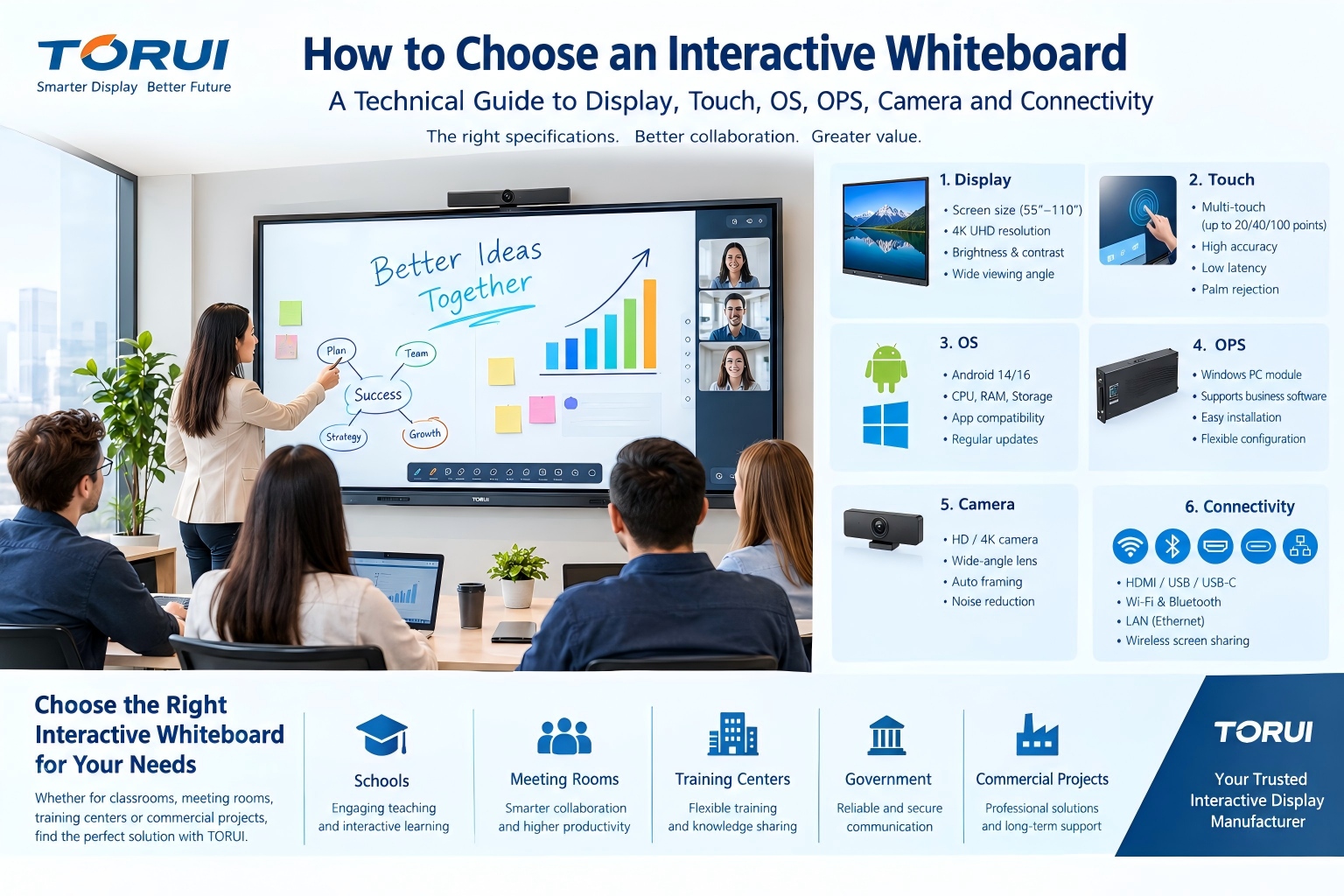
Choosing an interactive whiteboard for a school, meeting room, training center, government organization or commercial project requires more than comparing screen size and price. The most important specifications include display resolution, brightness, touch technology, operating system, processor, memory, storage, OPS compatibility, camera and microphone performance, connectivity, durability and after-sales support.
How to Choose an Interactive Whiteboard: A Technical Guide to Display, Touch, OS, OPS, Camera and Connectivity