
Understanding Interactive Technology: Transforming Education, Business, and Daily Life
author: toruitech
2025-09-23

Interactive technology refers to systems and tools that allow users to actively engage with digital content rather than passively consuming it. Unlike traditional one-way communication methods, interactive technology fosters participation, collaboration, and real-time feedback. From classrooms and workplaces to healthcare and entertainment, it is reshaping how people learn, work, and connect.
What Is Interactive Technology?
Interactive technology includes hardware, software, and digital platforms designed to enable user interaction. Examples range from interactive whiteboards, smart displays, and virtual reality (VR) systems to mobile apps, touchscreens, and artificial intelligence-driven chatbots. The core principle is to create a two-way flow of information, where users can manipulate content, share input, and receive instant responses.
Applications in Education
In modern classrooms, interactive technology plays a pivotal role. Interactive whiteboards, digital projectors, and online learning platforms encourage student participation. Instead of passively listening to lectures, students can annotate digital materials, collaborate on shared screens, or engage in gamified learning experiences. This approach improves engagement, strengthens memory retention, and fosters critical thinking. Furthermore, tools like VR and augmented reality (AR) make complex topics more tangible, allowing students to explore historical sites or scientific concepts virtually.
Role in Business and Collaboration
For businesses, interactive technology streamlines communication and decision-making. Tools such as video conferencing systems, collaborative platforms, and interactive displays enable hybrid teams to work together seamlessly. In meeting rooms, touch-enabled displays allow participants to brainstorm visually, edit documents in real time, and share ideas across locations. These tools improve productivity, reduce miscommunication, and accelerate project outcomes. In addition, interactive digital signage is widely used in retail and marketing to provide personalized customer experiences, helping brands build stronger engagement with their audiences.
Healthcare and Training Benefits
The healthcare sector also benefits greatly from interactive technology. Doctors and medical students use VR simulations for training, enabling hands-on practice without risks. Patients can access telemedicine platforms that offer real-time consultations and personalized health monitoring. In rehabilitation, interactive software assists patients in performing guided exercises, tracking progress, and maintaining motivation.
Everyday Use and Entertainment
Interactive technology has become part of daily life. Smartphones, smart TVs, gaming consoles, and voice assistants rely on interactivity to improve user experience. Social media platforms encourage real-time engagement through likes, comments, and live streams, making communication more dynamic. The entertainment industry, particularly gaming, has pushed the boundaries with immersive VR and AR experiences that allow players to become active participants rather than mere spectators.
Advantages of Interactive Technology
-
Engagement: Encourages active participation instead of passive consumption.
-
Collaboration: Enhances teamwork through shared platforms and tools.
-
Personalization: Adapts content to individual needs and preferences.
-
Efficiency: Reduces communication barriers and accelerates problem-solving.
-
Innovation: Opens doors to new experiences, from virtual classrooms to digital customer service.
Challenges and Considerations
Despite its benefits, interactive technology poses challenges. High implementation costs can limit access for smaller organizations or schools. Technical issues, such as connectivity problems or outdated systems, may disrupt workflow. Additionally, privacy and data security must be carefully managed when using interactive platforms, especially in education and healthcare.
Conclusion
Interactive technology is no longer a futuristic concept—it is an essential part of modern life. By transforming education, business, healthcare, and entertainment, it provides users with dynamic, engaging, and efficient experiences. Organizations that embrace interactive technology gain a competitive edge, while individuals enjoy more personalized and immersive interactions. As technology continues to evolve, interactivity will remain at the heart of innovation, shaping how we communicate, learn, and live in the digital age.
The Role and Benefits of Interactive Whiteboards in Modern Education and Business
Smart Whiteboard Cost: A Complete Guide for Schools and Businesses
Related Article

Choosing the right interactive whiteboard size is an important decision for distributors, wholesalers, and education technology suppliers. The 65-inch, 75-inch, and 86-inch interactive whiteboards are popular options for classrooms, meeting rooms, training centers, and commercial projects.
65 vs 75 vs 86-Inch Interactive Whiteboard: Which Model Should Distributors Choose?

Choosing the right interactive whiteboard manufacturer in China is an important decision for distributors, wholesalers, education technology suppliers, and system integrators. The right manufacturing partner can help businesses improve product quality, maintain competitive pricing, customize products for local markets, and build a sustainable distribution business.
Who Are the Best Interactive Whiteboard Manufacturers in China for B2B Distributors and Wholesalers?
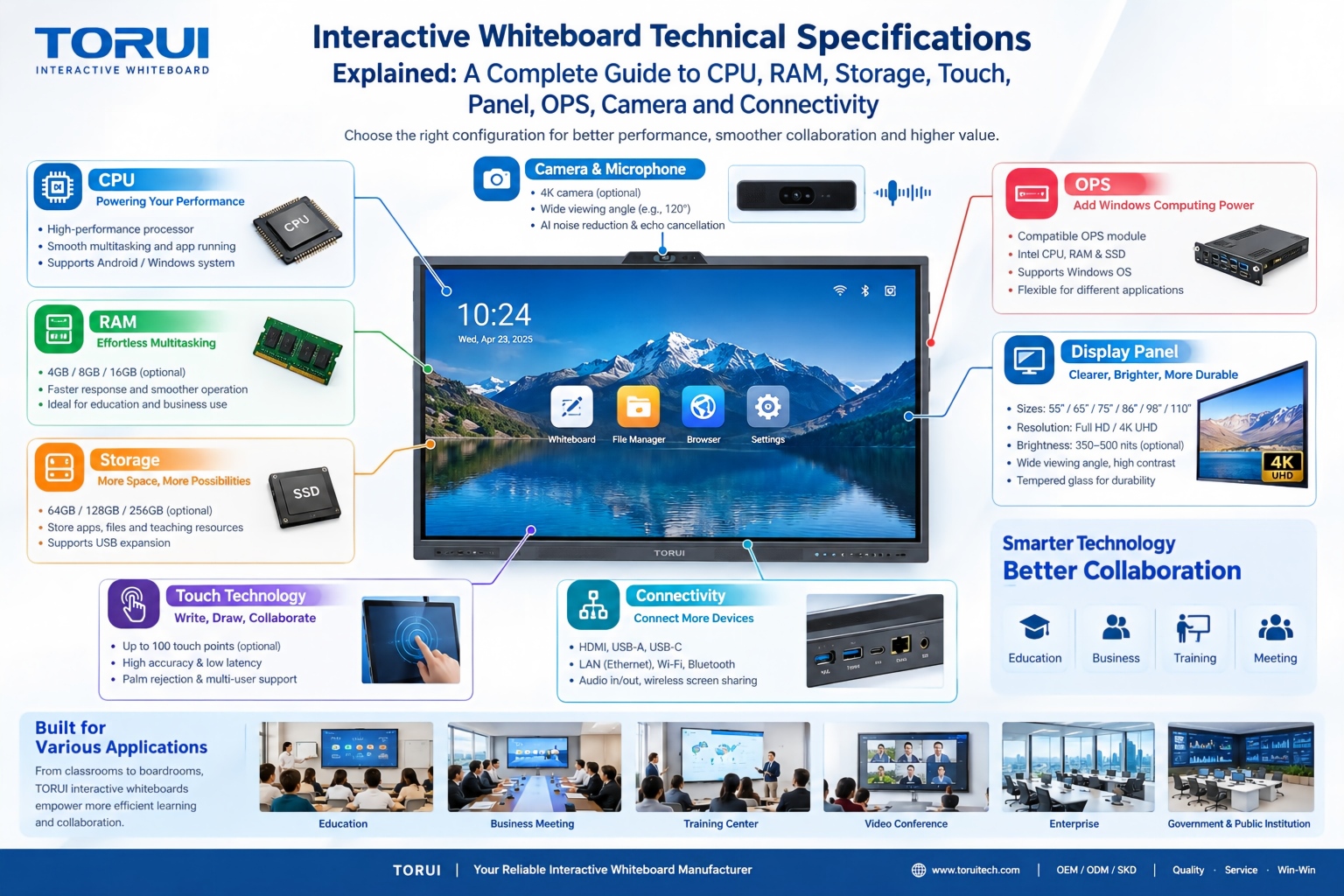
Choosing an interactive whiteboard involves more than comparing screen sizes and prices. For schools, businesses, distributors, wholesalers, and system integrators, understanding the technical specifications is essential to selecting a reliable product that meets different application requirements.
Interactive Whiteboard Technical Specifications Explained: A Complete Guide to CPU, RAM, Storage, Touch, Panel, OPS, Camera and Connectivity
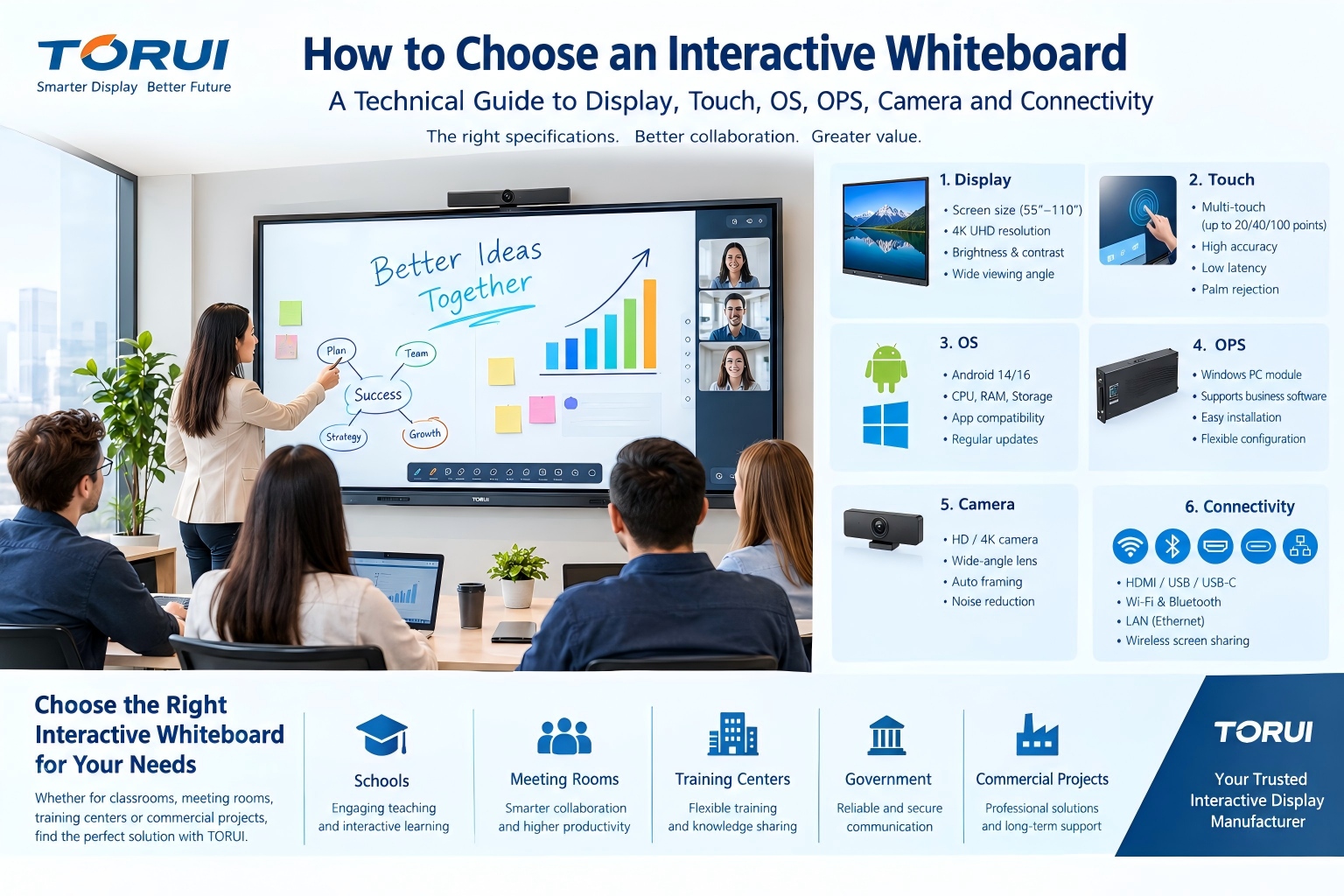
Choosing an interactive whiteboard for a school, meeting room, training center, government organization or commercial project requires more than comparing screen size and price. The most important specifications include display resolution, brightness, touch technology, operating system, processor, memory, storage, OPS compatibility, camera and microphone performance, connectivity, durability and after-sales support.
How to Choose an Interactive Whiteboard: A Technical Guide to Display, Touch, OS, OPS, Camera and Connectivity