
What Are Interactive Displays?
author: toruitech
2025-09-02

In today’s rapidly evolving technological landscape, interactive displays have become an essential tool across various sectors, especially in education, business, and public services. But what exactly are interactive displays, and why are they transforming the way we communicate, collaborate, and learn?
Definition and Core Features
Interactive displays are advanced digital screens that allow users to interact directly with the content displayed, typically through touch, stylus, or gesture controls. Unlike traditional monitors or projectors, interactive displays are designed to respond to multiple inputs, enabling real-time engagement and collaboration. They often feature high-resolution screens, multi-touch capabilities, integrated software, and connectivity options such as Wi-Fi, Bluetooth, and USB ports.
Types of Interactive Displays
There are several types of interactive displays available today, including:
Interactive Whiteboards: Commonly used in classrooms and meeting rooms, these large touch-sensitive boards enable teachers and presenters to write, draw, and manipulate content directly on the screen.
Interactive Flat Panels: These are modern, sleek screens that combine the functionality of a whiteboard with the clarity of a high-definition display. They are often equipped with smart software for annotation, video conferencing, and wireless sharing.
Touchscreen Monitors: Smaller in size, these are used for personal workstations or kiosks, providing intuitive navigation and data input.
Interactive Tables and Kiosks: Designed for public spaces, these allow multiple users to interact simultaneously, making them ideal for exhibitions, museums, and customer service points.
Applications of Interactive Displays
The versatility of interactive displays makes them valuable in numerous environments:
Education: Interactive displays have revolutionized teaching and learning. Teachers can present multimedia lessons, annotate directly on the screen, and encourage students to participate through touch-based activities. This fosters a more engaging and collaborative classroom atmosphere. Features like split-screen, wireless device mirroring, and cloud integration allow for diversified teaching methods and easy access to resources.
Business: In corporate settings, interactive displays facilitate dynamic meetings and presentations. Team members can brainstorm, share documents, and annotate proposals in real time, enhancing productivity and decision-making. Video conferencing integration enables seamless communication with remote colleagues.
Healthcare: Hospitals and clinics utilize interactive displays for patient education, digital signage, and collaborative treatment planning. Medical professionals can visualize complex data and interact with patient records more efficiently.
Retail and Public Services: Interactive kiosks and digital signage provide customers with self-service options, product information, and wayfinding assistance. This improves customer experience and streamlines operations.
Benefits of Interactive Displays
The adoption of interactive displays provides numerous advantages:
Enhanced Engagement: Real-time interaction with content increases attention and participation, whether in a classroom or a business meeting.
Collaboration: Multiple users can contribute simultaneously, fostering teamwork and idea sharing.
Flexibility: Interactive displays support various media formats, software applications, and connectivity options, adapting to different needs.
Efficiency: Quick access to information and the ability to save, share, and edit content on the spot reduces time and paperwork.
Accessibility: Touch and gesture controls make technology more accessible to users of all ages and abilities.
Challenges and Considerations
Despite their many benefits, interactive displays also present challenges such as higher initial investment costs, the need for regular maintenance, and potential learning curves for new users. Organizations must consider compatibility with existing systems and provide adequate training to maximize the effectiveness of these devices.
The Future of Interactive Displays
As technology continues to advance, interactive displays are expected to become even more sophisticated, integrating artificial intelligence, augmented reality, and cloud-based collaboration tools. They will play a pivotal role in shaping smart classrooms, connected workplaces, and interactive public spaces.
Conclusion
Interactive displays are more than just digital screens—they are powerful platforms for engagement, collaboration, and innovation. Their ability to transform how we communicate and learn makes them indispensable in today’s digital age. Whether in education, business, healthcare, or retail, interactive displays are paving the way for a more connected and interactive future.
Specific Applications of Interactive Whiteboards in Mathematics Teaching
September 1st marks the start of the new school year, and TORUI interactive whiteboards are empowering smart classrooms
Related Article

Choosing the right interactive whiteboard size is an important decision for distributors, wholesalers, and education technology suppliers. The 65-inch, 75-inch, and 86-inch interactive whiteboards are popular options for classrooms, meeting rooms, training centers, and commercial projects.
65 vs 75 vs 86-Inch Interactive Whiteboard: Which Model Should Distributors Choose?

Choosing the right interactive whiteboard manufacturer in China is an important decision for distributors, wholesalers, education technology suppliers, and system integrators. The right manufacturing partner can help businesses improve product quality, maintain competitive pricing, customize products for local markets, and build a sustainable distribution business.
Who Are the Best Interactive Whiteboard Manufacturers in China for B2B Distributors and Wholesalers?
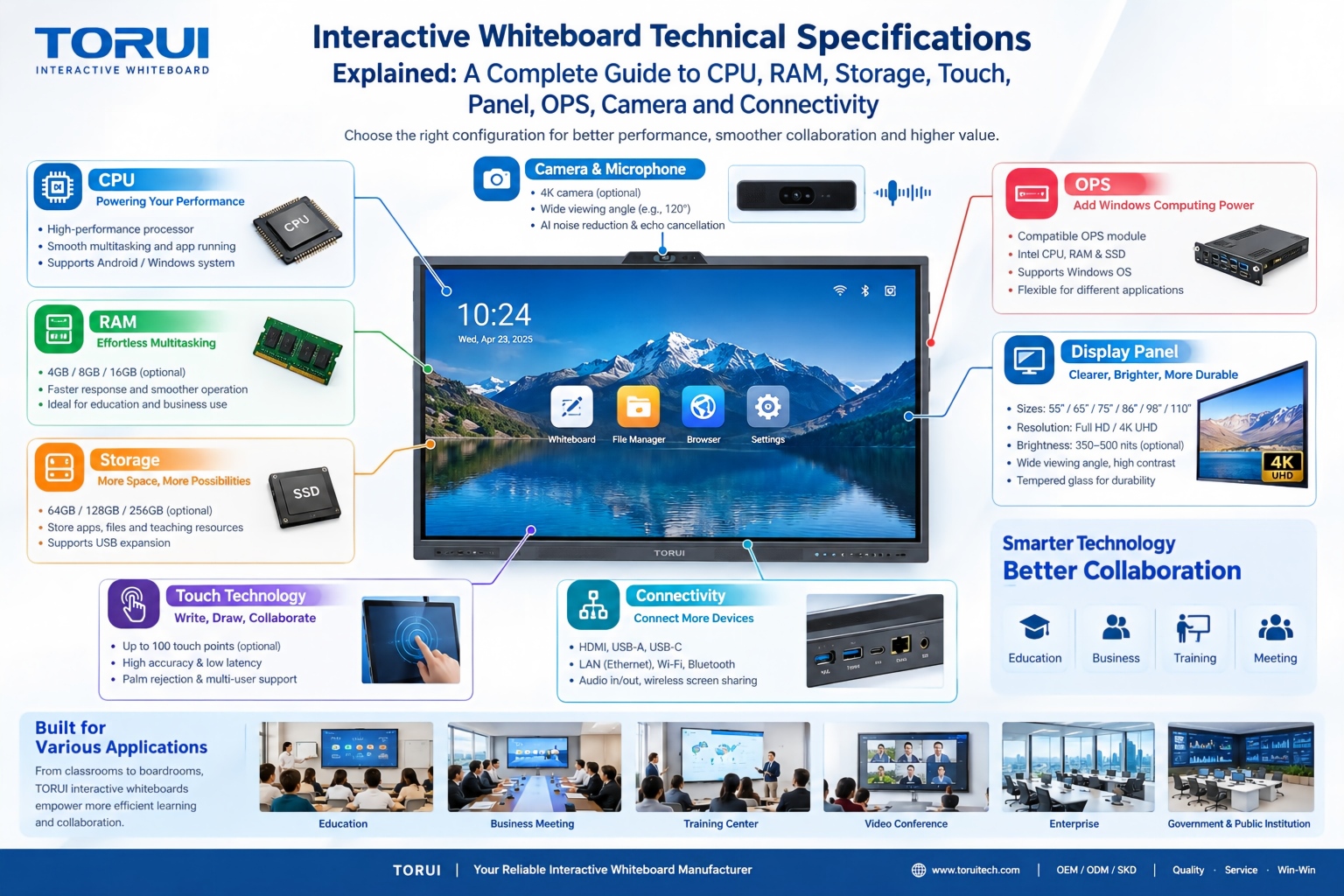
Choosing an interactive whiteboard involves more than comparing screen sizes and prices. For schools, businesses, distributors, wholesalers, and system integrators, understanding the technical specifications is essential to selecting a reliable product that meets different application requirements.
Interactive Whiteboard Technical Specifications Explained: A Complete Guide to CPU, RAM, Storage, Touch, Panel, OPS, Camera and Connectivity
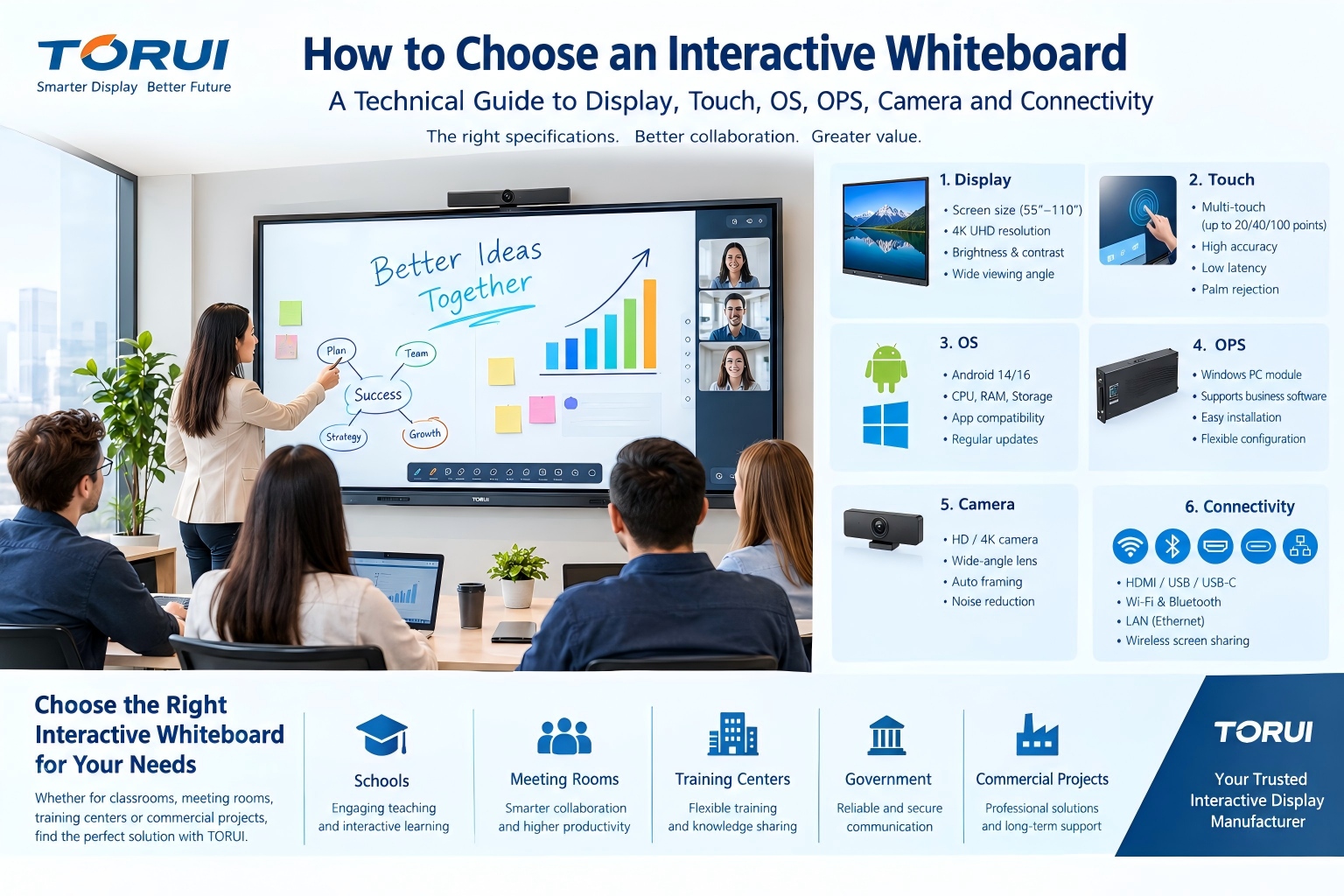
Choosing an interactive whiteboard for a school, meeting room, training center, government organization or commercial project requires more than comparing screen size and price. The most important specifications include display resolution, brightness, touch technology, operating system, processor, memory, storage, OPS compatibility, camera and microphone performance, connectivity, durability and after-sales support.
How to Choose an Interactive Whiteboard: A Technical Guide to Display, Touch, OS, OPS, Camera and Connectivity