
what is a smart board interactive whiteboard
author: toruitech
2025-06-01

In today's digital age, technology has become an integral part of education, business, and communication. One such revolutionary tool is the Smart Board interactive whiteboard, which enhances the collaboration, learning, and presentation processes. Most commonly found in classrooms, corporate offices, and conference rooms, Smart Boards combine traditional whiteboards with advanced digital technology, paving the way for a more dynamic and interactive experience.
But what exactly is a Smart Board interactive whiteboard? How does it work? And why is it so important? In this article, we'll take a deep dive into its features, functions, benefits, and applications.
Defining Smart Board Interactive Whiteboard
A Smart Board interactive whiteboard is a modern touch-enabled display device that acts as a large-screen computer interface. Unlike traditional whiteboards that require the use of a marker, Smart Boards allow users to interact with digital images, presentations, videos, websites, and software through touch gestures, a stylus, or a finger.
One of the great features of a smart whiteboard is its interactivity. Not only does it act as a projector, mirroring the computer screen onto the screen, it also allows users to control and manipulate what's displayed on the screen. As a result, smartboards are popular in educational and professional environments that value engagement, collaboration, and visual learning.
How do smartboards work?
Smartboards combine hardware and software to provide unique capabilities. Here's a detailed explanation of how they work:
1. Touchscreen functionality
The core feature of a smartboard is its touchscreen interface. The display uses resistive, capacitive, or infrared sensing technology to detect touch input, such as finger gestures or stylus movements. Depending on the model, a smartboard may support multi-touch gestures, allowing multiple users to interact with the whiteboard at the same time.
2. Computer connection and content display
A smartboard connects to a computer via a cable or wireless connection (such as Bluetooth or Wi-Fi). It can be used as both a display and a command interface, mirroring content on the computer onto the whiteboard. Users can open applications, browse the web, access files, and interact directly with displayed content.
3. Software integration
Smartboards are often bundled with proprietary software designed for specific applications. In education, for example, teachers can use specialized programs to create lessons, annotate documents, and save interactive worksheets. In a business setting, presenters can use collaboration tools, draw diagrams, and instantly share meeting notes.
4. Additional features
Modern smart whiteboards often include additional features, such as:
Digital pen: A tool for precise drawing or writing on the screen.
Gesture control: Advanced models support touch gestures such as zooming and swiping for easy content manipulation.
Cloud sharing: Some smart whiteboards support real-time content sharing with connected devices via cloud services.
Audio and video integration: Built-in microphones, speakers, and cameras enhance the teleconferencing and video playback experience.
Key features of smart whiteboards
Smart interactive whiteboards stand out with several key features:
1. Multi-touch capabilities
Modern smart whiteboards support multi-touch technology, allowing multiple users to write, draw, or interact on the whiteboard at the same time. This feature helps promote collaboration, especially in group settings.
2. High-resolution display
Smart whiteboards often come with HD or 4K displays for crisp, clear visuals. This is especially useful for presentations, videos, and projects that require high definition.
3. Annotation tools
Users can add pictures, text, and document annotations directly to the smart whiteboard, a feature that is highly valued in classrooms and business meetings.
4. Interactive software
Smart whiteboards are often bundled with software customized for specific industries.
5. Connectivity options
Smart whiteboards offer a variety of connectivity options, including USB ports, HDMI inputs, and wireless streaming compatibility, making them easy to integrate with other devices.
Applications of smart interactive whiteboards
Smart interactive whiteboards are versatile and widely used in a variety of environments. Let's take a look at their most prominent applications:
1. Education
In the field of education, smart whiteboards have revolutionized teaching methods. Through touch screens, multi-point interaction, and real-time feedback functions, it has greatly improved the interactivity and fun of classroom teaching, enabling complex knowledge points to be intuitively presented through dynamic videos, charts, and real-time annotations, helping students better understand and remember.
2. Meetings
In meeting scenarios, smart interactive whiteboards solve the limitations of traditional presentation tools. Through multi-user operation, file sharing and cloud collaboration functions, they improve team communication efficiency. At the same time, they support remote meetings and presentations, allowing participants to participate in discussions and modify files even if they are in different locations. Whether in classrooms or meeting rooms, smart interactive whiteboards have become an important tool for promoting innovation, improving efficiency and stimulating collaboration.
Smart Interactive Whiteboard Price: Key Factors and Insights
Smart interactive whiteboard: Redefining the future of education and collaboration
Related Article

Choosing the right interactive whiteboard size is an important decision for distributors, wholesalers, and education technology suppliers. The 65-inch, 75-inch, and 86-inch interactive whiteboards are popular options for classrooms, meeting rooms, training centers, and commercial projects.
65 vs 75 vs 86-Inch Interactive Whiteboard: Which Model Should Distributors Choose?

Choosing the right interactive whiteboard manufacturer in China is an important decision for distributors, wholesalers, education technology suppliers, and system integrators. The right manufacturing partner can help businesses improve product quality, maintain competitive pricing, customize products for local markets, and build a sustainable distribution business.
Who Are the Best Interactive Whiteboard Manufacturers in China for B2B Distributors and Wholesalers?
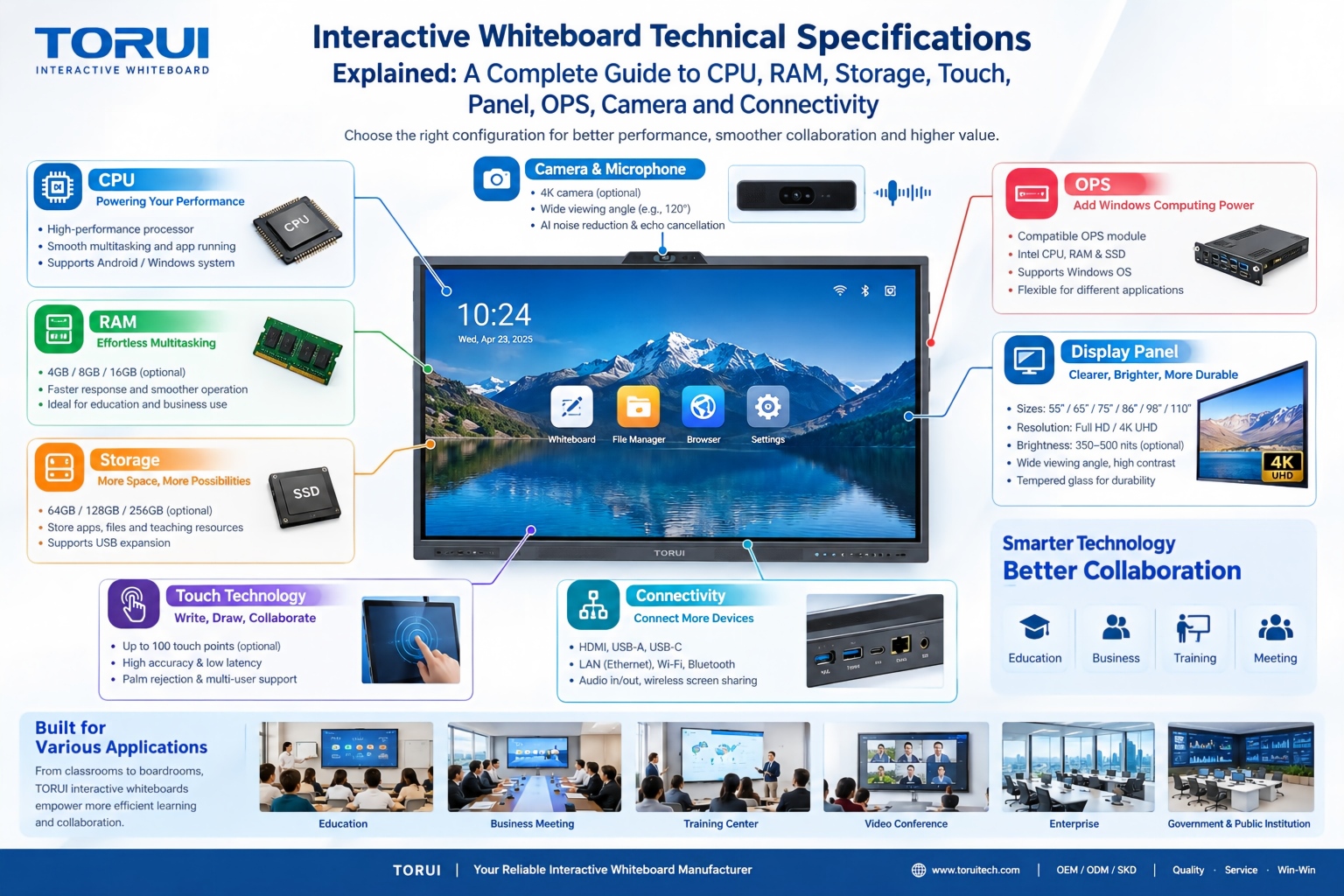
Choosing an interactive whiteboard involves more than comparing screen sizes and prices. For schools, businesses, distributors, wholesalers, and system integrators, understanding the technical specifications is essential to selecting a reliable product that meets different application requirements.
Interactive Whiteboard Technical Specifications Explained: A Complete Guide to CPU, RAM, Storage, Touch, Panel, OPS, Camera and Connectivity
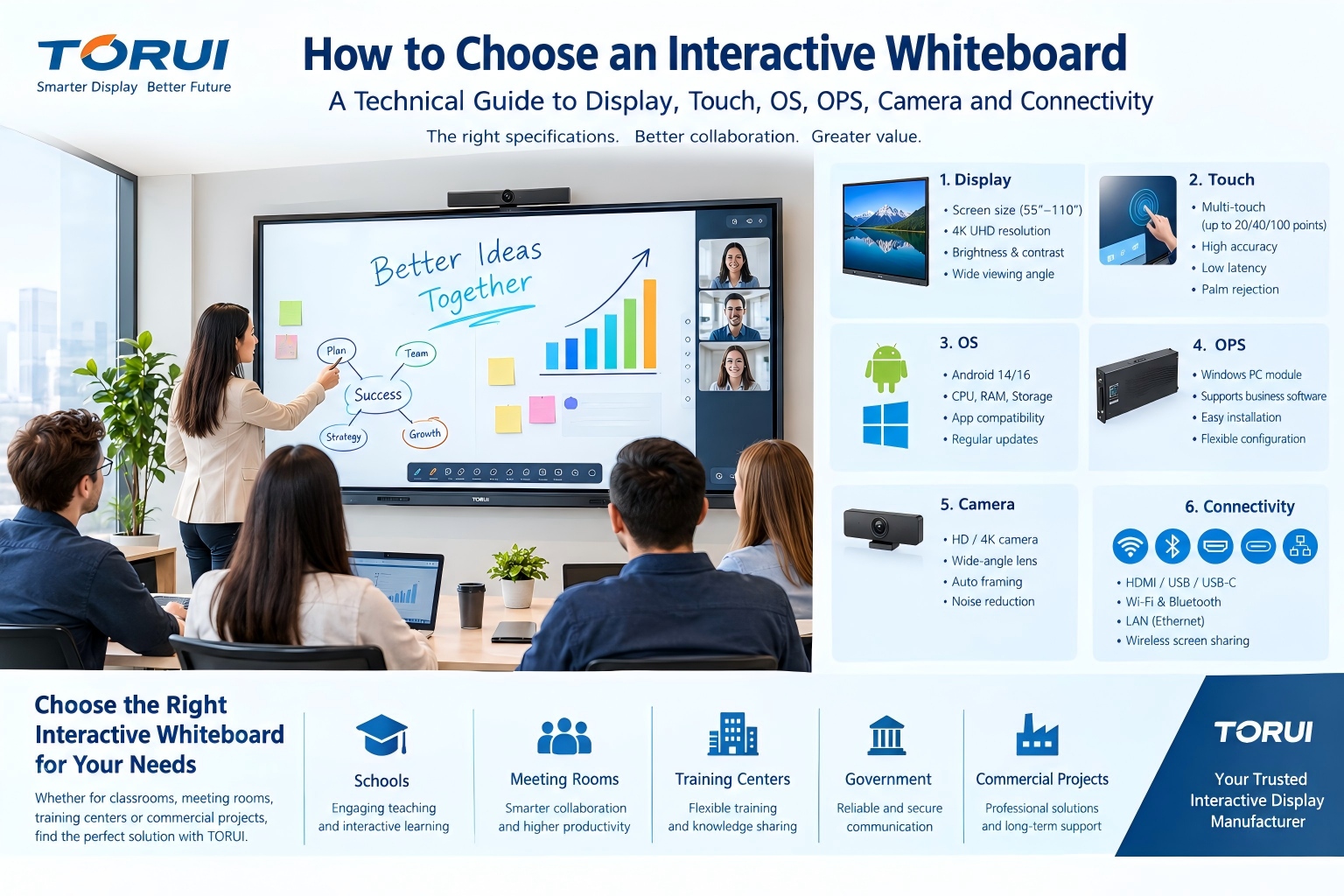
Choosing an interactive whiteboard for a school, meeting room, training center, government organization or commercial project requires more than comparing screen size and price. The most important specifications include display resolution, brightness, touch technology, operating system, processor, memory, storage, OPS compatibility, camera and microphone performance, connectivity, durability and after-sales support.
How to Choose an Interactive Whiteboard: A Technical Guide to Display, Touch, OS, OPS, Camera and Connectivity