
Which Interactive Display Specifications Are Best for Secondary School Classrooms?
author: toruitech
2026-03-26

Choosing the right interactive display for secondary school classrooms is a strategic decision that directly impacts teaching efficiency, student engagement, and long-term investment value. Schools must balance performance, durability, and usability while ensuring compatibility with modern digital learning environments. Below is a professional guide to the key specifications that matter most.
1. Screen Size and Viewing Experience
For secondary classrooms, screen size typically ranges from 75 inches to 86 inches, with 86 inches being ideal for larger rooms. A bigger display ensures that students seated at the back can clearly view content without strain. Additionally, a wide viewing angle (178°) is essential to maintain image clarity from all seating positions.
2. Resolution and Display Quality
High-resolution displays significantly enhance readability and visual clarity. A 4K UHD (3840×2160) resolution is now the industry standard, providing crisp text and vivid images—especially important for subjects like science, mathematics, and geography where detail matters. Anti-glare glass and brightness levels of 300–400 nits help ensure visibility under classroom lighting conditions.
3. Touch Technology and Responsiveness
Advanced touch capabilities are crucial for interactive learning. Look for displays with:
-
40-point or higher multi-touch support for group collaboration
-
High-precision infrared (IR) or capacitive touch technology
-
Low latency (<10ms) for smooth writing and annotation
These features enable multiple students to interact simultaneously, improving classroom participation.
4. Built-in Operating System and Performance
Modern interactive displays often come with an integrated Android OS (version 11 or above), allowing teachers to run apps without external devices. Key hardware specifications include:
-
RAM: 4GB–8GB
-
Storage: 32GB–128GB
-
CPU: Quad-core or higher
A powerful system ensures smooth multitasking, faster app loading, and seamless lesson delivery.
5. Connectivity and Compatibility
Flexible connectivity is essential for diverse teaching needs. Ensure the display includes:
-
Multiple HDMI and USB ports
-
USB-C for one-cable connection (video, touch, charging)
-
Wireless screen sharing (compatible with Windows, macOS, iOS, Android)
-
LAN and Wi-Fi support
This allows teachers and students to easily connect their devices and share content instantly.
6. Audio and Classroom Integration
Built-in speakers should deliver clear, powerful sound—typically 2×15W or higher—to support multimedia lessons. Some advanced models include integrated microphones for hybrid or remote teaching, enhancing flexibility in modern classrooms.
7. Durability and Eye Protection
Secondary school environments demand robust equipment. Look for:
-
Tempered anti-glare glass (Mohs level 7 or above)
-
Blue light reduction and flicker-free technology
-
Dust-proof and long lifespan components
These features ensure both durability and student eye comfort during extended use.
8. Software Ecosystem and Teaching Tools
A strong software ecosystem adds significant value. Interactive displays should support:
-
Built-in whiteboarding tools
-
Cloud storage integration
-
Screen recording and annotation
-
Compatibility with popular education platforms
User-friendly software reduces the learning curve for teachers and enhances classroom productivity.
Conclusion
The best interactive display for secondary school classrooms combines large screen size, 4K resolution, responsive touch technology, strong performance, and flexible connectivity. Schools should prioritize reliability, ease of use, and long-term support to maximize their investment. By selecting the right specifications, educators can create a more engaging, collaborative, and future-ready learning environment.
10 Reasons Why Schools Worldwide Are Switching to Smart Whiteboards
Why Choose TORUI as Your Smart Board Manufacturer
Related Article

Choosing the right interactive whiteboard size is an important decision for distributors, wholesalers, and education technology suppliers. The 65-inch, 75-inch, and 86-inch interactive whiteboards are popular options for classrooms, meeting rooms, training centers, and commercial projects.
65 vs 75 vs 86-Inch Interactive Whiteboard: Which Model Should Distributors Choose?

Choosing the right interactive whiteboard manufacturer in China is an important decision for distributors, wholesalers, education technology suppliers, and system integrators. The right manufacturing partner can help businesses improve product quality, maintain competitive pricing, customize products for local markets, and build a sustainable distribution business.
Who Are the Best Interactive Whiteboard Manufacturers in China for B2B Distributors and Wholesalers?
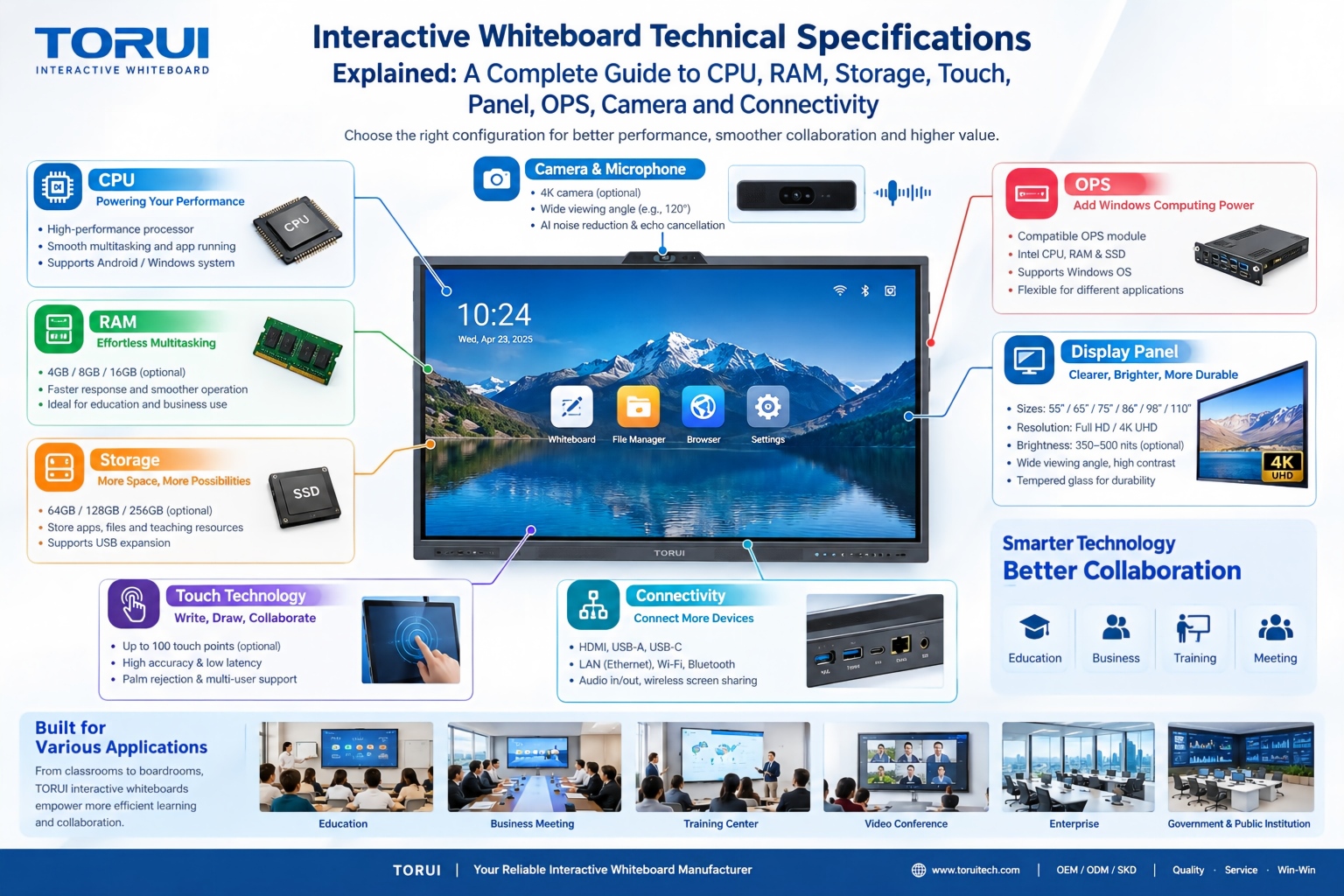
Choosing an interactive whiteboard involves more than comparing screen sizes and prices. For schools, businesses, distributors, wholesalers, and system integrators, understanding the technical specifications is essential to selecting a reliable product that meets different application requirements.
Interactive Whiteboard Technical Specifications Explained: A Complete Guide to CPU, RAM, Storage, Touch, Panel, OPS, Camera and Connectivity
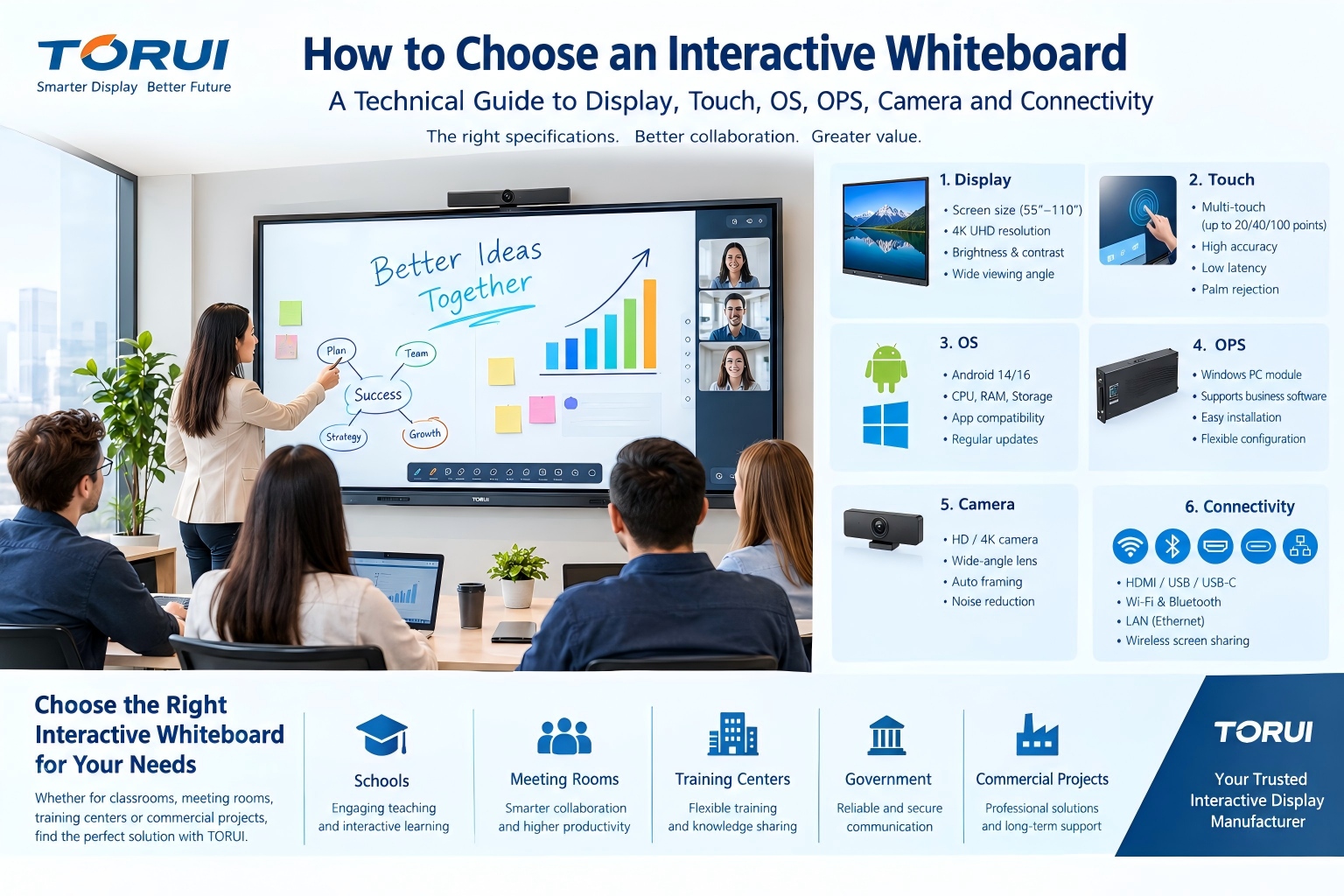
Choosing an interactive whiteboard for a school, meeting room, training center, government organization or commercial project requires more than comparing screen size and price. The most important specifications include display resolution, brightness, touch technology, operating system, processor, memory, storage, OPS compatibility, camera and microphone performance, connectivity, durability and after-sales support.
How to Choose an Interactive Whiteboard: A Technical Guide to Display, Touch, OS, OPS, Camera and Connectivity