
How to Use a Smart Board Interactive Whiteboard: A Step-by-Step Guide
author: toruitech
2025-06-16

As a modern education and business communication tool, smart whiteboards (Smart Board interactive whiteboards) have gradually become the core equipment for classroom teaching and conference presentations. Knowing how to use smart whiteboards correctly can significantly improve efficiency and enhance interactive effects. In this guide, we will detail the basic steps and some practical tips for using smart whiteboards.
1. Set up and prepare smart whiteboards
First, make sure the whiteboard is properly connected to the computer, usually via USB or wireless connection. Turn on the whiteboard and install the corresponding software, such as Smart Notebook. Configure touch screen calibration to ensure touch accuracy. During the setup process, make sure the device is aligned with the projector or display.
2. Familiar with basic functions
Smart whiteboards usually support handwriting, drawing, screen sharing and other functions. You can use the whiteboard's exclusive pen to mark, circle, or directly operate with your fingers. Most smart whiteboards support multi-touch, making it possible for multiple people to work together. The built-in toolbar allows you to easily switch functions, such as drawing lines, erasing, adding text, etc.
3. How to perform interactive operations
The biggest advantage of smart whiteboards is their interactive features. With whiteboards, screen content can be shared in real time, and even participants can collaborate on editing on mobile phones or computers. For example, in class, teachers can display course content on whiteboards and invite students to operate directly, which can increase participation. In conference scenarios, teams can mark key points or edit content in real time to improve communication efficiency.
4. Application scenarios and skills
Education scenarios: Teachers can use whiteboards for interactive teaching, create dynamic courseware, and enhance student interest.
Business scenarios: Used for conference brainstorming or presentations, and video conferencing functions can help remote collaboration.
Remember to save the content on the whiteboard when using it to avoid data loss. In addition, files can be directly shared with all participants through cloud services.
5. Common problems and solutions
During operation, you may encounter problems such as disconnection of the whiteboard or inaccurate touch screen. Checking the connection cable or restarting the device can usually solve the problem. In addition, regularly updating the software of the smart whiteboard can ensure its stable performance.
6. Summary
Mastering how to use smart whiteboards can not only help improve teaching quality, but also significantly improve work efficiency. By flexibly utilizing its features, you can achieve efficient interactions in both the classroom and the meeting room. Remember, practice is the key to familiarity!
55-inch smart interactive whiteboard: redefining the future of modern collaboration and teaching
65-inch touch screen smart whiteboard: New technology that changes collaboration
Related Article
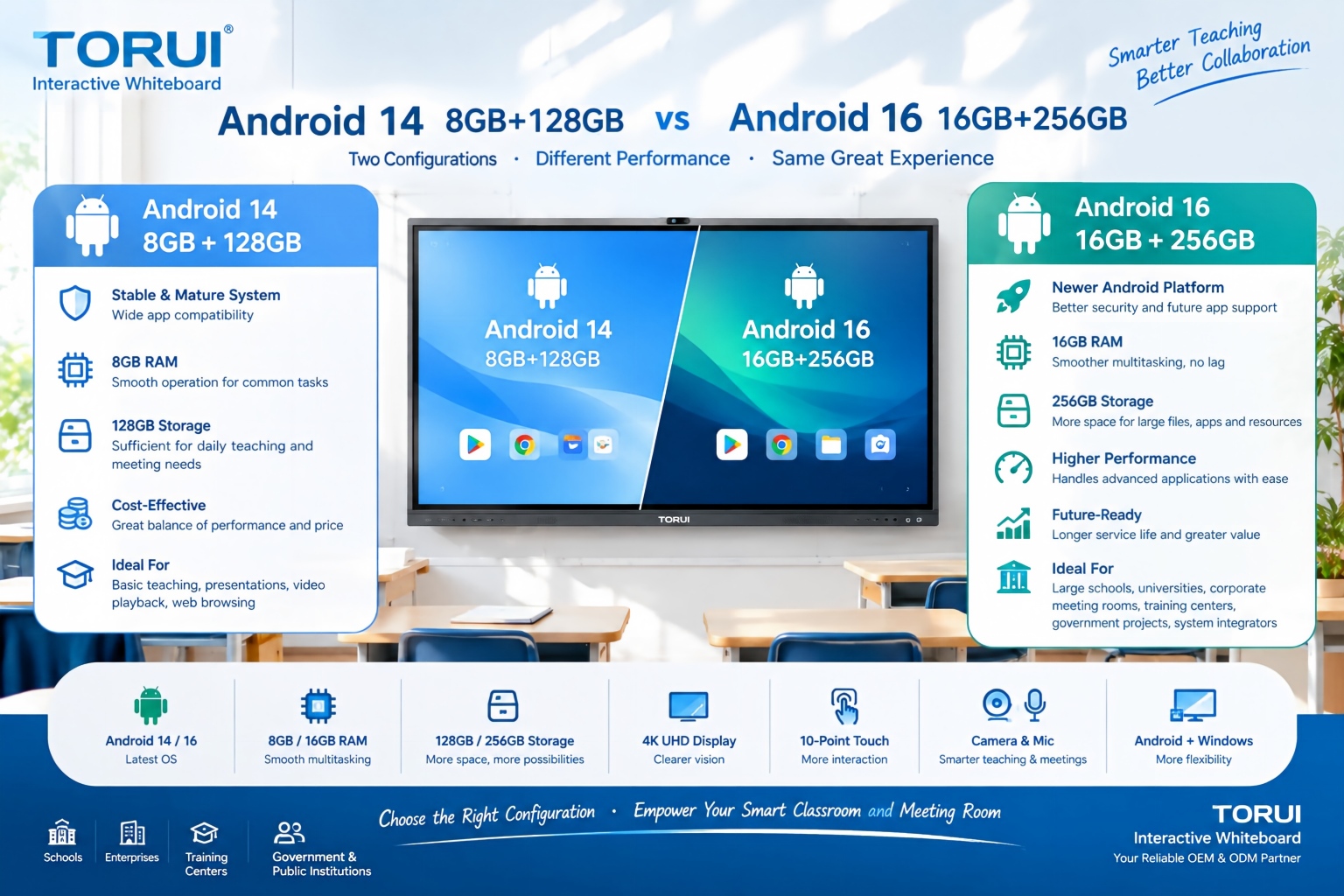
When choosing an interactive whiteboard for a school, training center, meeting room, or commercial project, the Android version and hardware configuration can significantly affect user experience. Two common configurations are Android 14 with 8GB RAM and 128GB storage and Android 16 with 16GB RAM and 256GB storage.
Android 14 8GB+128GB vs Android 16 16GB+256GB: Which Interactive Whiteboard Is Better?

Buying an interactive whiteboard is not simply about choosing the right screen size, resolution, or operating system. For B2B buyers, distributors, system integrators, schools, and corporate procurement teams, quality control is one of the most important factors affecting long-term reliability, user experience, warranty costs, and customer satisfaction.
Interactive Whiteboard Quality Control: What Should Buyers Check?
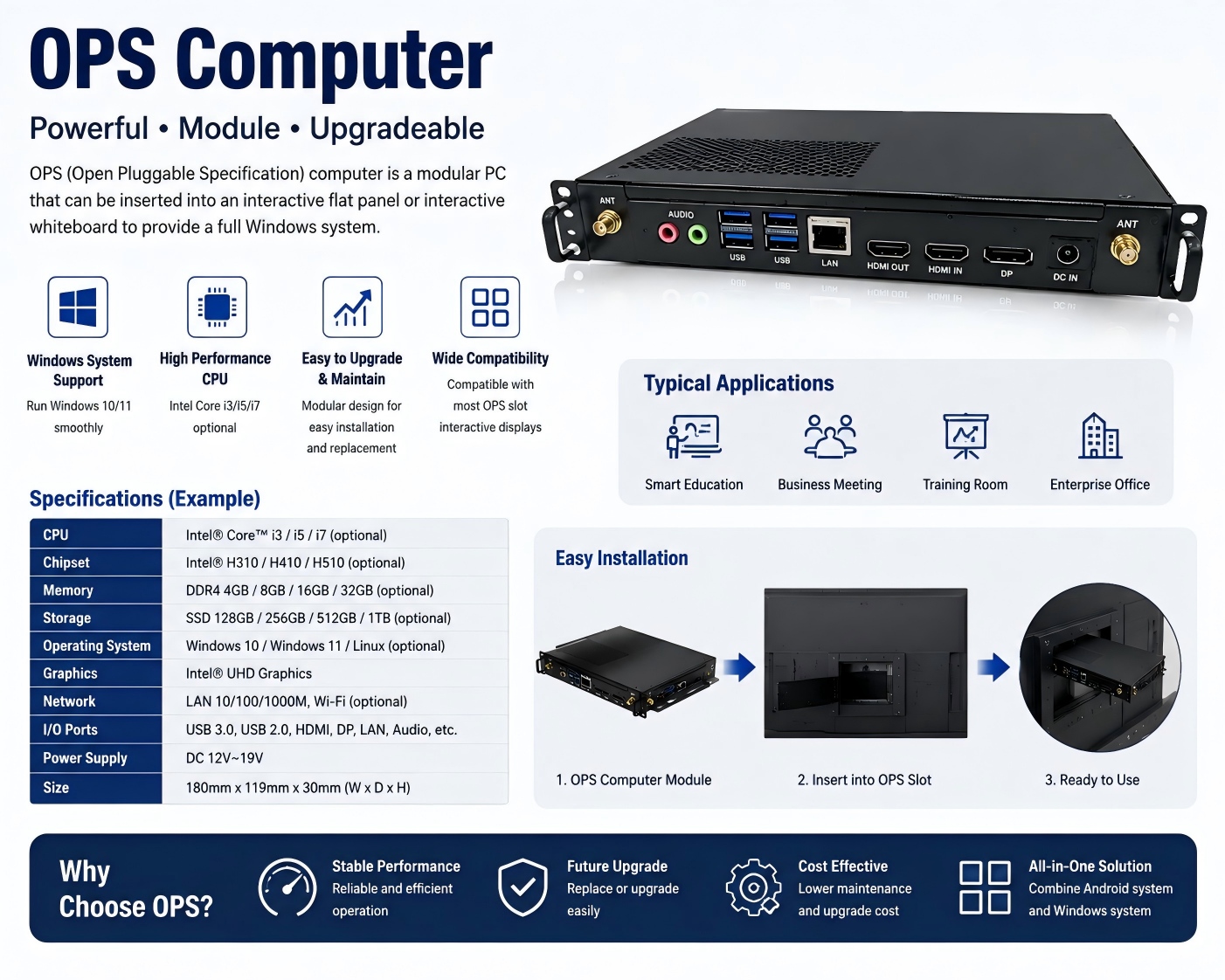
An OPS computer for an interactive whiteboard is a modular plug-in PC designed to add Windows-based computing power to an interactive display. OPS stands for Open Pluggable Specification, a standardized form factor originally developed for commercial interactive displays.
What Is an OPS Computer for Interactive Whiteboards?

Choosing the right chipset is an important decision when sourcing an interactive whiteboard for schools, conference rooms, training centers, government projects, or commercial applications. Among Rockchip platforms, RK3588 and RK3576 are two powerful options for modern Android interactive displays.
RK3588 vs RK3576: Which Chip Is Better for Interactive Whiteboards?